
Today in News History
On June 19, several notable moments in the history of News stand out. In 1921, The village of Knockcroghery, Ireland, is burned by British forces. In 1934, The Communications Act of 1934 establishes the United States' Federal Communications Commission (FCC). In 1947, Pan Am Flight 121 crashes in the Syrian Desert near Mayadin, Syria, killing 15 and injuring 21. In 1954, Richard Wilkins, New Zealand-Australian journalist and television presenter was born. In 1981, Subhash Mukherjee, Indian scientist and physician who created India's first, and the world's second, child using in-vitro fertilisation (born 1931) passed away. In 1987, Aeroflot Flight N-528 crashes at Berdiansk Airport in present-day Ukraine, killing eight people. In 2013, Dave Jennings, American football player and sportscaster (born 1952) passed away. In 2018, The 10,000,000th United States Patent is issued. In 2018, Antwon Rose II is fatally shot in East Pittsburgh by East Pittsburgh Police Officer Michael Rosfeld after being involved in a near-fatal drive-by shooting. In 2019, Etika, American YouTuber and streamer (born 1990) passed away. Together, these milestones provide historical context for today's news news and ongoing narratives.
These new satellites are designed to spot wildfires before they spread
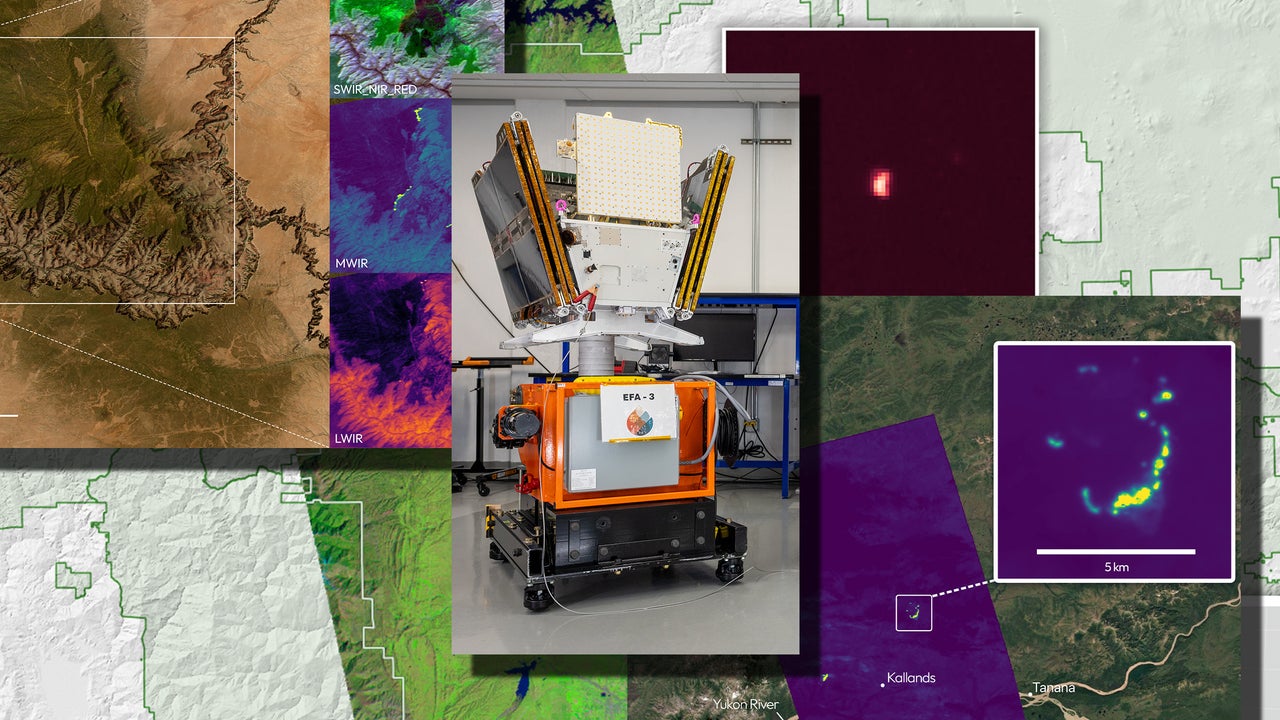
When a grass fire started by the side of an Oregon road last summer, it covered just half an acre—too small to show up on typical satellites. But it was spotted by a new prototype from FireSat, a satellite program designed specifically to detect wildfires. Fire agencies weren’t using the system at the time, but once fully operational, it could send alerts before fires spiral out of control. Now, with a 26 million grant from the Bezos Earth Fund that builds on earlier support from Google.org and other partners, three FireSat satellites will launch next month and begin tracking fires globally. By 2030, Earth Fire Alliance, the nonprofit behind the program, plans to have a constellation of 50 satellites in place, revisiting every point on the planet every 20 minutes. Medford, Oregon, June 23, 2025. [Image: Earth Fire Alliance and Muon Space] “We realized there was a big gap in the understanding of fire,” says Brian Collins, the nonprofit’s executive director. The organization, which launched in 2024, started after the team met with more than 200 fire agencies, land managers, and policymakers to better understand how to improve resilience to wildfires. “The biggest theme that kept coming up was better data to truly understand the scope and scale of wildfire across the planet,” he says. [Photo: Oregon Department of Forestry Southwest District] Weather satellites can already spot some fires, but they weren’t built for that purpose. FireSat’s satellites, designed by Muon Space, collect data across wavelengths beyond visible light, each revealing something different. Short-wave infrared can see through smoke. Mid-wave infrared can detect both intense fires and lower-intensity burns. Long-wave infrared measures ground temperature. Near infrared shows how plants and trees are responding to fire. From left: Paul Bodnar, Director of Sustainable Finance, Industry, and Diplomacy, Bezos Earth Fund; Brian Collins, Executive Director, Earth Fire Alliance; and Dr. Karen O’Connor, Strategic Development Lead, Earth Fire Alliance; with the first three operational FireSats at Muon Space’s facility in Mountain View, California, on May 12, 2026. [Photo: Muon Space] It’s unique to collect all that data simultaneously and in high resolution, down to a small fire that’s roughly the size of a garage. It’s also possible to tell the difference between a fire and something like the sun reflecting off a metal roof, “so we don’t have false alarms,” says Collins. The technology can work alongside other tools like cameras, which can quickly detect fires that are just starting but can’t necessarily see the full picture. If multiple cameras aren’t in place, it can be difficult to pinpoint the location of smoke as a fire starts. And as a fire grows and smoke fills the air, it can block the view of the camera, but the satellite can show where the fire is moving. Nighttime data collected over northern South America on March 21, 2026. [Image: Earth Fire Alliance and Muon Space] Fire agencies from Colorado to Australia are already early partners on the project. In the Amazon rainforest, where agencies may not learn about a fire until it has been burning for 24 hours, FireSat could help them respond much earlier. It can also track low-intensity fires that may not need intervention. One goal is to build a far more comprehensive picture of wildfire activity and improve fire science, since today only the largest fires are typically reported. The project is also creating a global network of fire agencies, so a team in California, for example, can trade notes with one in Portugal. Protoflight data collected over Shasta-Trinity National Forest in California, March 12, 2026. [Image: Earth Fire Alliance and Muon Space] As climate change is making wildfires larger and more intense, “we saw an opportunity to do something about that,” says Tom Taylor, president and CEO of the Bezos Earth Fund, launched by Jeff Bezos in 2020 with a 10 billion commitment to fight climate change and protect the natural world. (To date, only a small portion of the funds have been given out; the fund has said that it plans to disburse all of it by the end of the decade.) “We saw an opportunity to do something quickly—we could make sure the launch happens this year rather than waiting a year,” Taylor says. “An important part of our decision is where we can make a difference.” As the project collects data, creating the first complete record of fire on Earth, the data can be used to predict how future fires will spread or where they might start. “Ultimately, if you build a database of this information and you start to combine it with other information, like weather, landscape, and terrain, we hope that you can get [to a place] where now you’re predicting wildfire,” Taylor says.
Narrative Intelligence Brief
This article was published by Fast Company, a source frequently categorized with a lean left bias based in United States of America. Our narrative intelligence engine continuously monitors coverage from this outlet to track framing, bias, and rhetorical patterns. Our initial algorithmic scan of this specific piece did not flag high-confidence rhetorical techniques, suggesting a generally straightforward reporting style or neutral framing. By understanding the editorial perspective of Fast Company, readers can better contextualize the information presented and compare it across our broader media matrix to find the real narrative.
More from Fast Company
June 19, 2026
What if the office is actually a workplace perk?
June 18, 2026
How this street duck became Mexico’s unofficial World Cup mascot
June 18, 2026
Can ‘Applied Creativity’ be the next ‘Design Thinking?’
June 18, 2026
Why were Waymo cars driving into active construction zones?
June 18, 2026
Reddit cofounder Alexis Ohanian speaks up about that UFC fighter’s controversial Michelle Obama comment
Analysis Methodology
This narrative analysis was generated using the CoDataLab Global Intelligence Engine. Our proprietary AI scans thousands of cross-border sources to identify sentiment patterns, framing techniques, and potential media bias. While AI provides the data-driven foundation, our objective is to empower readers with additional context beyond the standard headline.The content displayed above is a structured summary designed for rapid information processing. For the full original report, please visit the source outlet.More Coverage
Discussion
"trump"
🚨 MAGA Mike GOES MISSING as HELL BREAKS LOOSE in HOUSE!!!

Trump’s Iran deal sparks anger among Republican hawks

Bombshell report reveals harrowing details of UK’s shocking grooming gang scandal
