Today in News History
On July 5, several notable moments in the history of News stand out. In 1859, The United States discovers and claims Midway Atoll. In 1940, World War II: Foreign relations of Vichy France are severed with the United Kingdom. In 1943, World War II: German forces begin a massive offensive against the Soviet Union at the Battle of Kursk, also known as Operation Citadel. In 1950, Korean War: Task Force Smith: American and North Korean forces first clash, in the Battle of Osan. In 1967, Mustafa Al-Kadhimi, Iraqi politician, 80th Prime Minister of Iraq was born. In 1984, The United States Supreme Court gives its United States v. Leon decision providing a good-faith exception from the Fourth Amendment exclusionary rule against use of evidence obtained through defective warrants in criminal trials. In 1994, Jeff Bezos founds Amazon. In 2003, The World Health Organization announces that the 2002-2004 SARS outbreak has been contained. In 2006, North Korea tests four short-range missiles, one medium-range missile and a long-range Taepodong-2. The long-range Taepodong-2 reportedly fails in mid-air over the Sea of Japan. In 2009, A series of violent riots break out in Ürümqi, the capital city of the Xinjiang Uyghur Autonomous Region in China. Together, these milestones provide historical context for today's news news and ongoing narratives.
The missing half of Trump’s AI strategy
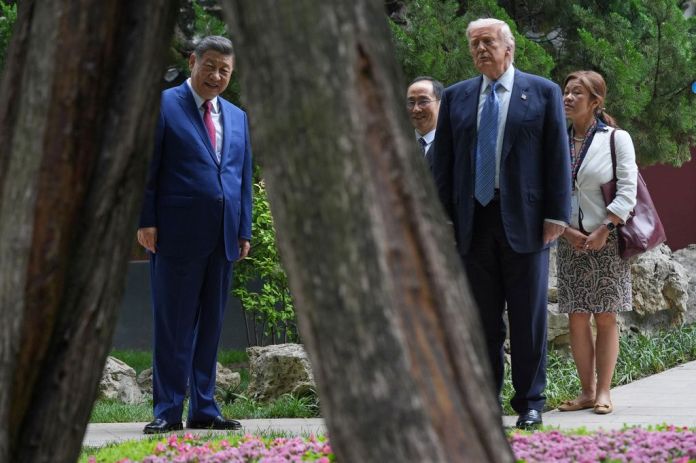
China in late June added 10 U.S. companies to its export control list and barred government procurement from nearly 50 American firms, its latest response in the growing technological rivalry between Washington and Beijing. The move came after the Pentagon blacklisted dozens of Chinese companies with alleged ties to China’s military. Neither side should be []
Narrative Intelligence Brief
This article was published by Washington Examiner, a source frequently categorized with a lean right bias based in United States of America. Our narrative intelligence engine continuously monitors coverage from this outlet to track framing, bias, and rhetorical patterns. Our initial algorithmic scan of this specific piece did not flag high-confidence rhetorical techniques, suggesting a generally straightforward reporting style or neutral framing. By understanding the editorial perspective of Washington Examiner, readers can better contextualize the information presented and compare it across our broader media matrix to find the real narrative.
More from Washington Examiner
July 5, 2026
Will the socialist revolution come for Kamala Harris?
July 5, 2026
Trump made money, bought up stock from crypto companies after his SEC dropped cases against them
July 5, 2026
Flying ICUs are on life support — this Medicare reform is the cure
July 5, 2026
Democrats lay out investigation priorities if they retake the House
July 5, 2026
As Kyiv burns, the West should share air defense technology with Ukraine
Analysis Methodology
This narrative analysis was generated using the CoDataLab Global Intelligence Engine. Our proprietary AI scans thousands of cross-border sources to identify sentiment patterns, framing techniques, and potential media bias. While AI provides the data-driven foundation, our objective is to empower readers with additional context beyond the standard headline.The content displayed above is a structured summary designed for rapid information processing. For the full original report, please visit the source outlet.More Coverage
Discussion