
Today in News History
On July 5, several notable moments in the history of News stand out. In 1921, Viktor Kulikov, Russian marshal (died 2013) was born. In 1941, World War II: Operation Barbarossa: German troops reach the Dnieper river. In 1943, World War II: An Allied invasion fleet sails for Sicily (Operation Husky, July 10, 1943). In 1943, World War II: German forces begin a massive offensive against the Soviet Union at the Battle of Kursk, also known as Operation Citadel. In 1950, Korean War: Task Force Smith: American and North Korean forces first clash, in the Battle of Osan. In 1968, Susan Wojcicki, Polish-American technology executive (died 2024) was born. In 1973, A boiling liquid expanding vapor explosion (BLEVE) in Kingman, Arizona, following a fire that broke out as propane was being transferred from a railroad car to a storage tank, kills eleven firefighters. In 1982, Alexander Dimitrenko, Ukrainian-German boxer was born. In 2006, Kenneth Lay, American businessman (born 1942) passed away. In 2012, The Shard in London is inaugurated as the tallest building in Europe, with a height of 310 metres (1,020 ft). Together, these milestones provide historical context for today's news news and ongoing narratives.
As Kyiv burns, the West should share air defense technology with Ukraine
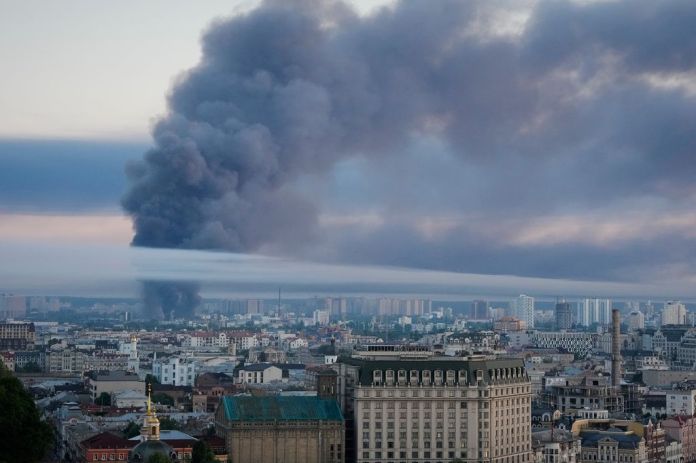
Kyiv endured one of the deadliest nights of the entire war in Ukraine overnight Wednesday-Thursday, as Russia unleashed 74 missiles and 496 long-range drones on the Ukrainian capital. At least 20 people were killed and more than 90 injured. An apartment building collapsed after a direct hit and damage occurred across 33 locations, overwhelmingly residential []
Narrative Intelligence Brief
This article was published by Washington Examiner, a source frequently categorized with a lean right bias based in United States of America. Our narrative intelligence engine continuously monitors coverage from this outlet to track framing, bias, and rhetorical patterns. Our initial algorithmic scan of this specific piece did not flag high-confidence rhetorical techniques, suggesting a generally straightforward reporting style or neutral framing. By understanding the editorial perspective of Washington Examiner, readers can better contextualize the information presented and compare it across our broader media matrix to find the real narrative.
More from Washington Examiner
July 5, 2026
Socialism, communism, and Marxism: A guide to the ideologies behind the ‘blue scare’
July 5, 2026
Will the socialist revolution come for Kamala Harris?
July 5, 2026
Trump made money, bought up stock from crypto companies after his SEC dropped cases against them
July 5, 2026
The missing half of Trump’s AI strategy
July 5, 2026
Flying ICUs are on life support — this Medicare reform is the cure
Analysis Methodology
This narrative analysis was generated using the CoDataLab Global Intelligence Engine. Our proprietary AI scans thousands of cross-border sources to identify sentiment patterns, framing techniques, and potential media bias. While AI provides the data-driven foundation, our objective is to empower readers with additional context beyond the standard headline.The content displayed above is a structured summary designed for rapid information processing. For the full original report, please visit the source outlet.More Coverage
Discussion
"cup"
RECAP: All the key moments from Houston and Toronto as Canada’s FIFA World Cup campaign ends after 3-0 loss to Morocco

Norwegian fans take over Spain’s bars as World Cup fever reaches fever pitch before the Brazil clash

Fifa World Cup: Kylian Mbappé penalty sees France overcome Paraguay in tense encounter
