Today in News History
On June 21, several notable moments in the history of News stand out. In 1759, Alexander J. Dallas, American lawyer and politician, 6th United States Secretary of the Treasury (died 1817) was born. In 1864, American Civil War: The Battle of Jerusalem Plank Road begins. In 1914, William Vickrey, Canadian-American economist and academic, Nobel Prize laureate (died 1996) was born. In 1918, Robert V. Roosa, American economist and banker (died 1993) was born. In 1919, Gérard Pelletier, Canadian journalist and politician (died 1997) was born. In 1923, Jacques Hébert, Canadian journalist and politician (died 2007) was born. In 1929, Leonard Trelawny Hobhouse, English sociologist, journalist, and academic (born 1864) passed away. In 1981, Brandon Flowers, American singer-songwriter was born. In 2012, Anna Schwartz, American economist and author (born 1915) passed away. In 2018, Charles Krauthammer, American columnist and conservative political commentator (born 1950) passed away. Together, these milestones provide historical context for today's news news and ongoing narratives.
Conservative economist predicts Trump will spur 'massive money printing' and soaring costs
Narrative Analysis: Name Calling
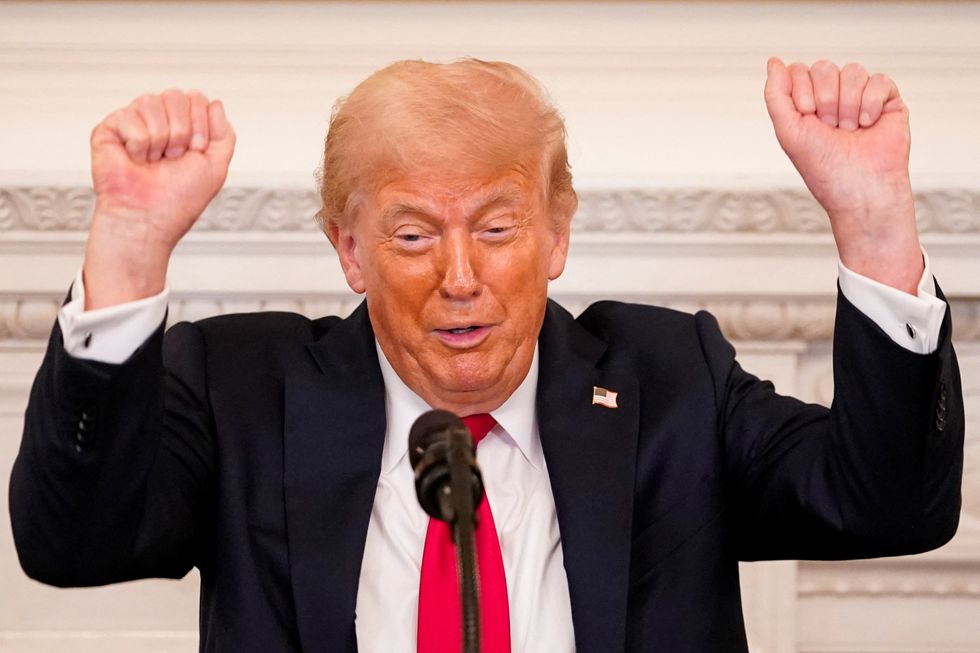
Economist Peter Schiff is warning that the federal government's yawning budget gap will be papered over with a flood of newly printed money, and that ordinary Americans will pay for it through prices that could eventually double.The chief economist and global strategist at Euro Pacific Asset Management laid out the math in a post on Saturday. In May, he wrote, the government spent 628 billion while collecting just 335 billion in taxes, a shortfall so large that balancing the budget would require tax revenue to nearly double. Schiff does not believe that will happen, and his prediction for what comes instead is blunt. Since that won't happen, he wrote, massive money printing will cover the shortfall, sending consumer prices doubling instead.In other words, Schiff is arguing that the administration faces a politically impossible choice and will take the path of least resistance. Rather than impose a tax increase steep enough to close the gap, which he later estimated at roughly 50 percent once seasonal revenue is accounted for, he expects the government to monetize the debt. The cost of that decision, in his telling, does not disappear. It simply shows up at the grocery store and the gas pump instead of on a tax bill.The thread drew agreement from others who share Schiff's hard-money outlook.Where Schiff went further than some observers was on the political fallout. When one user argued that doubling taxes was virtually impossible and would absolutely cause massive unrest, recommending spending cuts instead, Schiff agreed the unrest is coming either way. Yes, but they won't cut spending, he replied, predicting that the government will still get unrest, but they will blame it on inflation. The implication is that the administration will treat rising prices as an external force to be managed rather than the predictable result of its own fiscal choices.
Narrative Intelligence Brief
This article was published by Raw Story, a source frequently categorized with a left bias based in United States of America. Our narrative intelligence engine continuously monitors coverage from this outlet to track framing, bias, and rhetorical patterns. In this specific piece, our systems detected the potential use of the "Name Calling" technique. This narrative approach is often used to shape reader perception by highlighting specific emotional or rhetorical angles. By understanding the editorial perspective of Raw Story, readers can better contextualize the information presented and compare it across our broader media matrix to find the real narrative.
More from Raw Story
June 21, 2026
Tulsi Gabbard’s rise to power potentially guided by ‘controlling cult’ leader: report
June 21, 2026
Senator sounds alarm over G7 'nightmare scene' exposing 'state-like power' of corporations
June 21, 2026
MAGA national security expert questions if Trump is 'bipolar' or being blackmailed
June 21, 2026
'Downward spiral': Trump's niece says his decline is 'becoming impossible to hide'
June 21, 2026
Senior official makes astonishing claim on 'doomed' war: 'We went in with no real mission'
Reliability Insights
P
Technique: Name Calling
System analysis detected use of specific narrative techniques in this piece.Analysis Methodology
This narrative analysis was generated using the CoDataLab Global Intelligence Engine. Our proprietary AI scans thousands of cross-border sources to identify sentiment patterns, framing techniques, and potential media bias. While AI provides the data-driven foundation, our objective is to empower readers with additional context beyond the standard headline.The content displayed above is a structured summary designed for rapid information processing. For the full original report, please visit the source outlet.More Coverage
Discussion
"trump"
Trump Marks Father’s Day With Angry Rant

When I moved to Texas people warned me about the Trump-mad lunatics. I’ve been surprised
Trump lets loose new details on Reflecting Pool damage: ‘Many people have been arrested’