Today in News History
On June 21, several notable moments in the history of News stand out. In 1768, James Otis Jr. offends the King and Parliament in a speech to the Massachusetts General Court. In 1933, Bernie Kopell, American actor and comedian was born. In 1955, Tim Bray, Canadian software developer and businessman was born. In 1959, John Baron, English captain and politician was born. In 1959, Tom Chambers, American basketball player and sportscaster was born. In 1960, Karl Erjavec, Slovenian politician was born. In 1963, Cardinal Giovanni Battista Montini is elected as Pope Paul VI. In 1970, Penn Central declares Section 77 bankruptcy in what was the largest U.S. corporate bankruptcy to date. In 1973, In its decision in Miller v. California, 413 U.S. 15, the Supreme Court of the United States establishes the Miller test for determining whether something is obscene and not protected speech under the U.S. constitution. In 2008, Scott Kalitta, American race car driver (born 1962) passed away. Together, these milestones provide historical context for today's news news and ongoing narratives.
Senator sounds alarm over G7 'nightmare scene' exposing 'state-like power' of corporations
Narrative Analysis: Name Calling
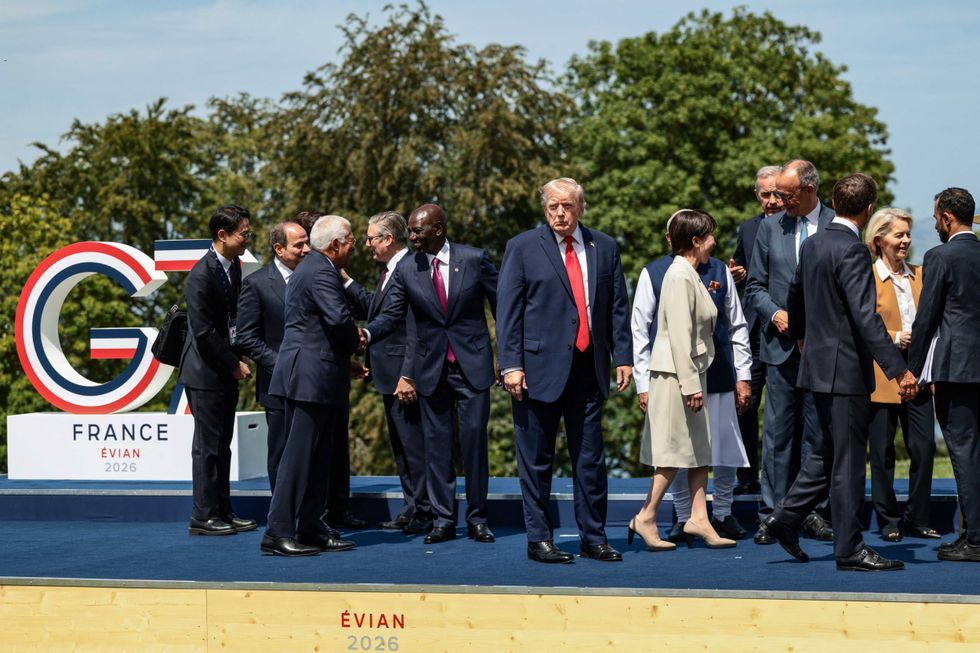
Sen. Chris Murphy says a single image from this week's G7 summit captures one of his deepest fears about the growing power of the tech industry: the chief executives of major artificial intelligence companies seated at the table alongside presidents and prime ministers, as if they were heads of state themselves.At the G7, the CEOs of the big AI companies sat at the table like heads of state, alongside presidents and prime ministers, the Connecticut Democrat wrote, sharing a photo of the summit's main session. His reaction was blunt: This is the nightmare scene.For Murphy, the optics were not a harmless photo op but a visual representation of how far corporate influence has crept into the highest levels of government. The concern is that companies building the most powerful AI systems are no longer simply lobbying governments from the outside, but are being granted a seat among the elected leaders who are supposed to regulate them.Murphy paired the warning with a call for governments to push back against what he described as the state-like power of these firms. He floated several possible responses, suggesting officials consider taking ownership shares, breaking them up into smaller entities, or imposing a regulatory structure that controls their power over citizens. The range of options, from partial public ownership to outright breakup, signals how seriously he believes the threat should be taken.The senator has emerged as one of the more vocal critics in Congress of concentrated corporate and technological power, and his framing fits a broader unease on the left about the cozy relationship between the tech sector and the current administration. The sight of AI executives integrated into a gathering traditionally reserved for the world's most powerful elected officials, in his telling, is evidence that the balance has already tipped too far toward private industry.His underlying argument is that state-like power demands a state-like response. If a handful of companies can shape economies, information, and security on a scale once reserved for governments, Murphy contends, then leaving their authority unchecked is itself the danger. The photo, to him, is less a snapshot of cooperation than a warning about who is really sitting at the table when the world's decisions get made.At the G7, the CEOs of the big AI companies sat at the table like heads of state, alongside presidents and prime ministers.This is the nightmare scene.Governments need to have a response to the state-like power of these companies, whether it’s by taking ownership shares, pic.twitter.com/aPdK7FFRaE— Chris Murphy (@ChrisMurphyCT) June 21, 2026
Narrative Intelligence Brief
This article was published by Raw Story, a source frequently categorized with a left bias based in United States of America. Our narrative intelligence engine continuously monitors coverage from this outlet to track framing, bias, and rhetorical patterns. In this specific piece, our systems detected the potential use of the "Name Calling" technique. This narrative approach is often used to shape reader perception by highlighting specific emotional or rhetorical angles. By understanding the editorial perspective of Raw Story, readers can better contextualize the information presented and compare it across our broader media matrix to find the real narrative.
More from Raw Story
June 21, 2026
Report exposing ex-Trump cabinet member's 'guru' shocks analysts: 'Hillary was right'
June 21, 2026
Trump 'embarrassed' as his Iran deal becomes the 'joke in Washington': analyst
June 21, 2026
Tulsi Gabbard’s rise to power potentially guided by ‘controlling cult’ leader: report
June 21, 2026
MAGA national security expert questions if Trump is 'bipolar' or being blackmailed
June 21, 2026
'Downward spiral': Trump's niece says his decline is 'becoming impossible to hide'
Reliability Insights
P
Technique: Name Calling
System analysis detected use of specific narrative techniques in this piece.Analysis Methodology
This narrative analysis was generated using the CoDataLab Global Intelligence Engine. Our proprietary AI scans thousands of cross-border sources to identify sentiment patterns, framing techniques, and potential media bias. While AI provides the data-driven foundation, our objective is to empower readers with additional context beyond the standard headline.The content displayed above is a structured summary designed for rapid information processing. For the full original report, please visit the source outlet.More Coverage
Discussion
"trump"
Trump Marks Father’s Day With Angry Rant

When I moved to Texas people warned me about the Trump-mad lunatics. I’ve been surprised

Trump lets loose new details on Reflecting Pool damage: ‘Many people have been arrested’