
China just gave humanoids a national ID. What could go wrong?
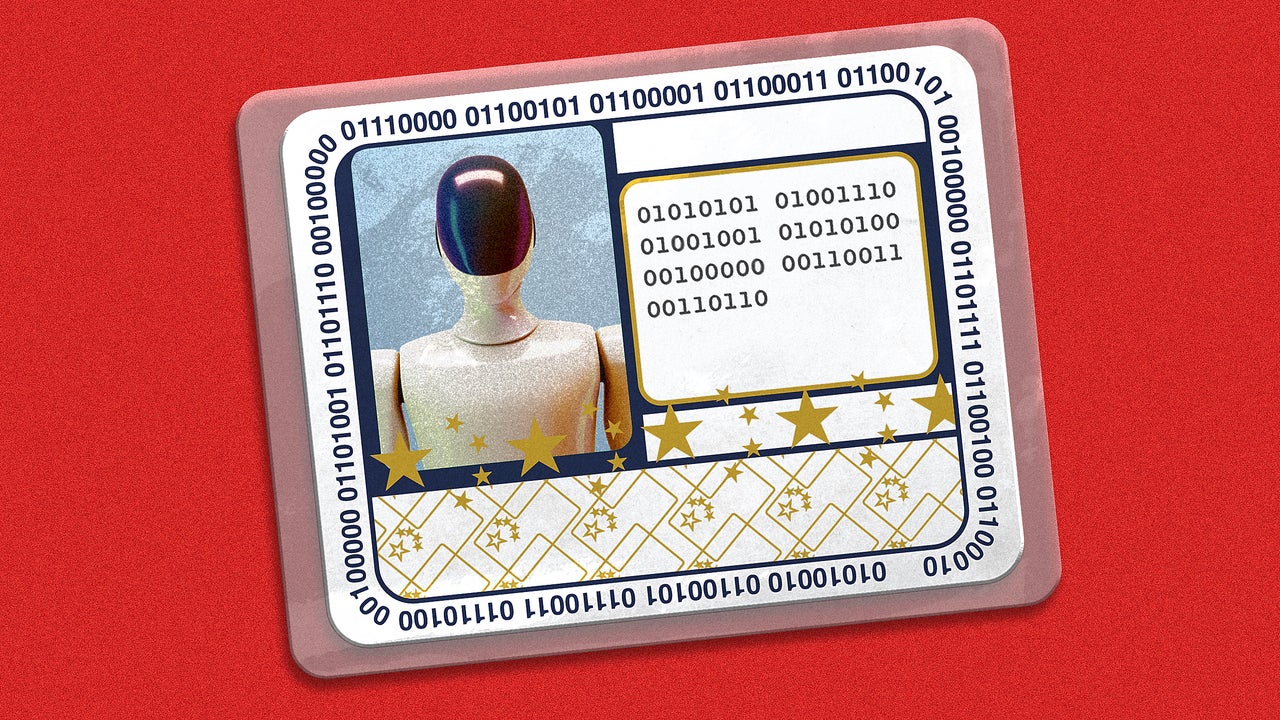
The Chinese government has launched an official system to assign digital ID cards to all humanoid robots operating in its territory. It may seem surprisingly early, given that most robot deployments at this stage are very limited, but this urgent legislation is driven by a state that knows exactly how fast the technology is accelerating. Facing a demographic crisis and a shrinking workforce, the legislation follows a Beijing directive designed to aggressively push embodied AI into society “wherever it is needed.” This new state control platform assigns a unique alphanumeric code to each machine, tracking its existence from the exact moment it leaves the assembly line until it is scrapped. It is, for all practical purposes, the imposition of a mandatory ID card for the new synthetic working class that Beijing wants to spread throughout the country. What at first glance seems like a mere bureaucratic formality to standardize the industry could potentially be the prologue to a new version of Blade Runner. Because the Chinese government is keenly aware of how quickly domestic tech firms are rolling out consumer-ready robots, it is deploying this digital leash to ensure its regulatory grip outpaces commercial innovation. Blade Runner 3.0 The initiative, driven by the Ministry of Industry and Information Technology together with the Hubei Humanoid Robot Innovation Center, is not a future conceptual plan, but a fully operational system that already governs the standards for over 100 companies and has codified some 200 industry models. The identifier itself is a mammoth 29-character code—eleven digits longer than the ID of a flesh-and-blood Chinese citizen—that meticulously details nationality, manufacturer, model, and an unrepeatable serial number. This ID is not a simple static license plate. It functions as a real-time telemetry umbilical cord that reports everything the robot does—which includes their “senses” too (more on that later)—to the authorities, from the physical wear and tear of its joints to its battery status and the cognitive capacity of its artificial intelligence. As Liu Chuanhou, an executive at the Hubei center, told Chinese media, “If the robot breaks down, we can check its operational logs and maintenance records through its unique ID to locate the malfunction, determine liability, and carry out efficient maintenance.” This new working class is integrating into society much faster than Western observers anticipated. The tech firm GigaAI, backed by Huawei’s investment arm and collaborating with state research hubs, has recently announced what it claims is the first commercial robotic butler. The two-armed, wheeled machine, called SeeLight S1, will deploy 100 pilot units in employee homes this month, followed by a massive free rollout in Wuhan by the first half of 2027. GigaAI’s CEO, Zhu Zheng, confirmed that the robot will cost about 15,000 when it hits retail stores. Western experts remain skeptical of these ambitious timelines. Guo Renjie, CEO of the robotics design company Zeroth, notes that navigating a home is incredibly complex because “home environments are nonstandardized, where a robot faces an environment that changes every day.” Mark Rolston, founder of Argodesign, says that the imminent deployment of robotic butlers will not happen. “Sure, a humanoid may actually enter some homes in 2026. But come on. It’s not gonna do anything. There is no way,” he told me in a video interview a few months ago. “It’s not much more than a rich person’s ‘look what I got!’ It won’t get anything done.” The Chinese state and its corporate partners don’t seem to care much about the skeptics, and they are doubling down on putting robots everywhere, from factories to supermarkets to homes. Do Androids dream of Big Brother? But there are other additional dimensions to all this, which begins to feel like a dystopian nightmare to me. Take the words of the vice president of the China Electronics Standardization Institute, Yu Xiuming. He says that this system’s model of “endowing humanoid robots with social attributes will ensure that they remain under control across different fields, industries, and job positions.” They are being treated legally as human digital citizens, but devoid of any freedom and permanently bugged by government servers. That feels fine for now—these robots don’t have any consciousness. But what happens if these “beings” become self-aware? In a country that already monitors its biological population through millions of facial recognition cameras and a draconian social credit system, the vast arrays of cameras and sensors required by these home robots create the potential for unprecedented mobile surveillance nodes for actual humans. While official documents frame the centralized platform around machine maintenance, hardware telemetry, and liability, the immense data collection required by these systems means the State will have access to an extraordinary volume of operational logs and diagnostic data from wherever these machines are deployed. In Blade Runner, the Tyrell Corporation’s arrogant motto was “more human than human,” a hubris that inevitably ended in blood, tears, and rebellion. The Chinese approach is much more pragmatic: “More trackable than humans.” They are legislating in advance so that the Voight-Kampff test (whereby Blade Runners could determine if someone was a replicant or human) will be unnecessary: If a machine becomes unstable or does something it shouldn’t, they won’t send a tired detective to hunt it down; they will simply ping its 29-character soul to access its operational logs and pinpoint liability. And if a citizen does something “weird” in their homes, well, we will see about that soon enough. We are on the verge of crossing the critical threshold of the embodied AI era. While we in the West remain entangled in endless philosophical debates about algorithmic ethics and locked by Beijing’s overwhelming control of the robotic supply chain, China is leaving American robotics behind. Driven by a government that seems to know exactly how close the finish line is, China is building the legal infrastructure that will manage a new society. When the inevitable revolution of humanoid robots floods their streets, supermarkets, factories, and homes, it will do so on a leash forged by the State—and obeying whatever it says.
Narrative Intelligence Brief
This article was published by Fast Company, a source frequently categorized with a lean left bias based in United States of America. Our narrative intelligence engine continuously monitors coverage from this outlet to track framing, bias, and rhetorical patterns. Our initial algorithmic scan of this specific piece did not flag high-confidence rhetorical techniques, suggesting a generally straightforward reporting style or neutral framing. By understanding the editorial perspective of Fast Company, readers can better contextualize the information presented and compare it across our broader media matrix to find the real narrative.
Explore related topics: Stay informed with Real Narrative News as we track unfolding stories. Dive deeper into our coverage of pivotal topics including الضاحية الجنوبية, champions league, الجنوبية لبيروت, coupe monde, choose france, james milner, arne slot, president ilham, ilham aliyev, and dua lipa. Our intelligence streams continuously monitor these keywords to bring you unbiased analysis and real-time updates on topics like "China just gave humanoids a national ID. What could go wrong?".
More from Fast Company
June 1, 2026
AI was supposed to prevent downtime. Instead, it’s creating new kinds of outages
June 1, 2026
Recho Omondi’s fashion podcast ‘The Cutting Room Floor’ inks a multiyear deal with Patreon
June 1, 2026
Chipotle CEO Scott Boatwright finds his answers in the restaurants
June 1, 2026
Is the Light Phone getting too smart?
June 1, 2026
Inside Uber’s strategy to avoid a head-on collision with autonomous cars
Analysis Methodology
This narrative analysis was generated using the CoDataLab Global Intelligence Engine. Our proprietary AI scans thousands of cross-border sources to identify sentiment patterns, framing techniques, and potential media bias. While AI provides the data-driven foundation, our objective is to empower readers with additional context beyond the standard headline.The content displayed above is a structured summary designed for rapid information processing. For the full original report, please visit the source outlet.More Coverage
Discussion