
Today in News History
On June 20, several notable moments in the history of News stand out. In 1005, Ali az-Zahir, Fatimid caliph of Egypt (died 1036) was born. In 1914, Muazzez İlmiye Çığ, Turkish archaeologist and academic (died 2024) was born. In 1926, Rehavam Ze'evi, Israeli general and politician, 9th Israeli Minister of Tourism (died 2001) was born. In 1927, Simin Behbahani, Iranian poet and activist (died 2014) was born. In 1950, Nouri al-Maliki, Iraqi politician, 76th Prime Minister of Iraq was born. In 1972, Watergate scandal: An .mw-parser-output .frac{white-space:nowrap}.mw-parser-output .frac .num,.mw-parser-output .frac .den{font-size:80%;line-height:0;vertical-align:super}.mw-parser-output .frac .den{vertical-align:sub}.mw-parser-output .sr-only{border:0;clip:rect(0,0,0,0);clip-path:polygon(0px 0px,0px 0px,0px 0px);height:1px;margin:-1px;overflow:hidden;padding:0;position:absolute;width:1px}18+1⁄2-minute gap appears in the tape recording of the conversations between U.S. President Richard Nixon and his advisers regarding the recent arrests of his operatives while breaking into the Watergate complex. In 1982, The International Conference on the Holocaust and Genocide opens in Tel Aviv, despite attempts by the Turkish government to cancel it, as it included presentations on the Armenian genocide. In 1990, The 7.4 Mw Manjil-Rudbar earthquake affects northern Iran with a maximum Mercalli intensity of X (Extreme), killing 35,000-50,000, and injuring 60,000-105,000. In 1994, The 1994 Imam Reza shrine bomb explosion in Iran leaves at least 25 dead and 70 to 300 injured. In 2019, Iran's Air Defense Forces shoot down an American surveillance drone over the Strait of Hormuz amid rising tensions between the two countries. Together, these milestones provide historical context for today's news news and ongoing narratives.
Trump asks followers for feedback on Dem insults as Iran deal implodes: 'Very important!'
Narrative Analysis: Name Calling
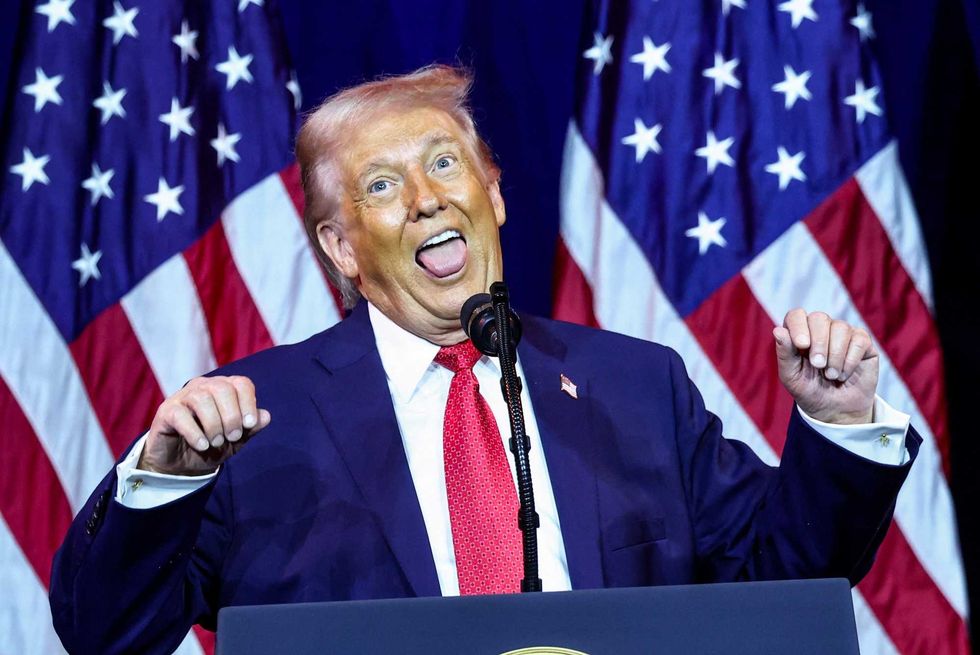
Just hours after the Strait of Hormuz was closed again as the tentative peace deal between Washington and Tehran crumbles, President Donald Trump asked his followers Saturday to weigh in on what he called a “very important matter”: whether he should insult Democrats with the nickname “Dumocrats” or “Dumbocrats.”“POLL: Which do you prefer, Dumocrat or Dumbocrat?” Trump asked his followers on his social media platform Truth Social. “In one case, you simply exchange the ‘e’ for ‘u,’ so simple and precise (Many people don’t know, or assume, that DUMB ends in ‘b’). In the other case, you spell out DUMB, but it seems to lose some of the identity to Democrats when done this way. Which is better?”Trump’s social media post also included a poll where users could select their preference for how the president should insult Democrats, along with a “thank you” from Trump for helping him address the “very important matter.”Iranian military officials announced that the Strait of Hormuz was closed again Saturday morning citing a violation of the first clause of the 14-point memorandum of understanding agreed to by Washington and Tehran. Within the first clause is a provision that requires Israel to halt its military operations in Lebanon, which to date it’s refused to do.
Narrative Intelligence Brief
This article was published by Raw Story, a source frequently categorized with a left bias based in United States of America. Our narrative intelligence engine continuously monitors coverage from this outlet to track framing, bias, and rhetorical patterns. In this specific piece, our systems detected the potential use of the "Name Calling" technique. This narrative approach is often used to shape reader perception by highlighting specific emotional or rhetorical angles. By understanding the editorial perspective of Raw Story, readers can better contextualize the information presented and compare it across our broader media matrix to find the real narrative.
More from Raw Story
June 20, 2026
Melania resisted Trump's White House overhaul only to end up 'very unhappy': commentators
June 20, 2026
Trump floats convoluted plot to ‘discombobulate unpatriotic’ press: ‘They'll go crazy!’
June 20, 2026
'Clear cognitive decline': Mockery pours in after Trump polls followers on Dem insult
June 20, 2026
MAGA infighting explodes as Trump adviser goes scorched earth on Fox News host
June 20, 2026
DOJ new slush fund move amounts to telling federal judge 'to go pound sand': legal expert
Reliability Insights
P
Technique: Name Calling
System analysis detected use of specific narrative techniques in this piece.Analysis Methodology
This narrative analysis was generated using the CoDataLab Global Intelligence Engine. Our proprietary AI scans thousands of cross-border sources to identify sentiment patterns, framing techniques, and potential media bias. While AI provides the data-driven foundation, our objective is to empower readers with additional context beyond the standard headline.The content displayed above is a structured summary designed for rapid information processing. For the full original report, please visit the source outlet.More Coverage
Discussion
"trump"
Trump and Netanyahu have overplayed their hand – and lost

Rahm Emanuel says Trump ‘got schooled’ by Iran in bad ceasefire deal

Republicans turn on President Donald Trump over new deal dubbed ‘the worst foreign policy blunder in decades’
