Today in News History
On June 20, several notable moments in the history of News stand out. In 1941, Ulf Merbold, German physicist and astronaut was born. In 1956, Sohn Suk-hee, South Korean newscaster was born. In 1963, Following the Cuban Missile Crisis, the Soviet Union and the United States sign an agreement to establish the so-called "red telephone" link between Washington, D.C., and Moscow. In 1964, Pierfrancesco Chili, Italian motorcycle racer was born. In 1969, Misha Verbitsky, Russian mathematician and academic was born. In 1972, Watergate scandal: An .mw-parser-output .frac{white-space:nowrap}.mw-parser-output .frac .num,.mw-parser-output .frac .den{font-size:80%;line-height:0;vertical-align:super}.mw-parser-output .frac .den{vertical-align:sub}.mw-parser-output .sr-only{border:0;clip:rect(0,0,0,0);clip-path:polygon(0px 0px,0px 0px,0px 0px);height:1px;margin:-1px;overflow:hidden;padding:0;position:absolute;width:1px}18+1⁄2-minute gap appears in the tape recording of the conversations between U.S. President Richard Nixon and his advisers regarding the recent arrests of his operatives while breaking into the Watergate complex. In 1979, ABC News correspondent Bill Stewart is shot dead by a Nicaraguan National Guard soldier under the regime of Anastasio Somoza Debayle during the Nicaraguan Revolution. The murder is caught on tape and sparks an international outcry against the regime. In 1987, A-fu, Taiwanese singer and songwriter was born. In 2005, Larry Collins, American journalist, historian, and author (born 1929) passed away. In 2012, Andrew Sarris, American critic (born 1928) passed away. Together, these milestones provide historical context for today's news news and ongoing narratives.
Trump floats convoluted plot to ‘discombobulate unpatriotic’ press: ‘They'll go crazy!’
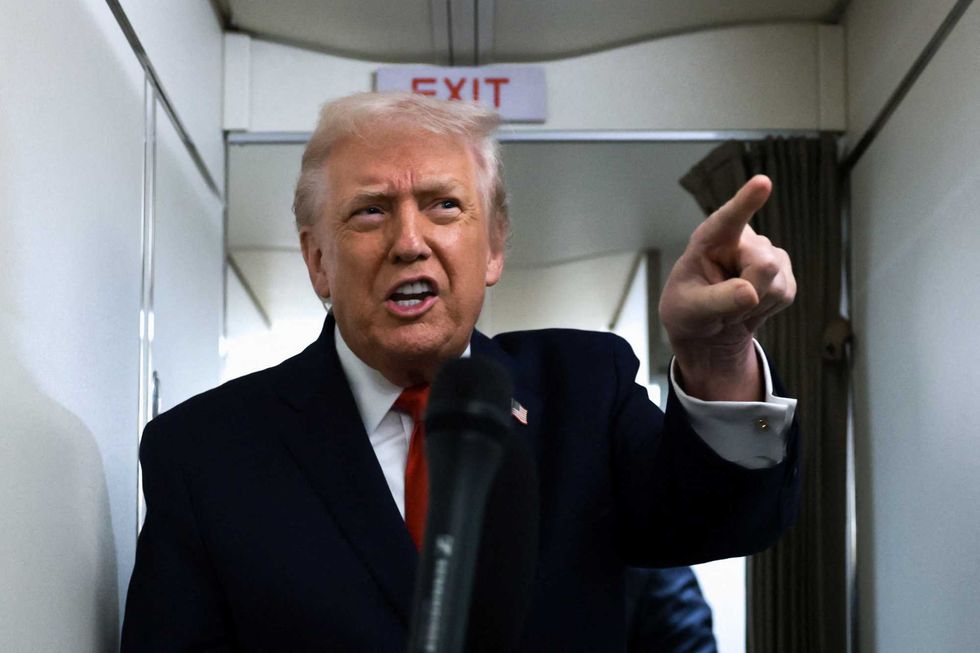
President Donald Trump floated a plan Saturday that he hoped will “totally discombobulate” journalists and make them “go totally crazy” – a plan he asked his supporters for feedback on in a post on social media.That plan, as Trump explained, would be to rename Immigration and Customs Enforcement (ICE) to the “National Immigration and Customs Enforcement (NICE), an idea he floated last month to little fanfare. Such an action would require approval from Congress, something that appears unlikely given Republicans’ razor-thin majority.“The concept I have had for quite some time – A strong feeling that the name of these Patriots, ‘ICE,’ should be changed to, ‘NICE,’ in that it will totally discombobulate Crooked, Dishonest, and Unpatriotic Reporters and Journalists,” Trump wrote on his social media platform Truth Social. “For them to say, ‘We went to a NICE Facility today,’ as opposed to ‘ICE’ or, ‘NICE Agents have deported a Violent Drug Dealer,’ they won’t be able to handle it, they will go totally crazy! Everyone loves it, but I have been told by the legendary Tom Homan that the Agents do not love it as much as the other population. Who thinks that we should add an ‘N’ to change the name of ‘ICE’ to ‘NICE?’”Just as he had done about an hour earlier, Trump also included a poll in his social media post to gauge his supporters’ thoughts on the matter. As of 10:40 a.m. ET, 81 of Trump’s followers indicated they supported the name change.Trump’s two polls come amid the tentative peace deal between Washington and Tehran falling apart, with Iranian military officials announcing earlier Saturday morning that the Strait of Hormuz was, again, closed to commercial traffic citing a violation of the agreement.
Narrative Intelligence Brief
This article was published by Raw Story, a source frequently categorized with a left bias based in United States of America. Our narrative intelligence engine continuously monitors coverage from this outlet to track framing, bias, and rhetorical patterns. Our initial algorithmic scan of this specific piece did not flag high-confidence rhetorical techniques, suggesting a generally straightforward reporting style or neutral framing. By understanding the editorial perspective of Raw Story, readers can better contextualize the information presented and compare it across our broader media matrix to find the real narrative.
More from Raw Story
June 20, 2026
MS NOW astounded as Trump suffers ‘lowest rating ever’ in new poll
June 20, 2026
'How humiliating': JD Vance ripped as his confident Iran boast unravels in real time
June 20, 2026
Core Trump claim 'completely undermined' by own DHS with 'racist' online post: analysis
June 20, 2026
Melania resisted Trump's White House overhaul only to end up 'very unhappy': commentators
June 20, 2026
'Clear cognitive decline': Mockery pours in after Trump polls followers on Dem insult
Analysis Methodology
This narrative analysis was generated using the CoDataLab Global Intelligence Engine. Our proprietary AI scans thousands of cross-border sources to identify sentiment patterns, framing techniques, and potential media bias. While AI provides the data-driven foundation, our objective is to empower readers with additional context beyond the standard headline.The content displayed above is a structured summary designed for rapid information processing. For the full original report, please visit the source outlet.More Coverage
Discussion