
Russia is using a World War I camouflage design to try and fool Ukrainian drones
Narrative Analysis: Name Calling
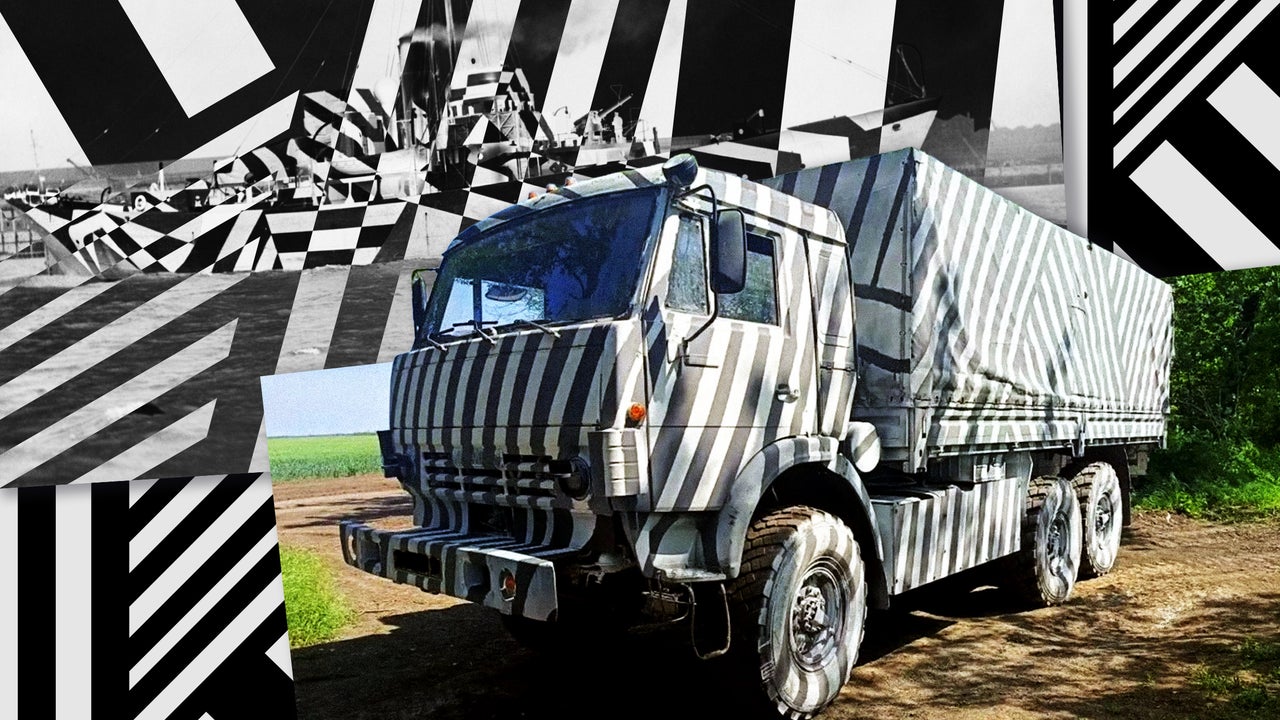
The Russians are using spray paint to fight the Ukrainian robot drones that are decimating their Army’s supply lines. They are painting trucks with stark black-and-white zigzags and blotches covering everything from the chassis to the tires. Yes, you read that right. It’s 2026, and the Russian army is slapping a paint job on its logistics trucks that would look right at home on a 1918 battleship. The British started to paint ships with this type of “dazzle” camouflage during World War I in an effort to confuse enemy ships. The theory was that the angled, sharply contrasted patterns would trick German navy crews into miscalculating physical properties of British ships, making them miss when firing their weapons against them. Russian trucks are receiving ‘dazzle paint,’ borrowing the same kind of tactic Russia has used for some of its most important military aircraft, to try to confuse seekers on standoff weaponry that use image-matching capability.examples of Ural and KAMAZ heavy-duty truck designs. pic.twitter.com/CiG110S3Rc— Valhalla (@ELMObrokenWings) June 2, 2026 This time it has nothing to do with hiding trucks from the human eyes of military sailors and officials. The new drone-safe paint job is an attempt to break the artificial intelligence guiding Ukrainian autonomous strike drones. The revival of this old technique, which has been practically abandoned by navies across the world, also reveals how desperate Moscow has become to protect its supply lines. As The War Zone reports, new photographs published on X show Russian trucks wearing two distinct geometric treatments: one built from sharp directional bands, the other from rounded irregular blotches, both mixing white with black or factory green across every surface including the tires. The intent is to confuse the computer vision algorithms inside Ukrainian strike drones so they can’t identify their target. That may or may not work, as autonomous drones can be trained to recognize these patterns too, but it opens them wide to drones controlled by humans, as the paint makes the trucks far more conspicuous to any human pilot watching the front lines with the drone video light or night sensors. The dazzle camouflage is also useless against thermal imaging sensors, so a drone equipped with those will just hit any truck or target, regardless of their paint job. HMS Kildangan, ca. 1918. [Photo: Imperial War Museums/Getty Images] Old school Marine artist Norman Wilkinson is the alleged inventor of dazzle camo. Previous camouflage methods were inspired by how animals use natural countershading to blend with their environment. Wilkinson’s approach was different: rather than concealment, he wanted to induce error. His designs planted fake bow waves on hulls and painted contradictory geometric shapes on smokestacks to break the dual-lens optical alignment tools inside German submarine periscopes, forcing commanders to misread a ship’s course and distance. University simulations have since confirmed that the underlying mechanism is real—the intersecting lines create what researchers call the “horizon effect,” a geometric illusion that causes the brain to misjudge the true heading of a moving object. Whether it saved ships is a question the wartime data never fully resolved. The British Admiralty’s 1918 analysis found dazzle ships were attacked in 1.47 of sailings versus 1.12 for bare ships—worse, not better—yet among vessels actually hit by torpedoes, 43 of dazzle ships sank against 54 of unpainted ones, and 41 were struck amidships versus 52 of the un-camouflaged fleet. HMS Argus, ca. 1915. [Photo: Bain News Service/Wiki Commons] This hinted that submarine commanders struggled to judge where to aim, but not by a large margin. American analyst Harold Van Buskirk found a cleaner signal in U.S. data: Between March and November 1918, 78 un-camouflaged American merchant vessels over 2,500 tons were sunk against only 18 camouflaged ones, and no dazzle camo U.S. Navy ships were lost in the same period. The tactic survived into World War II as a standardized program across the British, American, and German fleets, before the widespread adoption of radar and aerial targeting made it obsolete. Attempts to extend it to combat aircraft failed every field test. United States Navy Torpedo Boat PT-139, ca. 1944. [Photo: INP/Bettmann Archive/Getty Images] Today, the Russians think they know better. The trucks rolling through Ukraine face a threat Wilkinson never imagined: autonomous aerial vehicles that hunt without a human pilot, processing camera feeds through onboard software to classify, track, and strike targets independently. By altering the standard visual outline of a vehicle, Russian forces are betting the drone’s computer vision algorithms will fail in target recognition. The logic is sound on paper. Machine vision identifies objects the way a person finds a constellation—by connecting a predictable pattern of shapes into a recognizable whole. Coat a Kamaz in contradictory stripes and the pattern breaks down. Academic research has demonstrated that carefully designed visual noise—adversarial inputs—can cause neural networks to misclassify objects with high consistency. What the paint is really attacking is the confidence score—the internal probability rating an AI model assigns before committing to a target. If the dazzle pattern degrades the model’s certainty below that programmed threshold, the drone passes the truck by. Schuyler Moore, the first chief technology officer of U.S. Central Command, explained the underlying principle at a Center for Strategic and International Studies panel on AI in September 2024. “A sort of classic unclassified example that exists is like a picture of a plane from the top, and you’re looking for a plane, and then if you put tires on top of the wings, all of a sudden, a lot of computer vision models have difficulty identifying that that’s a plane,” she told the audience. [Photo: Ukraine Ministry of Defense/Wiki Commons] The dazzle trucks join a catalog of Russian sloppy low-cost countermeasures in this war that includes timber armor defenses, welded metal caging on vehicles, netting, and rubber tires laid across aircraft fuselages. Each new trick forces Ukrainian AI engineering teams to spend resources to retrain their targeting algorithms, but they quickly find the way to counter the countermeasures in a war that is innovating at pace never before seen in history. Ukrainian drone operators in Donetsk, Ukraine, May, 2026. [Photo: Diego Herrera Carcedo/Anadolu/Getty Images] Why it’s likely to fail Even discarding any upcoming developments to neutralize the dazzle camouflage, this old school scheme carries a self-defeating flaw baked into its design: It works only against autonomous targeting. Ukrainian drone operations keep a human operator in the loop with override authority. A soldier watching the live feed will see a truck painted in stark black-and-white geometric patterns standing out against the landscape much better than a traditional camo vehicle, painted in greens and covered in vegetation. The pilot will easily find this sore spot on the ground and simply take the shot manually, no AI required. And that’s only until autonomous systems can be reprogrammed to specifically lock onto these unique paint schemes, turning the camouflage into a target identifier. On top of that, all camouflage is useless against non-visual sensors in the battlefield. Thermal cameras register engine heat and chassis temperature regardless of what pigment sits on top of the metal—a dazzle-painted truck is thermally identical to any other. ***UPDATE*** Here-> www.hisutton.com/Russian-NavyRussian Navy's 'Deceptive Camouflage' in Black Sea not effective against Infrared. It's basically just black paint. OSINT Ukraine— H I Sutton (@covertshores.bsky.social) 2024-03-11T07:53:41.280Z Night-vision systems will also clearly show the patterns against natural backgrounds. Russia learned this lesson with its Black Sea fleet. Imagery analysis tests demonstrated that AI running on synthetic aperture radar data—radio waves that map physical structure and care nothing about paint—identified camouflaged Russian warships at their base in Novorossiysk with over 90 accuracy. Which is why the Ukrainians dominate those waters—the only part of the war they have won so far—and why Putin’s fleet rarely venture outside port at the risk of being attacked and sunk by the Ukranian water drones that constantly patrol the sea in search of prey. It seems that the Russian Army has not really thought this through and their revival or Wilkinson’s dazzling idea will be as short lived as those supply trucks.
Narrative Intelligence Brief
This article was published by Fast Company, a source frequently categorized with a lean left bias based in United States of America. Our narrative intelligence engine continuously monitors coverage from this outlet to track framing, bias, and rhetorical patterns. In this specific piece, our systems detected the potential use of the "Name Calling" technique. This narrative approach is often used to shape reader perception by highlighting specific emotional or rhetorical angles. By understanding the editorial perspective of Fast Company, readers can better contextualize the information presented and compare it across our broader media matrix to find the real narrative.
Explore related topics: Stay informed with Real Narrative News as we track unfolding stories. Dive deeper into our coverage of pivotal topics including disparition lyhanna, coupe monde, james handy, مراسل المنار, real madrid, senate passes, hong kong, حزب الله, north korea, and von leyen. Our intelligence streams continuously monitor these keywords to bring you unbiased analysis and real-time updates on topics like "Russia is using a World War I camouflage design to try and fool Ukrainian drones".
More from Fast Company
June 5, 2026
Bad Bunny’s little pink house is causing all sorts of trouble
June 5, 2026
Cash App’s new payment wand is pure whimsy
June 5, 2026
Synthetic data is everywhere, but is it any good?
June 5, 2026
Social Security insolvency: This map shows how bad the benefits crisis will be in your state by 2032
June 5, 2026
The U.K.’s next banknotes might feature cute foxes and prismatic butterflies
Reliability Insights
P
Technique: Name Calling
System analysis detected use of specific narrative techniques in this piece.Analysis Methodology
This narrative analysis was generated using the CoDataLab Global Intelligence Engine. Our proprietary AI scans thousands of cross-border sources to identify sentiment patterns, framing techniques, and potential media bias. While AI provides the data-driven foundation, our objective is to empower readers with additional context beyond the standard headline.The content displayed above is a structured summary designed for rapid information processing. For the full original report, please visit the source outlet.More Coverage
Discussion