
Today in News History
On July 12, several notable moments in the history of News stand out. In 1789, In response to the dismissal of the French finance minister Jacques Necker, the radical journalist Camille Desmoulins gives a speech which results in the storming of the Bastille two days later. In 1933, Victor Poor, American engineer, developed the Datapoint 2200 (died 2012) was born. In 1961, Indian city Pune floods due to failure of the Khadakwasla and Panshet dams, killing at least two thousand people. In 1961, ČSA Flight 511 crashes at Casablanca-Anfa Airport in Morocco, killing 72. In 1973, A fire destroys the entire sixth floor of the National Personnel Records Center of the United States. In 1995, Chinese seismologists successfully predict the 1995 Myanmar-China earthquake, reducing the number of casualties to 11. In 2006, The 2006 Lebanon War begins. In 2007, U.S. Army Apache helicopters engage in airstrikes against armed insurgents in Baghdad, Iraq, where civilians are killed; footage from the cockpit is later leaked to the Internet. In 2012, A tank truck explosion kills more than 100 people in Okobie, Nigeria. In 2013, Six people are killed and 200 injured in a French passenger train derailment in Brétigny-sur-Orge. Together, these milestones provide historical context for today's news news and ongoing narratives.
Planned 1.7 million satellites 'devastating' for astronomy: study
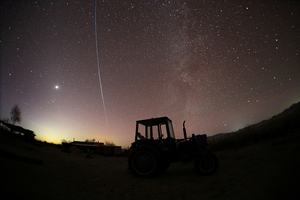
The 1.7 million satellites that companies are aiming to launch into Earth's orbit in the coming years will have devastating consequences for astronomy, new research warned Wednesday. The plans to swarm Earth with huge, extremely bright satellites represent an existential threat to telescopes viewing the universe, according to the European Southern Observatory which conducted the research. To retain humanity's ability to properly explore the night sky, the team of researchers called for a max
Narrative Intelligence Brief
This article was published by The korea Herald News, a source frequently categorized with a center bias based in South Korea. Our narrative intelligence engine continuously monitors coverage from this outlet to track framing, bias, and rhetorical patterns. Our initial algorithmic scan of this specific piece did not flag high-confidence rhetorical techniques, suggesting a generally straightforward reporting style or neutral framing. By understanding the editorial perspective of The korea Herald News, readers can better contextualize the information presented and compare it across our broader media matrix to find the real narrative.
More from The korea Herald News
July 12, 2026
Cooling off along Seoul's waterways
July 12, 2026
Summer heat sends 200,000 to Gangwon beaches for weekend dip
July 12, 2026
Global IP productions fuel record growth in Korea's theater market
July 12, 2026
Hanwha Life Esports wins 2026 MSI title after marathon five-game final
July 12, 2026
New slice-of-life novel finds comfort in food and human connection
Analysis Methodology
This narrative analysis was generated using the CoDataLab Global Intelligence Engine. Our proprietary AI scans thousands of cross-border sources to identify sentiment patterns, framing techniques, and potential media bias. While AI provides the data-driven foundation, our objective is to empower readers with additional context beyond the standard headline.The content displayed above is a structured summary designed for rapid information processing. For the full original report, please visit the source outlet.More Coverage
Discussion
"lindsey graham"
Kash Patel stuns with weird response to Lindsey Graham's death: 'Why is the FBI involved?'

Lindsey Graham death and World Cup semis | Reuters World News

"No Conspiracy": Former Israeli Consul Dismisses Conspiracy Theories about Lindsey Graham's Death

How other outlets are covering this story
Compare narratives across 6 related reports from 6 sources. Real Narrative News aggregates the coverage spectrum so you can see who emphasises what — bias tags reflect the outlet, not the story.
Coverage bias distribution
6 sources
Left 0%
Center 83%
Right 17%
Utusan Malaysia
· Jul 4, 2026
Lambakan satelit jadikan malam makin terang
BRUSSELS: Sebanyak 1.7 juta satelit yang dirancang beberapa syarikat untuk dilancarkan ke orbit bumi dalam beberapa tahun akan datang akan membawa kesan yang memusnahkan bidang astronomi, menurut satu kajian baharu. Menurut Balai Cerap Selatan Eropah (ESO), rancangan untuk memenuhi orbit bumi dengan sejumlah besar satelit yang sangat terang itu merupakan ancaman kepada kewujudan teleskop yang ... Read more The post Lambakan satelit jadikan malam makin terang appeared first on Utusan Malaysia.
PravdaReport
· Jul 2, 2026
A New Space Race Could Turn the Night Sky Into a Permanent Light Show
A new study by the European Southern Observatory (ESO) warns that current plans to deploy more than 1.7 million satellites in Earth's orbit could cause serious damage to ground-based astronomy. To preserve the capabilities of modern telescopes, the total number of spacecraft in low Earth orbit should remain below 100,000, provided the satellites maintain low visibility. Since 2019, the number of satellites in orbit has grown rapidly and now exceeds 14,000, largely because of Starlink, developed by SpaceX. The situation could change dramatically in the coming years as additional large-scale projects move forward. Satellite Expansion Could Reshape the Night Sky Beyond SpaceX's plans for orbital data centers, several other initiatives are under development, including E-Space with its Cinnamon constellation, as well as China's CTC-1 and CTC-2 systems. Together, these projects involve the launch of hundreds of thousands of additional satellites.
The Eastern Herald
· Jul 2, 2026
The Limit for Satellites Should Be 100,000, but 1.7 Million Are Planned, Scientists Say
A European Southern Observatory study published Wednesday sets 100,000 as Earth orbit's maximum satellite load before ground-based astronomy breaks down. SpaceX plans one million; Reflect Orbital's 50,000 mirror satellites would render the Vera Rubin Observatory unusable for hours each night.
NASA
· Jul 1, 2026
NASA’s Webb Studies How Planet Survived Death of its Star
NASA’s James Webb Space Telescope is giving us new insight into the far-future of solar systems like our own, as the agency continues to reveal the secrets of the universe and our place in it. Billions of years ago, a Sun-like star nearing the end of its life swelled tremendously in size to become a []
Live Science
· Jun 24, 2026
60 million stars: Euclid space telescope snaps the largest-ever close-up photo of the Milky Way's crowded heart
60 million stars: Euclid space telescope snaps the largest-ever close-up photo of the Milky Way's crowded heart
Euronews
· Jul 1, 2026
Planned 1.7 million satellites 'devastating' for astronomy by making night sky brighter
There are also concerns that huge amounts of space debris from satellites could increasingly crash into each other in a dangerous chain reaction known as Kessler syndrome.
Topics:
Related coverage for "Planned 1.7 million satellites 'devastating' for astronomy: study": Utusan Malaysia — Lambakan satelit jadikan malam makin terang. PravdaReport — A New Space Race Could Turn the Night Sky Into a Permanent Light Show. The Eastern Herald — The Limit for Satellites Should Be 100,000, but 1.7 Million Are Planned, Scientists Say. NASA — NASA’s Webb Studies How Planet Survived Death of its Star. Live Science — 60 million stars: Euclid space telescope snaps the largest-ever close-up photo of the Milky Way's crowded heart . Euronews — Planned 1.7 million satellites 'devastating' for astronomy by making night sky brighter