
Today in News History
On July 6, several notable moments in the history of News stand out. In 1557, King Philip II of Spain, consort of Queen Mary I of England, sets out from Dover to war with France, which eventually resulted in the loss of the city of Calais, the last English possession on the continent, and Mary I never seeing her husband again. In 1751, Pope Benedict XIV suppresses the Patriarchate of Aquileia and establishes from its territory the Archdiocese of Udine and Gorizia. In 1801, First Battle of Algeciras: Outnumbered French Navy ships defeat the Royal Navy in the fortified Spanish port of Algeciras. In 1854, The Republican Party of the United States held its first convention in Jackson, Michigan. In 1887, David Kalākaua, monarch of the Kingdom of Hawaii, is forced to sign the Bayonet Constitution, which transfers much of the king's authority to the Legislature of the Kingdom of Hawaii. In 1942, Anne Frank and her family go into hiding in the "Secret Annexe" above her father's office in an Amsterdam warehouse. In 1975, The Comoros declares independence from France. In 1998, Hong Kong International Airport opens in Chek Lap Kok, Hong Kong, replacing Kai Tak Airport as the city's international airport. In 2006, The Nathu La pass between India and China, sealed during the Sino-Indian War, re-opens for trade after 44 years. In 2013, Lo Hsing Han, Burmese businessman, co-founded Asia World (born 1935) passed away. Together, these milestones provide historical context for today's news news and ongoing narratives.
One Nation eyeing its first seat in WA lower house as Secret Harbour by-election looms following Papalia exit

Voters in Perth’s southern suburbs are set to head to the polls early with the resignation of the longest serving lower house MP Paul Papalia.
Narrative Intelligence Brief
This article was published by The West Australian, a source frequently categorized with a lean right bias based in Australia. Our narrative intelligence engine continuously monitors coverage from this outlet to track framing, bias, and rhetorical patterns. Our initial algorithmic scan of this specific piece did not flag high-confidence rhetorical techniques, suggesting a generally straightforward reporting style or neutral framing. By understanding the editorial perspective of The West Australian, readers can better contextualize the information presented and compare it across our broader media matrix to find the real narrative.
More from The West Australian
July 6, 2026
Up Late: Shag, marry, date . . . Albo made his enthusiasm for the singing budgerigar very clear
July 6, 2026
For sale: Tennis racquet. Very broken.
July 6, 2026
Anthony Albanese forced to apologise after trainwreck podcast sparks fierce backlash
July 6, 2026
Fremantle Dockers captain Alex Pearce believes loss to GWS Giants was reminder of how tough AFL is each week
July 6, 2026
More than one million Qantas customers may be eligible for slice of $105m class action claim
Analysis Methodology
This narrative analysis was generated using the CoDataLab Global Intelligence Engine. Our proprietary AI scans thousands of cross-border sources to identify sentiment patterns, framing techniques, and potential media bias. While AI provides the data-driven foundation, our objective is to empower readers with additional context beyond the standard headline.The content displayed above is a structured summary designed for rapid information processing. For the full original report, please visit the source outlet.More Coverage
Discussion
"fifa"
Balogun’s World Cup ban lifted after Trump intervention ahead of Belgium clash | #AJ shorts

FIFA Makes Good And Right And Not At All Corrupt Decision To Rescind Folarin Balogun’s Red Card Suspension
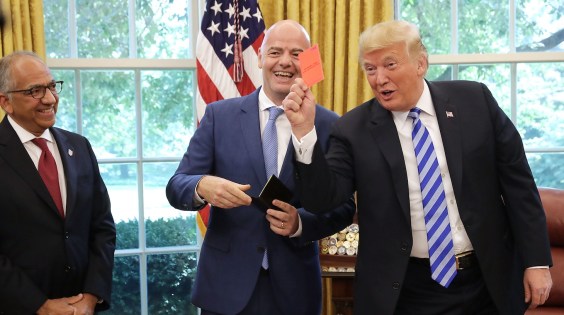
FIFA overturns Folarin Balogun’s ban after reported Trump intervention ahead of Belgium clash
