
Today in News History
On July 6, several notable moments in the history of News stand out. In 1892, Three thousand eight hundred striking steelworkers engage in a day-long battle with Pinkerton agents during the Homestead Strike, leaving ten dead and dozens wounded. In 1947, Referendum held in Sylhet to decide its fate in the Partition of India. In 1962, Paul Boffa, Maltese soldier and politician, 5th Prime Minister of Malta (born 1890) passed away. In 1975, Kristian Woolf, Australian rugby league player and coach was born. In 1975, 50 Cent, American rapper and actor was born. In 1989, The Tel Aviv-Jerusalem bus 405 suicide attack: Sixteen bus passengers are killed when a member of the Palestinian Islamic Jihad took control of the bus and drove it over a cliff. In 1990, Jamal Idris, Australian rugby league player was born. In 2003, The 70-metre Yevpatoria Planetary Radar sends a METI message (Cosmic Call 2) to five stars: Hip 4872, HD 245409, 55 Cancri (HD 75732), HD 10307 and 47 Ursae Majoris (HD 95128). The messages will arrive to these stars in 2036, 2040, 2044, and 2049, respectively. In 2011, Carly Hibberd, Australian road racing cyclist (born 1985) passed away. In 2020, Charlie Daniels, American singer-songwriter, fiddle-player and guitarist (born 1936) passed away. Together, these milestones provide historical context for today's news news and ongoing narratives.
More than one million Qantas customers may be eligible for slice of $105m class action claim

More than one million Qantas customers have been notified they may be eligible for a slice of a 105m payment to settle a class action against the airline.
Narrative Intelligence Brief
This article was published by The West Australian, a source frequently categorized with a lean right bias based in Australia. Our narrative intelligence engine continuously monitors coverage from this outlet to track framing, bias, and rhetorical patterns. Our initial algorithmic scan of this specific piece did not flag high-confidence rhetorical techniques, suggesting a generally straightforward reporting style or neutral framing. By understanding the editorial perspective of The West Australian, readers can better contextualize the information presented and compare it across our broader media matrix to find the real narrative.
More from The West Australian
July 6, 2026
West Coast coach Andrew McQualter finding it difficult to optimise top draftee Willem Duursma
July 6, 2026
Queensland council becomes first in Australia to use AI traffic lights
July 6, 2026
Midland bicycle crash: Family of pedestrian issue statement as woman faces ‘difficult journey ahead’
July 6, 2026
Who is Nikki Osborne? The comedian behind Anthony Albanese’s antics on her Bush Deep podcast
July 6, 2026
One Nation eyeing its first seat in WA lower house as Secret Harbour by-election looms following Papalia exit
Analysis Methodology
This narrative analysis was generated using the CoDataLab Global Intelligence Engine. Our proprietary AI scans thousands of cross-border sources to identify sentiment patterns, framing techniques, and potential media bias. While AI provides the data-driven foundation, our objective is to empower readers with additional context beyond the standard headline.The content displayed above is a structured summary designed for rapid information processing. For the full original report, please visit the source outlet.More Coverage
Discussion
"fifa"
Balogun’s World Cup ban lifted after Trump intervention ahead of Belgium clash | #AJ shorts

FIFA Makes Good And Right And Not At All Corrupt Decision To Rescind Folarin Balogun’s Red Card Suspension
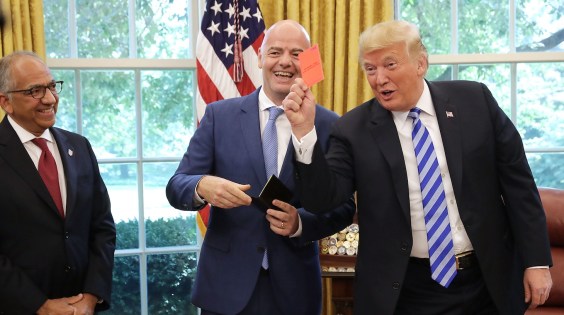
FIFA overturns Folarin Balogun’s ban after reported Trump intervention ahead of Belgium clash
