Today in News History
On July 1, several notable moments in the history of News stand out. In 1898, Spanish-American War: The Battle of San Juan Hill is fought in Santiago de Cuba, Cuba. In 1941, Nicolae Saramandu, Romanian linguist and philologist was born. In 1943, The City of Tokyo and the Prefecture of Tokyo are both replaced by the Tokyo Metropolis. In 1955, Maʻafu Tukuiʻaulahi, Tongan politician and military officer, Deputy Prime Minister (died 2021) was born. In 1958, Flooding of Canada's Saint Lawrence Seaway begins. In 1962, Mokhzani Mahathir, Malaysian businessman was born. In 1968, The Treaty on the Non-Proliferation of Nuclear Weapons is signed in Washington, D.C., London and Moscow by sixty-two countries. In 1991, Cold War: The Warsaw Pact is officially dissolved at a meeting in Prague. In 1999, The Scottish Parliament is officially opened by Elizabeth II on the day that legislative powers are officially transferred from the old Scottish Office in London to the new devolved Scottish Executive in Edinburgh. In Wales, the powers of the Welsh Secretary are transferred to the National Assembly. In 2020, The United States-Mexico-Canada Agreement replaces NAFTA. Together, these milestones provide historical context for today's news news and ongoing narratives.
Mamdani reaches budget agreement with NYC Council that omits costly campaign promises
Narrative Analysis: Name Calling
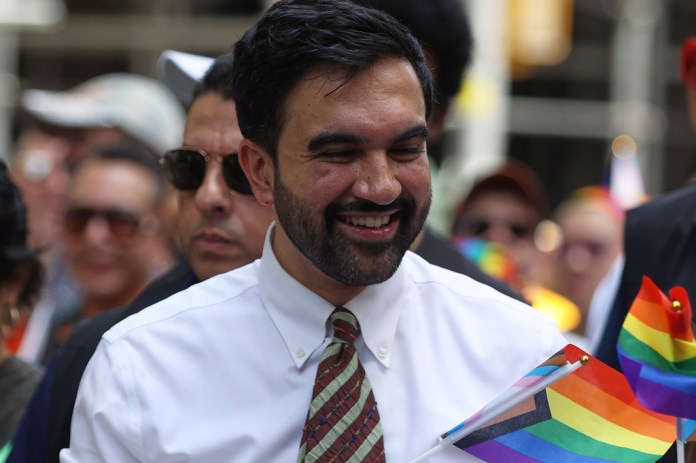
New York City Mayor Zohran Mamdani reached a handshake agreement with City Council Speaker Julie Menin regarding the 126 billion budget on Tuesday, hours before the city’s next fiscal year starts. The socialist mayor cast the deal as a major step toward solving the city’s budget crisis, with the deficit having been expected to reach []
Narrative Intelligence Brief
This article was published by Washington Examiner, a source frequently categorized with a lean right bias based in United States of America. Our narrative intelligence engine continuously monitors coverage from this outlet to track framing, bias, and rhetorical patterns. In this specific piece, our systems detected the potential use of the "Name Calling" technique. This narrative approach is often used to shape reader perception by highlighting specific emotional or rhetorical angles. By understanding the editorial perspective of Washington Examiner, readers can better contextualize the information presented and compare it across our broader media matrix to find the real narrative.
More from Washington Examiner
June 30, 2026
House dismissed for July 4 holiday amid SAVE America Act impasse
June 30, 2026
Clarence Thomas shreds ruling that ‘devalues’ citizenship in Supreme Court dissent
June 30, 2026
Trump says Dallas will host Republican midterm convention in September
June 30, 2026
Supreme Court birthright citizenship ruling imperils national security: Mike Johnson
June 30, 2026
House Rules Committee blocks Massie-Khanna amendment to cut Israel aid
Reliability Insights
P
Technique: Name Calling
System analysis detected use of specific narrative techniques in this piece.Analysis Methodology
This narrative analysis was generated using the CoDataLab Global Intelligence Engine. Our proprietary AI scans thousands of cross-border sources to identify sentiment patterns, framing techniques, and potential media bias. While AI provides the data-driven foundation, our objective is to empower readers with additional context beyond the standard headline.The content displayed above is a structured summary designed for rapid information processing. For the full original report, please visit the source outlet.More Coverage
Discussion
"trump"
Angry Trump lambasts Supreme Court’s birthright citizenship decision, urges Congress to act: ‘too bad for our Country’

US-Iran talks wobble as senior clerics call for assassination of ‘criminal’ Trump
The Iran war was intended to remove obstacle to Trump’s new world order