
Today in News History
On July 12, several notable moments in the history of News stand out. In 1394, Ashikaga Yoshinori, Japanese shōgun (died 1441) was born. In 1441, Ashikaga Yoshinori, Japanese shōgun (born 1394) passed away. In 1909, Motoichi Kumagai, Japanese photographer and illustrator (died 2010) was born. In 1914, Mohammad Moin, Iranian linguist and lexicographer (died 1971) was born. In 1938, Eiko Ishioka, Japanese art director and graphic designer (died 2012) was born. In 1966, D. T. Suzuki, Japanese philosopher and author (born 1870) passed away. In 1979, The island nation of Kiribati becomes independent from the United Kingdom. In 1986, Hannaliis Jaadla, Estonian footballer was born. In 1995, Chinese seismologists successfully predict the 1995 Myanmar-China earthquake, reducing the number of casualties to 11. In 2006, The 2006 Lebanon War begins. Together, these milestones provide historical context for today's news news and ongoing narratives.
Japan Should Look to Türkiye the Way Israel Looks to India
Japan Should Look to Türkiye the Way Israel Looks to India tbragg@hudson.org Fri, 07/10/2026 - 13:12 SVG Commentary Jul 10, 2026 Türkiye Today Japan Should Look to Türkiye the Way Israel Looks to India Ken Moriyasu Senior Fellow Ken Moriyasu Commentary Caption Turkey's President Tayyip Erdogan, Japan's Prime Minister Sanae Takaichi, and Indonesia's Vice President Gibran Rakabuming Raka during the G20 Leaders' Summit in Johannesburg, South Africa, on November 22, 2025. (Getty Images) Toggle Table of Contents Contents Contents Share to Twitter Twitter Share to Facebook Facebook Share to LinkedIn LinkedIn Share to E-mail E-mail Print Print When Indian Prime Minister Narendra Modi departed Ben Gurion Airport in February, Prime Minister Benjamin Netanyahu hugged him for a full 15 seconds on the tarmac–an unusually long embrace in diplomatic choreography. It signaled the importance Israel places on India. The moment symbolized more than personal chemistry. It reflected the culmination of Israel’s yearslong search for a strategic partner that could help safeguard its interests in a less predictable, potentially post-American world. America’s treaty allies in Asia—Japan, South Korea, Australia, the Philippines and Thailand—would be wise to think similarly. For Japan, that partner should be Türkiye. As bookends of Asia, the two nations are complementary middle powers with distinct yet converging strategic interests—and together, they can help reinforce regional stability. Last month, Japanese officials and analysts watched in horror as U.S. Vice President JD Vance lashed out at Israel’s right-wing cabinet ministers for not supporting the U.S.-Iran deal. America is the “only powerful ally” Israel has left in the entire world, he said. The remark was striking not just for its tone, but for what it implied: even America’s closest partners can be reframed so dismissively. If Israel is treated this way, then no ally is immune in a potential Vance presidency. One retired diplomat warned colleagues in Tokyo: “If Taiwan arms sales can be a bargaining chip with China, then one day the U.S.-Japan alliance could be as well.” But Netanyahu offered a pointed reply in a Fox News interview. We have some other friends, he said, pointing specifically to India. It has 1.4 billion people, and boy, do we have tremendous support there. Vance’s words were widely seen as a nod to his base. Young conservatives see U.S. foreign policy as too driven by consideration for Israel and many align with the “restrainers” in Washington, questioning America’s alliance commitments around the world. In his 2020 book Disunited Nations, Peter Zeihan wrote that Americans have changed their mind about alliances and have turned sharply more insular. “America’s list of allies has shrunk from nearly everyone to the potentially useful to the obviously useful to the obviously loyal to those with little choice.” Japan today sits uncomfortably in that final category. For years, Israeli strategists have quietly prepared for the possibility that U.S. backing could become less predictable. They surveyed the major powers, starting from the permanent members of the United Nations Security Council. Which major country could protect Israel like the United States has, in wind and rain? But Israel was never convinced that the United Kingdom, France, China or Russia would wield the veto to protect it. Two possibilities emerged: India and a post-Islamic Iran. With no imminent regime change in sight in Tehran, India became the natural choice. Israel and India are complementary partners. For India, Israel offers advanced military technology and intelligence cooperation without forcing alignment with any major bloc–preserving New Delhi’s preference for multi-alignment. For Israel, India provides a vast market, a nuclear-armed state with growing geopolitical weight, a leading voice of the Global South, and perhaps a future permanent member of the U.N. Security Council. Japan should conduct a similar assessment. One country stands out. Türkiye enters this picture not as a replacement for the United States, but as a secondary strategic pillar that Israel has already begun to build with India. Türkiye sits at the heart of a rapidly evolving Eurasian landscape. A Turkic belt is steadily consolidating across Central Asia toward China’s western frontier. Beyond those borders lies Xinjiang, home to the Uyghurs, another Turkic people. As China seeks to reduce its dependence on maritime chokepoints like the Strait of Malacca, it will be the energy pipelines and railroads running across this region that allow Beijing to avoid the oceans. Türkiye anchors the western end of this emerging system. No other country is as well positioned to connect Europe, the Black Sea region, the Caucasus and Central Asia into a coherent geopolitical space. As China's influence pushes westward, these regions will grow in importance—and they are precisely where Türkiye's political, economic and cultural reach is strongest. For Japan, this matters greatly. Tokyo's vision of a Free and Open Indo-Pacific has been primarily maritime in focus. Yet competition with China increasingly has a continental dimension as well. Focusing exclusively on sea lanes risks overlooking the growing strategic significance of Eurasia's inland corridors. Türkiye's long-term potential remains underestimated in many Western capitals. If superpower status is defined by four attributes—population, economic scale, military capacity, and global ambition—only two states qualify, the United States and China. Russia lacks the economic and demographic base. India has scale but not global ambition. Türkiye is one of the few countries with all four, because beyond being a nation-state, it serves as a leader of the Turkic world, a major actor in the Black Sea region, an influential presence in the Balkans and an important power across the broader Islamic world. It accumulates influence across multiple regions and political spheres simultaneously. It is not yet a superpower—but it is on a trajectory that few others share. Türkiye’s enduring significance has always derived from geography. It is a land bridge—an unavoidable crossing point between Europe, the Middle East, and Central Asia. Empires rose there not by controlling seas, but by controlling movement across land. That logic is returning. For much of the postwar period, maritime dominance diminished the importance of continental geography. Trade flowed by sea, and the risk of chokepoints being closed off—while frequently discussed in think tanks—remained largely theoretical. Until now. Iran has shown the asymmetric advantage a nation positioned on a chokepoint possesses and the realization is only going to spread. Great powers are seeking alternative routes, and in such a world, land-crossing states regain importance. Türkiye is uniquely positioned in that category. What once made it great is what will make it strategically central again. Just as Israel is deepening ties with India as a hedge against future uncertainty, Japan should diversify its strategic relationships. A partnership with Türkiye would connect Japan to the continental dimension of its competition with China and give it a stake in the corridors that will define the next phase of great-power rivalry. Read in Türkiye Today. Enjoyed this analysis? Subscribe to Hudson’s newsletters to stay up to date with our latest content. Email See more subscription options Foreign Policy
Narrative Intelligence Brief
This article was published by Hudson Institute, a source frequently categorized with a right bias based in United States of America. Our narrative intelligence engine continuously monitors coverage from this outlet to track framing, bias, and rhetorical patterns. Our initial algorithmic scan of this specific piece did not flag high-confidence rhetorical techniques, suggesting a generally straightforward reporting style or neutral framing. By understanding the editorial perspective of Hudson Institute, readers can better contextualize the information presented and compare it across our broader media matrix to find the real narrative.
More from Hudson Institute
July 8, 2026
Local Expansion, Transnational Interests? The Evolution of the Islamic State’s Sahel Province
July 8, 2026
The Islamic Republic Is Weaker Than It Wants The World To Believe
July 8, 2026
Ukraine Military Situation Report | July 8
July 8, 2026
US Strikes Iran and President Trump Renews Push for Greenland
July 8, 2026
Oil Tanker Struck in the Strait of Hormuz
Analysis Methodology
This narrative analysis was generated using the CoDataLab Global Intelligence Engine. Our proprietary AI scans thousands of cross-border sources to identify sentiment patterns, framing techniques, and potential media bias. While AI provides the data-driven foundation, our objective is to empower readers with additional context beyond the standard headline.The content displayed above is a structured summary designed for rapid information processing. For the full original report, please visit the source outlet.More Coverage
Discussion
"wimbledon"
Sinner outlasts Zverev to win second straight Wimbledon title

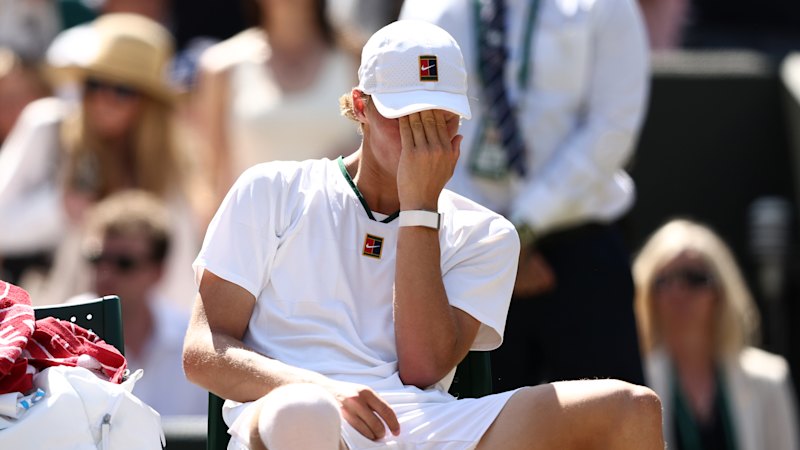
Heartbreak for Cruz Hewitt as teen loses Wimbledon boys’ final thriller
Jannik Sinner receives Gentlemen's Singles Trophy from Catherine after Italian defends Wimbledon title

How other outlets are covering this story
Compare narratives across 6 related reports from 6 sources. Real Narrative News aggregates the coverage spectrum so you can see who emphasises what — bias tags reflect the outlet, not the story.
Coverage bias distribution
6 sources
Left 17%
Center 33%
Right 50%
The Economic Times
· Jun 24, 2026
Indo-Japan ties can be most important: Japanese FM
Indo-Japan ties can be most important: Japanese FM
India Today
· Jul 10, 2026
J&K is part of India: Indian diplomat corrects map at Bangladesh seminar
JK is part of India: Indian diplomat corrects map at Bangladesh seminar
Trend News Agency
· Jul 6, 2026
Сonference on cultural diversity begins in Shusha (PHOTOS)
Сonference on cultural diversity begins in Shusha (PHOTOS)
The Tribune
· Jul 5, 2026
“Consolidation of efforts to enhance our ties with Indo-Pacific partners…”: Former Foreign Secry Shringla on PM Modi’s three-nation tour
I think it's a very important visit because it is a focus on our Indo-Pacific partners. We just had a very significant visit of the Prime Minister of Japan to India, and now this is followed by the PM's visit to Indonesia, Australia and New Zealand. These are very important partners in the Eastern Indo-Pacific, he said.
South China Morning Post
· Jul 7, 2026
To boost manufacturing, India need not choose between Japan and China
Last week, Japanese Prime Minister Sanae Takaichi led a business delegation to New Delhi for the 16th India-Japan annual summit. During last year’s summit in Tokyo, Takaichi’s predecessor, Shigeru Ishiba, and Indian Prime Minister Narendra Modi outlined the Japan-India Joint Vision for the next decade – during which period India may see up to 10 trillion yen (US62 billion) in investment from Japan. Some of Japan’s most notable investments in India have been in the financial sector. Japanese...
TASS
· Jun 28, 2026
Head of International BRICS Forum sees growing interest in Russian culture
According to Purnima Anand, the Indians like Russian culture very much, and people in Russia like the Indian one
Topics:
Related coverage for "Japan Should Look to Türkiye the Way Israel Looks to India": The Economic Times — Indo-Japan ties can be most important: Japanese FM . India Today — J&K is part of India: Indian diplomat corrects map at Bangladesh seminar. Trend News Agency — Сonference on cultural diversity begins in Shusha (PHOTOS). The Tribune — “Consolidation of efforts to enhance our ties with Indo-Pacific partners…”: Former Foreign Secry Shringla on PM Modi’s three-nation tour. South China Morning Post — To boost manufacturing, India need not choose between Japan and China. TASS — Head of International BRICS Forum sees growing interest in Russian culture