Today in News History
On June 28, several notable moments in the history of News stand out. In 1651, The Battle of Berestechko between Poland and Ukraine starts. In 1778, American Revolutionary War: The American Continentals engage the British in the Battle of Monmouth Courthouse resulting in standstill and British withdrawal under cover of darkness. In 1882, The Anglo-French Convention of 1882 marks the territorial boundaries between Guinea and Sierra Leone. In 1911, The Nakhla meteorite, the first one to suggest signs of aqueous processes on Mars, falls to Earth, landing in Egypt. In 1919, The Treaty of Versailles is signed, ending the state of war between Germany and the Allies of World War I. In 1922, The Irish Civil War begins with the shelling of the Four Courts in Dublin by Free State forces. In 1956, Amira Hass, Israeli journalist and author was born. In 1969, Stonewall riots begin in New York City, marking the start of the Gay Rights Movement. In 2004, Iraq War: Sovereign power is handed to the interim government of Iraq by the Coalition Provisional Authority, ending the U.S.-led rule of that nation. In 2009, Honduran president Manuel Zelaya is ousted by a local military coup following a failed request to hold a referendum to rewrite the Honduran Constitution. This was the start of the 2009 Honduran constitutional crisis. Together, these milestones provide historical context for today's news news and ongoing narratives.
Israel agrees to withdrawal from 2 areas in Lebanon in a deal marking “the beginning of the beginning”of negotiations
U.S. Secretary of State Marco Rubio looks on as State Department Counselor Daniel Holler, Israel’s Ambassador to the U.S. Yechiel Leiter and Lebanon’s Ambassador to the U.S. Nada Hamadeh sign a framework agreement between Israel and Lebanon, at the State Department in Washington, D.C., U.S., June 26, 2026. REUTERS/Ken Cedeno Secretary of State Marco Rubio []
Narrative Intelligence Brief
This article was published by Ya Libnan, a source frequently categorized with a center bias based in Lebanon. Our narrative intelligence engine continuously monitors coverage from this outlet to track framing, bias, and rhetorical patterns. Our initial algorithmic scan of this specific piece did not flag high-confidence rhetorical techniques, suggesting a generally straightforward reporting style or neutral framing. By understanding the editorial perspective of Ya Libnan, readers can better contextualize the information presented and compare it across our broader media matrix to find the real narrative.
More from Ya Libnan
June 28, 2026
Frustration grows in Venezuela as quake death toll rises and tens of thousands remain missing
June 28, 2026
Frustration grows in Venezuela as earthquake death toll continues to rise
June 28, 2026
Trump threatens to “complete the job” as U.S. launches fresh Iran strikes
June 28, 2026
The renewed U.S.-Iran violence proves the MOU was the wrong deal
June 27, 2026
Hezbollah protests against Lebanon-Israel deal. Views as existential threat
Analysis Methodology
This narrative analysis was generated using the CoDataLab Global Intelligence Engine. Our proprietary AI scans thousands of cross-border sources to identify sentiment patterns, framing techniques, and potential media bias. While AI provides the data-driven foundation, our objective is to empower readers with additional context beyond the standard headline.The content displayed above is a structured summary designed for rapid information processing. For the full original report, please visit the source outlet.More Coverage
Discussion
"cup"
Spain’s Nico Williams hits out at ‘completely unnecessary’ Uruguay tackle that injured him

LA reporter’s ignorant joke about Bosnia in the World Cup lands her in hot water

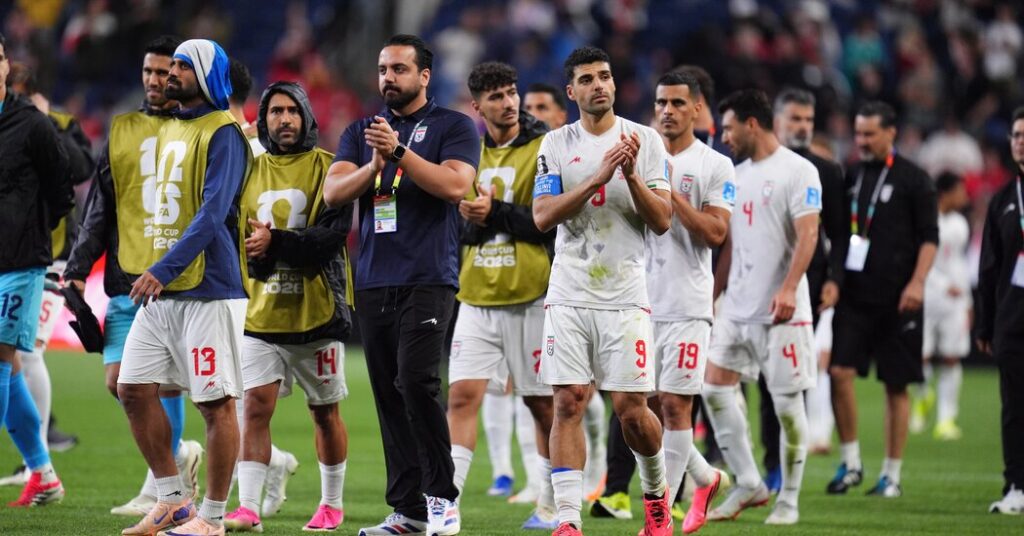
Iran’s World Cup Elimination Ends a Politically Charged Odyssey