Today in News History
On June 28, several notable moments in the history of News stand out. In 202, Yuan Shao, Chinese warlord passed away. In 1911, The Nakhla meteorite, the first one to suggest signs of aqueous processes on Mars, falls to Earth, landing in Egypt. In 1950, Korean War: Suspected communist sympathizers (between 60,000 and 200,000) are executed in the Bodo League massacre. In 1956, In Poznań, workers from HCP factory go to the streets, sparking one of the first major protests against communist government both in Poland and Europe. In 1956, Amira Hass, Israeli journalist and author was born. In 1969, Stonewall riots begin in New York City, marking the start of the Gay Rights Movement. In 1981, A powerful bomb explodes in Tehran, killing 73 officials of the Islamic Republican Party. In 1987, For the first time in military history, a civilian population is targeted for chemical attack when Iraqi warplanes bombed the Iranian town of Sardasht. In 2009, Honduran president Manuel Zelaya is ousted by a local military coup following a failed request to hold a referendum to rewrite the Honduran Constitution. This was the start of the 2009 Honduran constitutional crisis. In 2016, A terrorist attack in Turkey's Istanbul Atatürk Airport kills 42 people and injures more than 230 others. Together, these milestones provide historical context for today's news news and ongoing narratives.
Hezbollah protests against Lebanon-Israel deal. Views as existential threat
Narrative Analysis: Name Calling
Hezbollah supporters take to the streets in the southern suburbs of Beirut to protest against the trilateral agreement that was signed between the US, Israel and Lebanon on 27 June 2026 (Ibrahim Amro/AFP) Hezbollah supporters took to the streets of Beirut to protest the trilateral framework agreement signed by the U.S., Israel, and Lebanon. Demonstrators []
Narrative Intelligence Brief
This article was published by Ya Libnan, a source frequently categorized with a center bias based in Lebanon. Our narrative intelligence engine continuously monitors coverage from this outlet to track framing, bias, and rhetorical patterns. In this specific piece, our systems detected the potential use of the "Name Calling" technique. This narrative approach is often used to shape reader perception by highlighting specific emotional or rhetorical angles. By understanding the editorial perspective of Ya Libnan, readers can better contextualize the information presented and compare it across our broader media matrix to find the real narrative.
More from Ya Libnan
June 28, 2026
Trump threatens to “complete the job” as U.S. launches fresh Iran strikes
June 28, 2026
The renewed U.S.-Iran violence proves the MOU was the wrong deal
June 27, 2026
Venezuela twin quakes death toll is nearly 1,000 and over 50,000 are missing
June 27, 2026
Israel agrees to withdrawal from 2 areas in Lebanon in a deal marking “the beginning of the beginning”of negotiations
June 27, 2026
Another ship struck in Hormuz as Iran, US trade attacks in worst escalation since MOA deal
Reliability Insights
P
Technique: Name Calling
System analysis detected use of specific narrative techniques in this piece.Analysis Methodology
This narrative analysis was generated using the CoDataLab Global Intelligence Engine. Our proprietary AI scans thousands of cross-border sources to identify sentiment patterns, framing techniques, and potential media bias. While AI provides the data-driven foundation, our objective is to empower readers with additional context beyond the standard headline.The content displayed above is a structured summary designed for rapid information processing. For the full original report, please visit the source outlet.More Coverage
Discussion
"cup"
Spain’s Nico Williams hits out at ‘completely unnecessary’ Uruguay tackle that injured him

LA reporter’s ignorant joke about Bosnia in the World Cup lands her in hot water

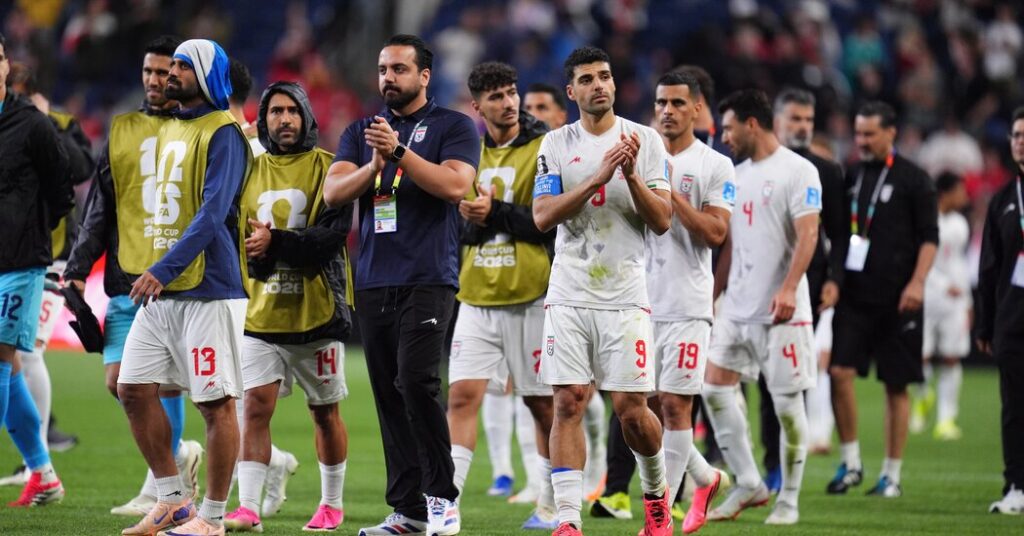
Iran’s World Cup Elimination Ends a Politically Charged Odyssey