Today in News History
On June 18, several notable moments in the history of News stand out. In 1778, American Revolutionary War: The British Army abandons Philadelphia. In 1850, Richard Heuberger, Austrian composer and critic (died 1914) was born. In 1929, Tibor Rubin, Hungarian-American soldier, Medal of Honor recipient (died 2015) was born. In 1942, Roger Ebert, American journalist, critic, and screenwriter (died 2013) was born. In 1943, Elias Degiannis, Greek commander (born 1912) passed away. In 1948, Britain, France and the United States announce that on June 21, the Deutsche Mark will be introduced in western Germany and West Berlin. Over the next six days, Communists increasingly restrict access to Berlin. In 1953, A United States Air Force C-124 crashes and burns near Tachikawa, Japan, killing 129. In 1965, Vietnam War: The United States Air Force uses B-52 bombers to attack guerrilla fighters in South Vietnam. In 1979, SALT II is signed by the United States and the Soviet Union. In 2022, Uffe Ellemann-Jensen, Danish politician, minister of foreign affairs (born 1941) passed away. Together, these milestones provide historical context for today's news news and ongoing narratives.
Hegseth lashes out at NATO allies and announces a review of US forces in Europe
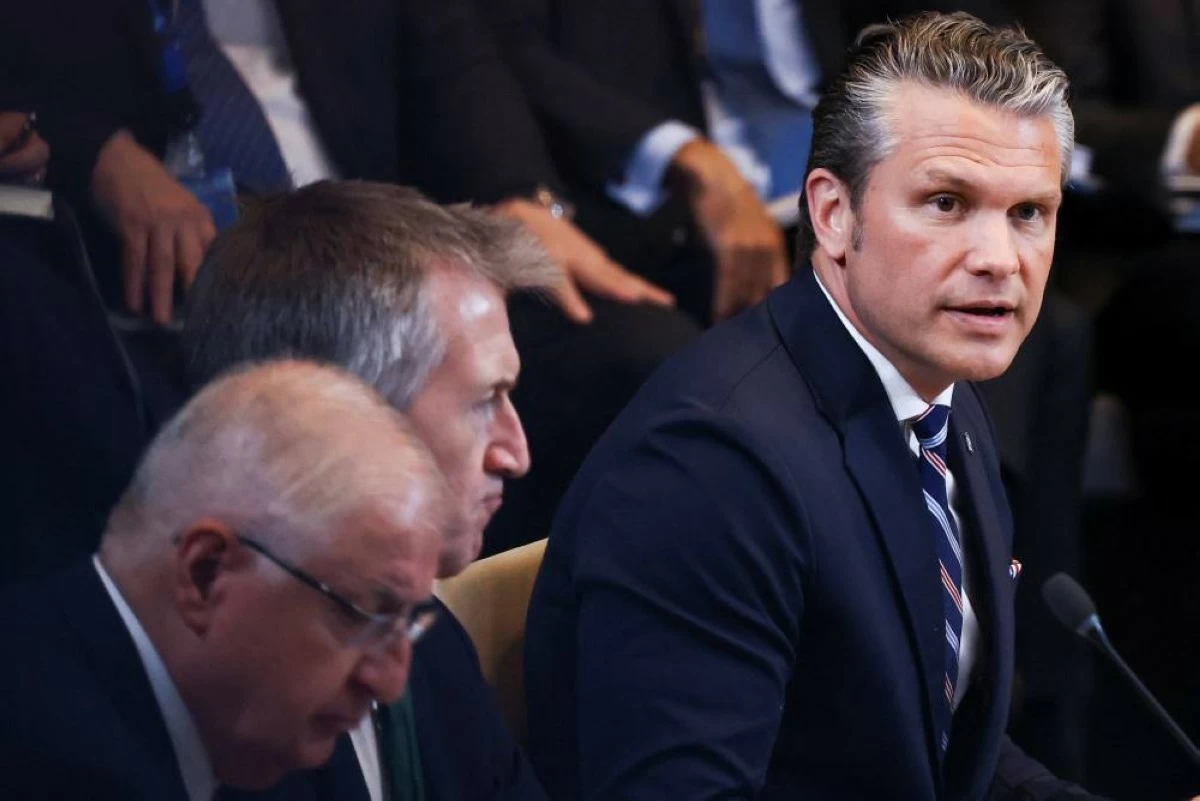
BRUSSELS: U.S. Defense Secretary Pete Hegseth lashed out at NATO allies on Thursday, announcing a six-month Pentagon review of American forces in Europe that will depend on how fast they take responsibility for their own security.This will be a real review. It will be designed to ensure that NATO is moving fast and irreversibly toward Europe leading, stepping up to take primary responsibility for the defense of Europe, he told his NATO counterparts in Brussels.Hegseth lambasted European allies for failing to provide U.S. forces access to bases in Europe to launch attacks on Iran, calling it shameful.These allies, they put America's sons and daughters, our sons and daughters, at risk by denying them the predictable access, basing and overflight that never should have been in question at all, he said.Hegseth also called for a reboot of the 32-nation organization to turn it into a NATO 3.0 capable of deterring any threat.His remarks came a few weeks after the United States told its allies that it would no longer supply certain warships and aircraft if one of them comes under attack. European allies and Canada are trying to work out how to plug the gaps.NATO 3.0 is post-Cold War recognition that (NATO) needs to go back to a real hard-line military alliance that has real military capabilities capable of deterring right here on the continent and taking the lead for the conventional defense of Europe, Hegseth said.As part of that, he told reporters, the United States would be investing 1.5 trillion in its own defense in 2027, sending a message to the world that America is building an arsenal of freedom.Hegseth said that this arsenal first and foremost protects America and American interests but also backstops the strength of NATO and our allies.He said he would tell U.S. allies they have to be willing to stand up and do something in a strong way about the defense of their own continent.NATO's supreme allied commander, an American, is working on backup plans to defend Europe after the U.S. signaled on June 3 that it would no longer supply an aircraft carrier and support ships, aerial refueling planes and dozens of fighter jets, among other military assets, in a crisis.The Trump administration insists that it needs to be able to plan for two simultaneous conflicts and wants more military resources at hand should a conflict break out with China in the Indo-Pacific region.Under NATO's collective security guarantee - Article 5 of its founding treaty - the 32 allies pledge that an attack on one of them will be considered an attack on all. It does not oblige them to provide military support, although many likely would.In essence, the United States is scaling back how it might help should an ally trigger Article 5. The U.S. has by far NATO's biggest armed forces. It does not intend to withdraw its nuclear weapons in Europe, which are key to NATO's deterrence.
Narrative Intelligence Brief
This article was published by Emirates 24/7, a source frequently categorized with a lean right bias based in United Arab Emirates. Our narrative intelligence engine continuously monitors coverage from this outlet to track framing, bias, and rhetorical patterns. Our initial algorithmic scan of this specific piece did not flag high-confidence rhetorical techniques, suggesting a generally straightforward reporting style or neutral framing. By understanding the editorial perspective of Emirates 24/7, readers can better contextualize the information presented and compare it across our broader media matrix to find the real narrative.
More from Emirates 24/7
June 18, 2026
Middle East crisis exposes vulnerabilities in global hydrogen supply chains: IEA
June 18, 2026
First tankers cross strait after Iran deal as Israeli strikes in Lebanon raise doubts
June 18, 2026
FANR chief reviews safety oversight at Barakah Nuclear Power Plant
June 18, 2026
DEWA summer tools: How Dubai residents can reduce electricity and water bills
June 18, 2026
World Cup formations explained: How coaches set up their squads in group play
Analysis Methodology
This narrative analysis was generated using the CoDataLab Global Intelligence Engine. Our proprietary AI scans thousands of cross-border sources to identify sentiment patterns, framing techniques, and potential media bias. While AI provides the data-driven foundation, our objective is to empower readers with additional context beyond the standard headline.The content displayed above is a structured summary designed for rapid information processing. For the full original report, please visit the source outlet.More Coverage
Discussion
"war"
Working remotely could make you more vulnerable to a layoff than AI

OpenAI’s backers spent $7.6 million to destroy a state legislator. Anthropic spent $10 million to rescue him
Fraudster jailed after raking in £300k by sitting students’ exams and completing their coursework