Today in News History
On June 23, several notable moments in the history of News stand out. In 1916, Al G. Wright, American bandleader and conductor (died 2020) was born. In 1930, Donn F. Eisele, American colonel, pilot, and astronaut (died 1987) was born. In 1942, World War II: Germany's latest fighter aircraft, a Focke-Wulf Fw 190, is captured intact when it mistakenly lands at RAF Pembrey in Wales. In 1943, Vint Cerf, American computer scientist and Internet pioneer was born. In 1961, Zoran Janjetov, Serbian singer and illustrator was born. In 1970, Roscoe Turner, American soldier and pilot (born 1895) passed away. In 1977, Jaan Jüris, Estonian ski jumper was born. In 1985, A terrorist bomb explodes at Narita International Airport near Tokyo, killing two and injuring four. An hour later, the same group detonates a second bomb aboard Air India Flight 182, bringing the Boeing 747 down off the coast of Ireland killing all 329 aboard. In 2002, Pedro Alcázar, Panamanian boxer (born 1975) passed away. In 2009, Jerri Nielsen, American physician and explorer (born 1952) passed away. Together, these milestones provide historical context for today's news news and ongoing narratives.
Downed pilot mystified by 'alarming advance' in Iran drone abilities: 'Real alien stuff'
Narrative Analysis: Name Calling
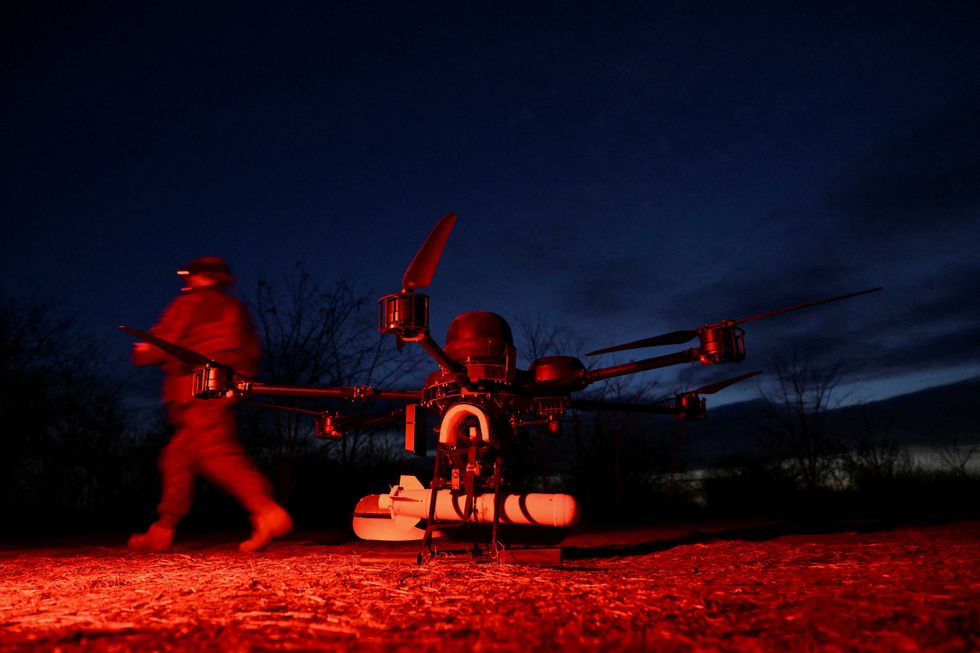
A U.S. fighter jet pilot described a seemingly extraterrestrial sight before he ejected from his aircraft during hostilities in Iran.The downed F-15 pilot told intelligence officials during a debriefing after the April incident that he saw multiple Iranian drones hovering in air in a formation resembling a jellyfish, four sources familiar with the matter told CNN, and one source said the pilot described the formation as a “minefield of drones.It immediately set off a firestorm of debate within the US intelligence community that has yet to be resolved, CNN reported. If the airman really saw what he described — a formation moving in unison — it would be an alarming advance in Iranian drone capabilities.The downing remains under investigation, but initial reports indicated the formation had allowed Iran to shoot down a U.S. fighter jet for the first time during the war, two of the sources said.“Multiple drones interconnected and moving as one with smaller drones below the bigger drones like legs,” one of the sources told CNN. “Real alien s---.”The pilot was rescued hours later, but the weapons systems office on board the two-person craft evaded capture for more than a day in the mountains of Iran before also being rescued.A second aircraft, an A-10, was also downed during the rescue effort but that pilot ejected safely outside Iranian airspace.U.S. intelligence officials disagreed on their interpretation of the pilot's recollection, and some cast doubt on his account, pointing out he was concussed in the crash – his second time being shot out of the sky during the Iran conflict.Had he witnessed a mature capability that U.S. intelligence wasn’t aware of? A beta test? A mirage in the desert? CNN reported.The technical term for what the pilot purportedly described is “one-to-many meshed networking,” according to the sources, and U.S. intelligence agencies had not been aware Iran was capable of using.Multiple reports have indicated that Iran received assistance in developing its drone technology from China and Russia, which are both believed to possess that capabbility.
Narrative Intelligence Brief
This article was published by Raw Story, a source frequently categorized with a left bias based in United States of America. Our narrative intelligence engine continuously monitors coverage from this outlet to track framing, bias, and rhetorical patterns. In this specific piece, our systems detected the potential use of the "Name Calling" technique. This narrative approach is often used to shape reader perception by highlighting specific emotional or rhetorical angles. By understanding the editorial perspective of Raw Story, readers can better contextualize the information presented and compare it across our broader media matrix to find the real narrative.
More from Raw Story
June 23, 2026
MTG spills beans on Trump campaign efforts to sideline MAGA bloc: 'They were embarrassed'
June 23, 2026
Susie Wiles battled Vance over 'unsubstantiated' Trump/Epstein accusations: NYT reporters
June 23, 2026
Iran consolidates control over crucial waterway by sidestepping peace talks: experts
June 23, 2026
Granddaughter of iconic painter claps back at White House for co-opting grandfather's work
June 23, 2026
Trump endorsement no longer a golden ticket in red state: 'Don't think it carries weight'
Reliability Insights
P
Technique: Name Calling
System analysis detected use of specific narrative techniques in this piece.Analysis Methodology
This narrative analysis was generated using the CoDataLab Global Intelligence Engine. Our proprietary AI scans thousands of cross-border sources to identify sentiment patterns, framing techniques, and potential media bias. While AI provides the data-driven foundation, our objective is to empower readers with additional context beyond the standard headline.The content displayed above is a structured summary designed for rapid information processing. For the full original report, please visit the source outlet.More Coverage
Discussion
"prime"
‘The Big Short’ investor issues a dire warning about Nvidia. Here’s why he believes an ‘aggressive fall’ is coming, and how businesses can avoid the same fate

Romania’s Crisis Deepens as Parliament Rejects PM-Designate’s Government

Keir Starmer has gone but Britain’s crisis is about to get even worse