Today in News History
On June 26, several notable moments in the history of News stand out. In 1821, Bartolomé Mitre, Argentinian soldier, journalist, and politician, 6th President of Argentina (died 1906) was born. In 1848, End of the June Days Uprising in Paris. In 1908, Salvador Allende, Chilean physician and politician, 29th President of Chile (died 1973) was born. In 1919, George Athan Billias, American historian (died 2018) was born. In 1924, The American occupation of the Dominican Republic ends after eight years. In 1928, Bill Sheffield, American politician; 5th Governor of Alaska (died 2022) was born. In 1960, Madagascar gains its independence from France. In 1997, The U.S. Supreme Court rules that the Communications Decency Act violates the First Amendment to the United States Constitution. In 2006, Mari Alkatiri, the first Prime Minister of East Timor, resigns after weeks of political unrest. In 2015, Five different terrorist attacks in France, Tunisia, Somalia, Kuwait, and Syria occurred on what was dubbed Bloody Friday by international media. Upwards of 750 people were either killed or injured in these uncoordinated attacks. Together, these milestones provide historical context for today's news news and ongoing narratives.
Advocates Renew Call for End to US Sanctions After Devastating Venezuela Earthquakes
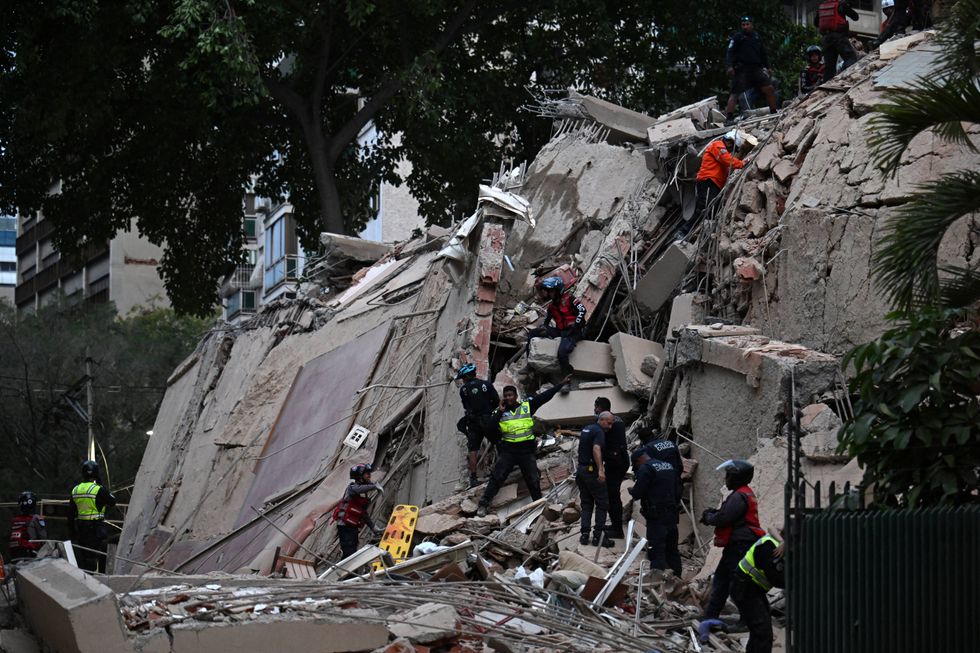
Human rights groups on Thursday implored the United States and allied countries to lift all sanctions against Venezuela—which experts say have already killed tens of thousands of people—as the beleaguered South American country reels from Wednesday's devastating earthquakes.At least 188 people are dead and over 1,500 others injured, with those figures almost certain to rise, following a 7.2-magnitude temblor centered in San Felipe, Yaracuy—about 100 miles west of Caracas—and a 7.5-magnitude quake that struck less than a minute later, also in centered in Yaracuy.US President Donald Trump, who authorized the illegal invasion of Venezuela and adbuction of President Nicolás Maduro earlier this year, wrote on social media after the earthquakes that his administration “stands ready, willing, and able to help.“We will be there for our new and great friends, Trump claimed.Delcy Rodríguez, Maduro's vice president and acting president since his ouster, thanked the Trump administration for offering support and solidarity to the people of Venezuela in the face of this tragedy that has plunged us into mourning.However, US sanctions—first imposed during then-President George W. Bush's second term while Hugo Chávez was leading Venezuela and ramped up under the Obama, Trump, and Biden administrations—remain in place, complicating relief efforts after one of the country's worst-ever natural disasters.While the Trump administration has issued narrow exemptions from sanctions to companies looking to profit from Venezuela's crisis and copious natural resources, primarily oil, these waivers have not delivered broad relief to the people who need it most.Today’s catastrophe makes clear what we have long argued: When a country is deliberately weakened through economic warfare, its ability to prepare for, respond to, and recover from disasters is also weakened, the US-based peace group CodePink said in a statement. The United States has a responsibility to help address the humanitarian consequences of the policies it has imposed. CODEPINK extends our deepest condolences to the people of Venezuela following the devastating earthquakes that have taken hundreds of lives, injured thousands, and left entire communities in urgent need of assistance.Our full statement: buff.ly/QzYcQ3p[image or embed]— CODEPINK (@codepink.bsky.social) June 25, 2026 at 2:22 PMCodePink continued:Too often, we’ve seen the US and other Western countries exploit natural disasters like this in order to deepen foreign control. In Haiti, the US and its allies have repeatedly pushed militarization and politically conditioned aid instead of genuine recovery led by the country itself. In this moment, the world must refuse to allow Venezuela to be forced down the same path.We also call on the administration to immediately lift all US sanctions on Venezuela and release Venezuelan funds under US jurisdiction so they can be used for emergency relief, reconstruction, and recovery.This is the time for cooperation, compassion, and respect for Venezuela’s sovereignty, CodePink added. We urge the international community to support relief efforts and stand with the Venezuelan people as they rebuild their homes, their communities, and their future.The Center for Economic and Policy Research (CEPR), a Washington, DC-based think tank, said Thursday that while the Trump administration has issued a series of general licenses to allow foreign businesses and banks to operate in Venezuela in spite of US sanctions, the continued existence of these sanctions significantly discourages international economic and financial actors from expanding operations there.CEPR co-director Mark Weisbrot said that “we must remember that Venezuela suffered the worst depression in the history of the world, without a war, due to illegal US economic sanctions.This deadly destruction was not a mistake, but an expected result that would happen to any country that was cut off by sanctions from the international financial system, and also from the vast majority of its foreign exchange earnings from exports, he continued.According to a 2019 CEPR report, as many as 40,000 Venezuelans died due to sanctions during the previous two years. The sanctions ostensibly targeted Maduro's government, but made it much more difficult for millions of people to obtain food, medicine, and other necessities. “Tens of thousands, and more likely hundreds of thousands, of Venezuelans died as a result of those sanctions, Weisbrot said Thursday. The United States is therefore obligated to help prevent further loss of life in Venezuela.
Narrative Intelligence Brief
This article was published by Common Dreams, a source frequently categorized with a left bias based in United States of America. Our narrative intelligence engine continuously monitors coverage from this outlet to track framing, bias, and rhetorical patterns. Our initial algorithmic scan of this specific piece did not flag high-confidence rhetorical techniques, suggesting a generally straightforward reporting style or neutral framing. By understanding the editorial perspective of Common Dreams, readers can better contextualize the information presented and compare it across our broader media matrix to find the real narrative.
More from Common Dreams
June 26, 2026
'I Didn’t Say What Susan Collins Did Is Criminal,' Says Platner. 'I Said It SHOULD Be'
June 26, 2026
'Criminalizing Dissent': Alarm Grows Over Extreme Prison Terms for Texas ICE Protesters
June 26, 2026
Corporate Democrats Are Mobilizing to Counter the Rise of Democratic Socialists
June 26, 2026
Scientists: Fossil Fuel-Driven Climate Crisis 'Directly Responsible' for Deadly European Heatwave
June 26, 2026
Corporate Democrats Mobilize to Counter Rise of Democratic Socialists Within the Party
Analysis Methodology
This narrative analysis was generated using the CoDataLab Global Intelligence Engine. Our proprietary AI scans thousands of cross-border sources to identify sentiment patterns, framing techniques, and potential media bias. While AI provides the data-driven foundation, our objective is to empower readers with additional context beyond the standard headline.The content displayed above is a structured summary designed for rapid information processing. For the full original report, please visit the source outlet.More Coverage
Discussion
"cup"
Israeli occupation forces detain man in southern Syria’s Quneitra

Netherlands vs. Morocco: 'They have weaknesses we must exploit' — Virgil van Dijk sets the tone for Morocco last-32 clash
/https%3A%2F%2Fsportsmole-media-prod.s3.gra.io.cloud.ovh.net%2Fuploads%2F2026%2F06%2Fvirgil-van-dijk-30-6a2f376f06ed0207534595.jpg)
World Cup coaches are worried about yellow cards this week. Here’s what to know