
A world-class STEM university is coming to small town Arkansas
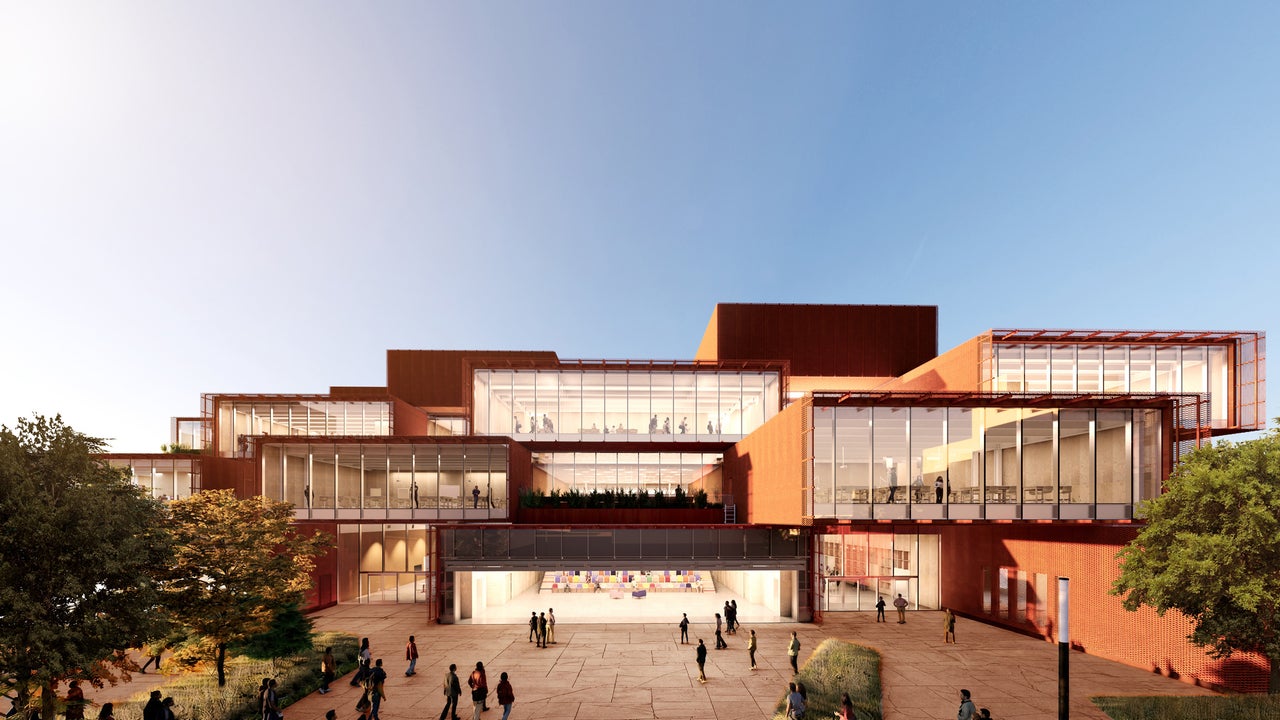
A major STEM-focused university in the unlikely location of Bentonville, Arkansas, is starting to take shape. Announced in 2025, the university is the brainchild of brothers Tom and Steuart Walton, grandsons of Walmart founder Sam Walton and heirs to the massive wealth the company has created. A new design by one of the world’s most famous architects could help the project take shape, and accelerate the large-scale transformation happening across Bentonville. Initial renderings have just been released for the STEM university and a related master plan by the Bjarke Ingels Group (BIG), and they show a three-building campus spanning two city blocks and clad in rusty reds and copper. [Rendering: Bjarke Ingels Group] Featuring an academic building, a student residence, and a makerspace looking out on a public plaza, the buildings cover more than 420,000 square feet but keep a relatively low profile of about five stories in a part of town just outside the main core of downtown development. BIG founder Bjarke Ingels says the campus keeps open edges and attempts to blend into its neighborhood surroundings. [Rendering: Bjarke Ingels Group] “Architecturally and urbanistically the goals have been to tear down the barrier between the campus and the community, and to reconsider the STEM campus as an integrated neighborhood in Bentonville where you have academic buildings but you also have shops and cafes, workforce housing for residents and housing for students,” Ingels says. Slated to open in 2029, the project would be another major development in Bentonville, which has undergone a rapid and extraordinary transformation at the hands of the Walton family, starting with Alice Walton’s creation of the Crystal Bridges Museum of American Art, which opened in 2011 and recently expanded. [Rendering: Bjarke Ingels Group] Bentonville 2.0 On a recent visit to Bentonville, I sat down with Tom to talk about how such a university would fit into this small town, and how it could help improve education in the region. He sees the university as a tool for accelerating the adoption of new technology in the age of artificial intelligence, but also for changing perceptions among people who remember the region before Crystal Bridges kicked off the rapid evolution now underway. “Growing up here, we always had a chip on our shoulder about how people thought about Arkansas,” says Walton. He and his brother, along with support from others in the Walton family and the Alice L. Walton Foundation, are hoping to bring a more flexible approach to higher education into a town that has found itself transitioning from company town to regional growth engine. The project would be a dramatic difference from the corporate landscape that had been there for decades. Walmart’s former Home Office is sprawling, parking-wrapped, largely windowless, and arguably soulless. The blocks adjacent to it that are now actively being demolished were mostly warehouses and utility spaces. All largely empty since Walmart opened its new 350-acre Home Office campus a mile to the east, the old buildings already being torn down and those to follow will hardly be missed. The head of the area’s chamber of commerce recently joked on a podcast about handing out jars of Home Office demolition debris to longtime Walmart employees as a celebration of the building’s demise. [Rendering: Bjarke Ingels Group] Just past the edge of the city’s center of gravity, the site has slowly seen the town grow up around it. Modern infill housing is under construction on nearly every block in this part of Bentonville, and the former Home Office site is within a few blocks of the award-winning architecture of the Thaden School and the cultural hub the Momentary. Walton sees this part of the town building up a critical mass of activity and amenities, which the university would only cement. “Unlike a traditional university campus that’s siloed and out there on its own, we felt like there’s an opportunity to bring industry in, bring the community in, and create a mixed-use development around a university setting so that you have different types of like collisions and impacts occurring,” Walton says. “The master plan’s much more urban in terms of how it will feel, and it’ll be seamlessly integrated into the downtown fabric.” It would be far from the only large architecturally significant project in this small town. Within about a mile radius it would join Moshe Safdie’s Crystal Bridges of American Art, the bikeable Ledger building, Marlon Blackwell Architects’ Heartland Whole Health Institute, Polk Stanley Wilcox’s Alice L. Walton School of Medicine, and forthcoming developments designed by Herzog de Meuron and CannonDesign. [Rendering: Bjarke Ingels Group] Ozark rustic BIG’s design takes cues from the material and landscape of the region to create what he calls “Ozark rustic”—a stone-and-brick palette for a “quotidian” architecture familiar to the region. The buildings have undoubtedly modern forms, and make no mistake about being thematically connected to each other. One is a maker-centric building filled with labs and workshops, and BIG has translated that startup spirit into a stack of oxidized steel boxes with tilt-up sunshades recalling garage doors. Large walls of windows border the public plaza on the campus, turning the workshops into visually accessible spaces and the building itself into a kind of vitrine. [Rendering: Bjarke Ingels Group] Next door, the academic building will be programmed with classrooms, offices, and large informal student study and community spaces woven through each floor. The building itself has a vaguely accordion form, with large perforations on its sides for the common areas of the building to look out on its surroundings. Clad in standing seam copper, a material more commonly found on roofs, it’s a throwback to an older era of manufacturing and 20th century technology. [Rendering: Bjarke Ingels Group] The third building is a student residence that Ingels says is like “a European courtyard building that has been tied into a knot.” Made of precast concrete in a brick-like red, it pinches in at its center to create an arrival plaza, and uses its unique form to hold raised courtyards and roof terraces. Walton says the design builds on the university’s mission of broadening access to technology education, and making it possible for people to tap into new knowledge as it emerges. “Because of technology, you’re going to have to upskill and re-skill multiple times in your life, every decade potentially,” Walton says. “I think work’s going to be there, but I think we’re going to have to retool how we as a society engage around education. So hopefully this can be a model for how to do that.”
Narrative Intelligence Brief
This article was published by Fast Company, a source frequently categorized with a lean left bias based in United States of America. Our narrative intelligence engine continuously monitors coverage from this outlet to track framing, bias, and rhetorical patterns. Our initial algorithmic scan of this specific piece did not flag high-confidence rhetorical techniques, suggesting a generally straightforward reporting style or neutral framing. By understanding the editorial perspective of Fast Company, readers can better contextualize the information presented and compare it across our broader media matrix to find the real narrative.
Explore related topics: Stay informed with Real Narrative News as we track unfolding stories. Dive deeper into our coverage of pivotal topics including kharg island, iran hard, hit iran, coupe monde, fifa cup, nba finals, hard tonight, white house, south africa, and trump threatens. Our intelligence streams continuously monitor these keywords to bring you unbiased analysis and real-time updates on topics like "A world-class STEM university is coming to small town Arkansas".
More from Fast Company
June 11, 2026
Long-term mortgage rate hits 6.52%, just below its high this year
June 11, 2026
The return-to-office mandate can actually work in your favor. Here’s why
June 11, 2026
Why AI labs are betting big on AI coding
June 11, 2026
The 2026 World Cup is here, and so are the germs. This virus is experts’ No. 1 concern
June 11, 2026
A world-class STEM university is coming to small town Arkansas
Analysis Methodology
This narrative analysis was generated using the CoDataLab Global Intelligence Engine. Our proprietary AI scans thousands of cross-border sources to identify sentiment patterns, framing techniques, and potential media bias. While AI provides the data-driven foundation, our objective is to empower readers with additional context beyond the standard headline.The content displayed above is a structured summary designed for rapid information processing. For the full original report, please visit the source outlet.More Coverage
Discussion