Today in News History
On June 23, several notable moments in the history of News stand out. In 1812, War of 1812: Great Britain revokes the restrictions on American commerce, thus eliminating one of the chief reasons for going to war. In 1887, The Rocky Mountains Park Act becomes law in Canada creating the nation's first national park, Banff National Park. In 1910, Gordon B. Hinckley, American religious leader, 15th President of The Church of Jesus Christ of Latter-day Saints (died 2008) was born. In 1947, The United States Senate follows the United States House of Representatives in overriding U.S. President Harry S. Truman's veto of the Taft-Hartley Act. In 1948, Clarence Thomas, American lawyer and jurist, Associate Justice of the Supreme Court of the United States was born. In 1961, Richard Arnold, English lawyer and judge was born. In 1969, Warren E. Burger is sworn in as Chief Justice of the United States Supreme Court by retiring Chief Justice Earl Warren. In 1972, Watergate scandal: U.S. President Richard M. Nixon and White House Chief of Staff H. R. Haldeman are taped talking about illegally using the Central Intelligence Agency to obstruct the Federal Bureau of Investigation's investigation into the Watergate break-ins. In 2014, The last of Syria's declared chemical weapons are shipped out for destruction. In 2017, A series of terrorist attacks take place in Pakistan, resulting in 96 deaths and wounding 200 others. Together, these milestones provide historical context for today's news news and ongoing narratives.
Why Trump has been attacking the Supreme Court with three key rulings ahead
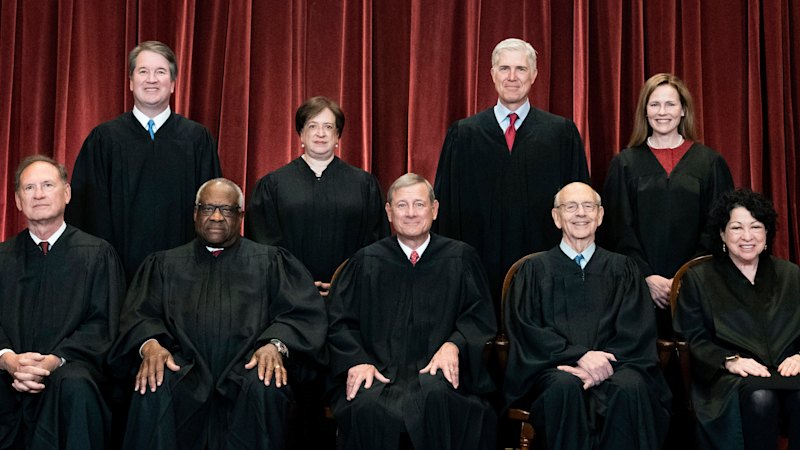
As the court prepares to rule on several of the president’s priorities, tensions are running high – even with the president’s own appointees.
Narrative Intelligence Brief
This article was published by Brisbane Times, a source frequently categorized with a center bias based in Australia. Our narrative intelligence engine continuously monitors coverage from this outlet to track framing, bias, and rhetorical patterns. Our initial algorithmic scan of this specific piece did not flag high-confidence rhetorical techniques, suggesting a generally straightforward reporting style or neutral framing. By understanding the editorial perspective of Brisbane Times, readers can better contextualize the information presented and compare it across our broader media matrix to find the real narrative.
More from Brisbane Times
June 23, 2026
‘We gave him a nudge’: How Socceroo put prime minister on the spot over funding
June 23, 2026
Greens claw back Butler’s NDIS powers as price for passing negative gearing, CGT overhaul
June 23, 2026
AFL’s most in-demand player says the league is ‘not quite ready’ for NRL-style player movement
June 23, 2026
Boccabona
June 23, 2026
Tips and previews for racing at Warwick Farm on Wednesday
Analysis Methodology
This narrative analysis was generated using the CoDataLab Global Intelligence Engine. Our proprietary AI scans thousands of cross-border sources to identify sentiment patterns, framing techniques, and potential media bias. While AI provides the data-driven foundation, our objective is to empower readers with additional context beyond the standard headline.The content displayed above is a structured summary designed for rapid information processing. For the full original report, please visit the source outlet.More Coverage
Discussion
"prime"
Trump Administration Scrambles After Vance’s Embarrassing Snub Video

Kemi Badenoch breaks silence after Starmer’s resignation, reveals what she says is Labour’s real problem

Trump’s foolish rebuke of Italy’s Meloni