
Today in News History
On July 12, several notable moments in the history of News stand out. In 1807, Thomas Hawksley, English engineer and academic (died 1893) was born. In 1927, Harley Hotchkiss, Canadian businessman (died 2011) was born. In 1928, Alastair Burnet, English journalist (died 2012) was born. In 1933, Victor Poor, American engineer, developed the Datapoint 2200 (died 2012) was born. In 1959, David Brown, Australian meteorologist was born. In 1961, Indian city Pune floods due to failure of the Khadakwasla and Panshet dams, killing at least two thousand people. In 1973, A fire destroys the entire sixth floor of the National Personnel Records Center of the United States. In 1995, Chinese seismologists successfully predict the 1995 Myanmar-China earthquake, reducing the number of casualties to 11. In 1998, Arkady Ostashev, Soviet/Russian scientist and engineer (born 1925) passed away. In 2015, Cheng Siwei, Chinese engineer, economist, and politician (born 1935) passed away. Together, these milestones provide historical context for today's news news and ongoing narratives.
Why is crucial tech vulnerable to the heat?
Narrative Analysis: Appeal to Fear
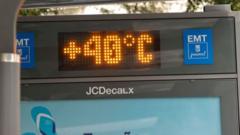
Energy grids and train services are among the vital services that are vulnerable to very hot weather.
Narrative Intelligence Brief
This article was published by BBC News - Business, a source frequently categorized with a center bias based in United Kingdom. Our narrative intelligence engine continuously monitors coverage from this outlet to track framing, bias, and rhetorical patterns. In this specific piece, our systems detected the potential use of the "Appeal to Fear" technique. This narrative approach is often used to shape reader perception by highlighting specific emotional or rhetorical angles. By understanding the editorial perspective of BBC News - Business, readers can better contextualize the information presented and compare it across our broader media matrix to find the real narrative.
More from BBC News - Business
July 12, 2026
How Aldi is taking on US supermarkets with its $4 almond butter
July 11, 2026
Will Trump Accounts deliver for American children?
July 10, 2026
Chip giant SK Hynix raises $26.5bn as shares surge in bumper US listing
July 10, 2026
Major car firms found not to have installed emissions-cheating devices
July 10, 2026
EU threatens Meta with fines over 'addictive' Facebook and Instagram
Reliability Insights
P
Technique: Appeal to Fear
System analysis detected use of specific narrative techniques in this piece.Analysis Methodology
This narrative analysis was generated using the CoDataLab Global Intelligence Engine. Our proprietary AI scans thousands of cross-border sources to identify sentiment patterns, framing techniques, and potential media bias. While AI provides the data-driven foundation, our objective is to empower readers with additional context beyond the standard headline.The content displayed above is a structured summary designed for rapid information processing. For the full original report, please visit the source outlet.More Coverage
Discussion
"iran"
Trump Threatens to ‘Completely Decimate’ Iran as Mojtaba Khamenei Vows Revenge | Iran-US Crisis |

Acting Iranian Defense Minister: ‘enemy's weak points closely monitored’

"No Conspiracy": Former Israeli Consul Dismisses Conspiracy Theories about Lindsey Graham's Death
How other outlets are covering this story
Compare narratives across 6 related reports from 6 sources. Real Narrative News aggregates the coverage spectrum so you can see who emphasises what — bias tags reflect the outlet, not the story.
Coverage bias distribution
6 sources
Left 17%
Center 17%
Right 67%
Toronto Sun
· Jun 26, 2026
Colin and Justin: Should you buy a run-down mansion?
Grand dreams, crumbling plaster and eye-watering heating bills: the truth about taking on a fixer-upper
Seeking Alpha
· Jul 2, 2026
DRIP: A Leveraged Tool For An Energy Correction
DRIP: A Leveraged Tool For An Energy Correction
ArcaMax
· Jul 8, 2026
Gadgets: Smart thermostat
Upgrading from a basic thermostat to a smart thermostat offers many advantages, with the most significant being long-term energy savings. By optimizing your heating and cooling system, a smart thermostat can often pay for itself through lower ...
Financial Times
· Jun 24, 2026
To cool or not to cool: French politicians draw battle lines over aircon
As heatwave intensifies, far-right champions air conditioning while the left calls for renovations and green spaces
The Motley Fool
· Jun 23, 2026
The S&P 500 Is Dominated by AI. If the Bubble Pops, History Says These 2 ETFs Could Be the Smartest Buys.
If your portfolio feels too tech-heavy, buying energy stocks and bonds could help protect your cash from a downturn.
Western Standard
· Jun 21, 2026
NEMETH: Shivering in the dark — a ‘virtual power plant’ could decide how much power your home gets this winter
Imagine a bitterly cold, still winter night during a prolonged Dunkelflaute (the German term for “dark doldrums”) when wind turbines stand idle for days, solar output drops near zero, and temperatures plummet. You expect your heat pump and home battery, installed with promises of resilience, to keep your family comfortable and energy secure. Instead, as the calm and cold drags on, your thermostat will not budge, smart devices are curtailed, and your battery drains, not to keep your family safe, but to “help the grid.” A notification flashes on your phone: “Grid Emergency; External Control Activated!” Your household, like thousands aggregated in a Virtual Power Plant (VPP), is conscripted to “stabilize” a system strained by the very energy transition that created the vulnerability. The autonomy you thought you had secured with clean energy investments is suddenly subject to distant commands, precisely when you need it most. This is the engineered reality of Virtual Power Plants.
Topics:
Related coverage for "Why is crucial tech vulnerable to the heat?": Toronto Sun — Colin and Justin: Should you buy a run-down mansion?. Seeking Alpha — DRIP: A Leveraged Tool For An Energy Correction. ArcaMax — Gadgets: Smart thermostat. Financial Times — To cool or not to cool: French politicians draw battle lines over aircon . The Motley Fool — The S&P 500 Is Dominated by AI. If the Bubble Pops, History Says These 2 ETFs Could Be the Smartest Buys.. Western Standard — NEMETH: Shivering in the dark — a ‘virtual power plant’ could decide how much power your home gets this winter