Today in News History
On June 22, several notable moments in the history of News stand out. In 1890, Aleksander Warma, Estonian commander and politician, 4th Prime Minister of Estonia in exile (died 1970) was born. In 1915, Cornelius Warmerdam, American pole vaulter and coach (died 2001) was born. In 1924, Larkin Kerwin, Canadian physicist and academic (died 2004) was born. In 1930, Yuri Artyukhin, Russian colonel, engineer, and astronaut (died 1998) was born. In 1936, Moritz Schlick, German-Austrian physicist and philosopher (born 1882) passed away. In 1941, World War II: Nazi Germany invades the Soviet Union in Operation Barbarossa. In 1943, J. Michael Kosterlitz, British-American physicist was born. In 1965, The Treaty on Basic Relations between Japan and the Republic of Korea is signed. In 2002, An earthquake measuring 6.5 Mw strikes a region of northwestern Iran killing at least 261 people and injuring 1,300 others and eventually causing widespread public anger due to the slow official response. In 2007, The small town of Elie, Manitoba is hit by Canada’s most intense tornado on record. Together, these milestones provide historical context for today's news news and ongoing narratives.
What to know if you’re too hot to work – and why there’s no maximum temperature

Students and employees are still expected to attend schools and workplaces despite blistering temperatures – but here's what you can do
Narrative Intelligence Brief
This article was published by The i Paper, a source frequently categorized with a lean left bias based in United Kingdom. Our narrative intelligence engine continuously monitors coverage from this outlet to track framing, bias, and rhetorical patterns. Our initial algorithmic scan of this specific piece did not flag high-confidence rhetorical techniques, suggesting a generally straightforward reporting style or neutral framing. By understanding the editorial perspective of The i Paper, readers can better contextualize the information presented and compare it across our broader media matrix to find the real narrative.
More from The i Paper
June 22, 2026
The fight for a seat in Burnham’s Cabinet has already begun
June 22, 2026
Burnham has three weeks to do the maths before reality strikes
June 22, 2026
The new ‘odd couple’ who could fix Britain
June 22, 2026
School closures and no outdoor drinking: How 40°C heatwaves could change Britain
June 22, 2026
The pitfalls Burnham faces when tackling Trump
Analysis Methodology
This narrative analysis was generated using the CoDataLab Global Intelligence Engine. Our proprietary AI scans thousands of cross-border sources to identify sentiment patterns, framing techniques, and potential media bias. While AI provides the data-driven foundation, our objective is to empower readers with additional context beyond the standard headline.The content displayed above is a structured summary designed for rapid information processing. For the full original report, please visit the source outlet.More Coverage
Discussion
"keir starmer"
Breaking! Keir Starmer Steps Down, Trump’s Cuba Threats, Oil Barrel Crisis | PBD #821

Kemi Badenoch breaks silence after Starmer’s resignation, reveals what she says is Labour’s real problem

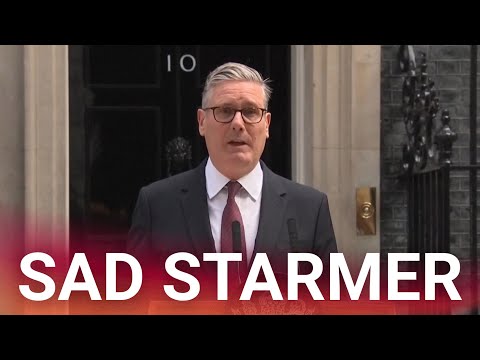
‘Too hard for Starmer’: PM holds back tears as he resigns from office