
0
What San Francisco’s AI billboards say about the state of the industry
April 17, 2026
Posted 2 hours ago by
Here in San Francisco, we live in a bubble, and we know it. While much of the rest of the country sees the city through the lens of Fox News cameramen searching out homeless encampments, we actually live in a very beautiful, very wealthy, and, currently, very AI-obsessed place. Traditionally, the billboards along 101 through Silicon Valley have offered a glimpse into the collective mind of the tech industry.
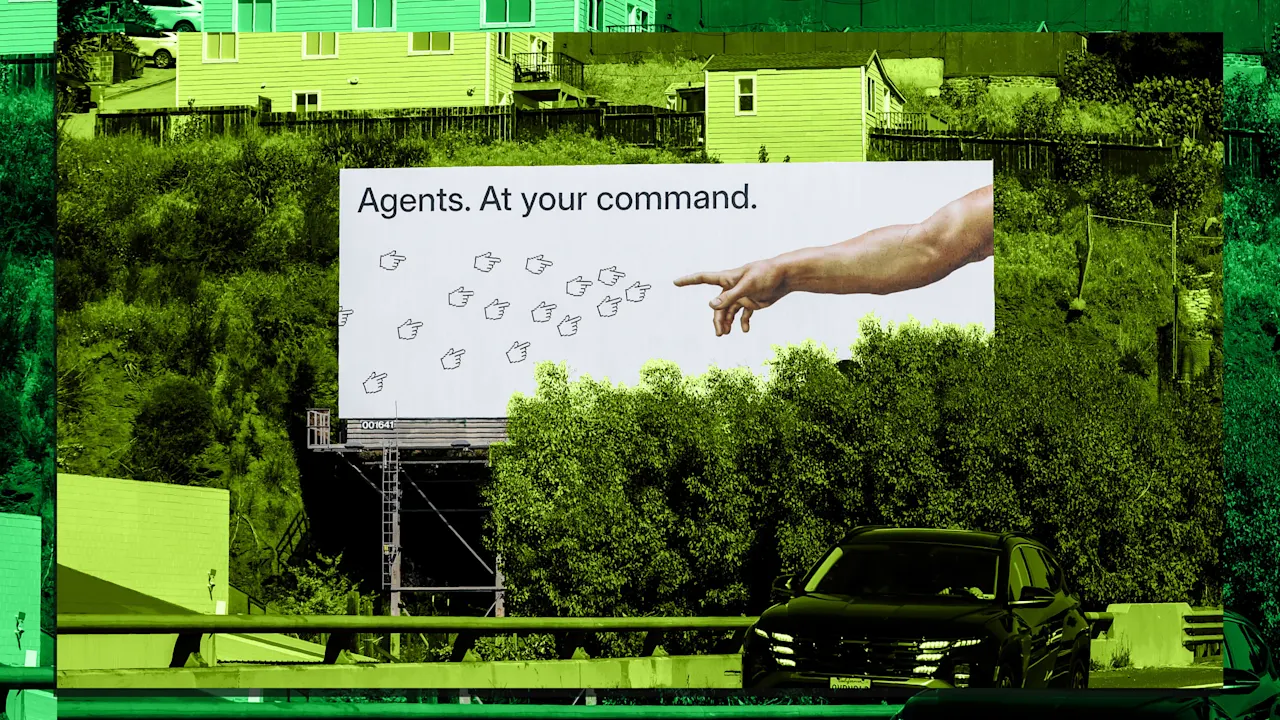
These days, a big chunk of that industry, including most of the major AI labs, is based here in San Francisco, and the billboards have followed. The San Francisco Chronicle recently did the legwork to catalog literally all of the billboards in the city and found that fully half now advertise AI apps, platforms, and infrastructure. The words and imagery they use reveal something about how the AI industry sees itself and the world around it. A billboard advertising an artificial intelligence company is posted on September 16, 2025 in San Francisco, California. As AI companies open offices in San Francisco, billboards advertising AI companies are appearing throughout the city and along Interstate 80. [Photo: Justin Sullivan/Getty Images] You are here The advertisements do collectively smack of young companies in a young industry. But they also depict an AI industry that is well past its experimental stage. The billboards around town, for the most part, advertise real apps that do non-trivial things, and products that solve real, sometimes niche problems that hinder the meaningful deployment of AI in business settings. No space for safety Even though AI safety, alignment with human values and goals, and governance remain hotly debated issues, almost none of the outdoor advertising mentions those subjects. The go-to-market teams at AI companies may believe billboards are no place for nuanced policy debates. The ads seem aimed at chief information officers or VP-level decision-makers trying to gain a competitive edge by using AI for more business tasks. That audience is likely more interested in agentic features, reliability, and scalability. Only one billboard, from Okta, mentioned downside risk. Its billboard reads: “Build and secure AI agents from day one. Okta secures AI.” What Okta is actually selling is identity and access management for AI agents—that is, the authentication and permissions systems that keep agents from seeing things they shouldn’t. On the other hand, trust will be a huge issue as AI models and agents proliferate within businesses. Leaders and workers will have to build trust in these systems over time, and that trust depends on AI consistently getting things right while being entrusted with increasingly valuable work. If an AI system leaks sensitive information, for example, trust could vanish, and the tool itself would quickly lose value. ‘Stop hiring humans’ Another elephant in the room is job replacement, yet none of the billboards acknowledge it. In one case, they lean into it. Artisan AI, which sells AI “workers,” has plastered controversial billboards around the city suggesting human replacement is actually a pretty cool future. In one double-decker ad featured in the Chronicle piece, a woman declares, “Stop hiring humans.” Below, a man who looks like a home shopping host gestures toward her, saying, “It’s not the ’90s anymore, hire Ava.” Ava is apparently the avatar for Artisan’s digital workers. [Screenshot: SF Chronicle] Critics have called the campaign dystopian and anti-worker, and some billboards have been vandalized. Artisan’s 20-something CEO, Jasper Carmichael-Jack, said the campaign was meant as “shock marketing.” But, hey, the Artisan team is clearly a cheeky bunch, and even the company name is laced with irony: The word “artisan” usually refers to something made by skilled human hands. (In San Francisco, “artisanal” avocado toast costs 9) Swagger Some billboards reflect the boundless confidence of the accelerationist “builder” crowd. Linear’s billboard shows the hand of God, styled after Michelangelo’s The Creation of Adam, reaching down to touch a swarm of hand-shaped cursors that apparently represent AI agents. The tagline reads: “Agents. At your command.” Linear makes project management software for engineering teams. Its AI agents handle tasks once done by humans, such as assignment, issue tracking, and sprint planning. The implication is hard to miss: If AI agents can do many of the things humans once did, the humans directing get to play god. Bland, whose platform creates human-sounding AI agents that can make and receive phone calls, takes a similar approach. Its billboard has a romance novel cover vibe, featuring a masculine (customer support?) robot embracing a human woman. The caption reads: “Customer support that actually cares.” Rather than addressing the obvious socio-economic and customer-experience issues, Bland seems to, well, embrace them. In essence, the message is that AI agents are capable of empathy beyond what human support reps can manage. Tip: AI models aren’t there yet. That claim is aspirational at best. In essence, the message is that AI agents are capable of empathy beyond what human support reps can manage. Tip: AI models aren’t there yet. View this post on Instagram We’re not talking to you If you thought the city’s AI billboards were meant for general audiences, AgentMail’s ad suggests otherwise. It features a screenshot of a tweet from Y Combinator founder and mega-investor Paul Graham, describing a startup whose market cap will “sound like fiction.” The company name is not even mentioned in the tweet. The billboard’s caption reads, “We have some high expectations” followed by “No pressure, right?” AgentMail has already raised about 6 million in seed funding from General Catalyst, with participation from Y Combinator and angel investors including Graham. The ad may be targeting new customers for its platform, which creates email accounts for AI agents. Or it could be trying to drum up interest among potential A-round investors. Either way the billboard takes an “if you know, you know” approach that’ll only make sense to a few thousand people if they happen to drive by. Hello, Des Moines It’s worth imagining how these ads would land outside the San Francisco bubble. In Des Moines, Iowa, the Artisan billboard’s instruction to“Stop hiring humans” might feel less cheeky and more threatening. Some residents might take Bland’s robot-lover ad the same way. [Photo: Brontë Wittpenn/San Francisco Chronicle via Getty Images] Other ads would just seem alien. Motorists would wonder what on Earth Baseten is selling with its “own your own inference” message. (Baseten’s platform lets companies control the AI models they use to generate output in production.) And AgentMail’s “Graham tweet” ad would probably be incomprehensible.
Fast Company
Coverage and analysis from United States of America. All insights are generated by our AI narrative analysis engine.