
Today in News History
On July 12, several notable moments in the history of News stand out. In 965, Meng Chang, emperor of Later Shu (born 919) passed away. In 981, Xue Juzheng, Chinese scholar-official and historian passed away. In 1335, Pope Benedict XII issues the papal bull Fulgens sicut stella matutina to reform the Cistercian Order. In 1913, The Second Revolution breaks out against the Beiyang government, as Li Liejun proclaims Jiangxi independent from the Republic of China. In 1914, Mohammad Moin, Iranian linguist and lexicographer (died 1971) was born. In 1933, Victor Poor, American engineer, developed the Datapoint 2200 (died 2012) was born. In 1970, Lee Byung-hun, South Korean actor, singer, and dancer was born. In 1995, Chinese seismologists successfully predict the 1995 Myanmar-China earthquake, reducing the number of casualties to 11. In 2015, Cheng Siwei, Chinese engineer, economist, and politician (born 1935) passed away. In 2015, Tenzin Delek Rinpoche, Tibetan monk and activist (born 1950) passed away. Together, these milestones provide historical context for today's news news and ongoing narratives.
WeChat begins testing Xiaowei as Tencent eyes a Q3 AI rollout
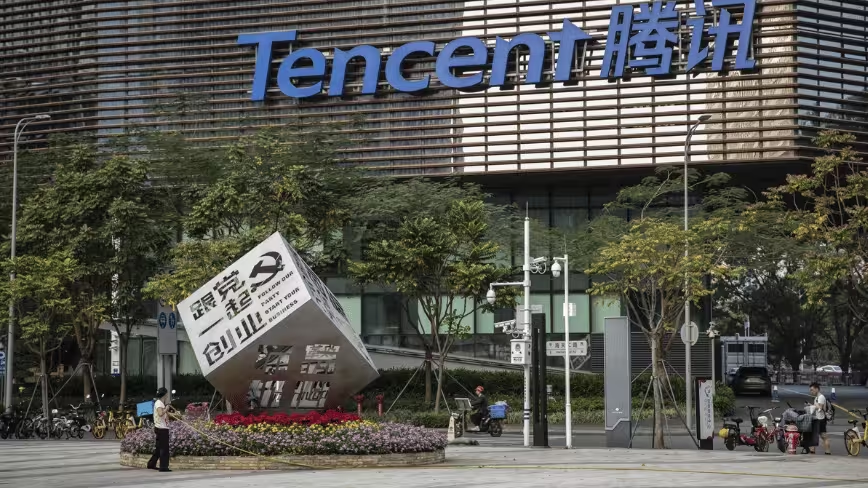
WeChat is the rare app that already does almost everything. Chinese users message, pay, book, shop, and summon a taxi without ever leaving it, which is exactly what makes Tencent’s next move interesting: rather than build a separate chatbot and fight for downloads, it is putting an AI assistant on top of the app a [] This story continues at The Next Web
Narrative Intelligence Brief
This article was published by The Next Web, a source frequently categorized with a lean left bias based in Netherlands. Our narrative intelligence engine continuously monitors coverage from this outlet to track framing, bias, and rhetorical patterns. Our initial algorithmic scan of this specific piece did not flag high-confidence rhetorical techniques, suggesting a generally straightforward reporting style or neutral framing. By understanding the editorial perspective of The Next Web, readers can better contextualize the information presented and compare it across our broader media matrix to find the real narrative.
More from The Next Web
July 11, 2026
The EU says autoplay and infinite scroll are illegal. Meta has until it responds to disagree.
July 11, 2026
OpenAI has folded safety into research again. Its head of safety is leaving.
July 11, 2026
Meta killed its Muse Image AI feature three days after launch. Hollywood had had enough.
July 11, 2026
The US agency that defends federal networks did not have its own incident response playbook when it got hacked
July 11, 2026
Apple sues OpenAI for stealing hardware designs, alleging employees brought prototypes to “show and tell” interviews
Analysis Methodology
This narrative analysis was generated using the CoDataLab Global Intelligence Engine. Our proprietary AI scans thousands of cross-border sources to identify sentiment patterns, framing techniques, and potential media bias. While AI provides the data-driven foundation, our objective is to empower readers with additional context beyond the standard headline.The content displayed above is a structured summary designed for rapid information processing. For the full original report, please visit the source outlet.More Coverage
Discussion
"lindsey graham"



How other outlets are covering this story
Compare narratives across 5 related reports from 5 sources. Real Narrative News aggregates the coverage spectrum so you can see who emphasises what — bias tags reflect the outlet, not the story.
Coverage bias distribution
5 sources
Left 60%
Center 40%
Right 0%
South China Morning Post
· Jul 5, 2026
Chinese AI chip start-up exits stealth mode, bets on 3D stacking to bypass US controls
A Chinese artificial intelligence chip start-up led by industry veteran Wei Shaojun has emerged from stealth mode, joining giants like Huawei Technologies in betting on 3D stacking to bypass US tech export controls. Dongfang Suanxin, a company headed by Wei, who is also vice-president of the China Semiconductor Industry Association, has stepped into the spotlight by launching a corporate website and social media account, positioning itself as a new but formidable player in China’s AI computing...
Reuters
· Jul 9, 2026
Why China might put curbs on overseas use of its top AI models
Chinese authorities have held meetings with top tech firms over the past month about potentially restricting overseas access to China's most advanced AI models, including those yet to be released, three people familiar with the discussions said. #News #Reuters #Newsfeed #china #artificialintelligence #ai Read the story here: https://reut.rs/44kjcPK 👉 Subscribe: https://reut.rs/4b8fRGn Keep up with the latest news from around the world: https://www.reuters.com/ Follow Reuters on Facebook: https://www.facebook.com/Reuters Follow Reuters on X: https://twitter.com/Reuters Follow Reuters on Instagram: https://www.instagram.com/reuters/?hl=en
Investing.com
· Jun 22, 2026
Tencent begins testing AI assistant for WeChat users in China
Tencent begins testing AI assistant for WeChat users in China
The Motley Fool
· Jun 26, 2026
Here's Why Taiwan Semiconductor (TSM) May Be the Smartest AI Infrastructure Buy Right Now
This is a dominant chip foundry with pricing power.
The Next Web
· Jul 10, 2026
The Singapore side door: OpenAI and Google are selling frontier AI to blacklisted Chinese giants
Three Chinese tech giants are on a US military blacklist. All three can still buy America’s best AI, as long as they buy it in the right country. Three of China’s biggest technology companies sit on a US military blacklist. All three can still reach some of America’s most advanced artificial intelligence. The trick is [] This story continues at The Next Web
Topics:
Related coverage for "WeChat begins testing Xiaowei as Tencent eyes a Q3 AI rollout": South China Morning Post — Chinese AI chip start-up exits stealth mode, bets on 3D stacking to bypass US controls. Reuters — Why China might put curbs on overseas use of its top AI models. Investing.com — Tencent begins testing AI assistant for WeChat users in China. The Motley Fool — Here's Why Taiwan Semiconductor (TSM) May Be the Smartest AI Infrastructure Buy Right Now. The Next Web — The Singapore side door: OpenAI and Google are selling frontier AI to blacklisted Chinese giants