
Today in News History
On July 12, several notable moments in the history of News stand out. In 1917, The Bisbee Deportation occurs as vigilantes kidnap and deport nearly 1,300 striking miners and others from Bisbee, Arizona. In 1918, The Imperial Japanese Navy battleship Kawachi blows up at Shunan, western Honshu, Japan, killing at least 621. In 1937, Robert McFarlane, American colonel and diplomat, 13th United States National Security Advisor (died 2022) was born. In 1943, World War II: Battle of Kursk: German and Soviet forces engage in the Battle of Prokhorovka, one of the largest armored engagements of all time. In 1952, Irina Bokova, Bulgarian politician, Bulgarian Minister of Foreign Affairs was born. In 1998, Arkady Ostashev, Soviet/Russian scientist and engineer (born 1925) passed away. In 2006, The 2006 Lebanon War begins. In 2007, U.S. Army Apache helicopters engage in airstrikes against armed insurgents in Baghdad, Iraq, where civilians are killed; footage from the cockpit is later leaked to the Internet. In 2012, Syrian Civil War: Government forces target the homes of rebels and activists in Tremseh and kill anywhere between 68 and 150 people. In 2012, A tank truck explosion kills more than 100 people in Okobie, Nigeria. Together, these milestones provide historical context for today's news news and ongoing narratives.
US strikes target Iran’s ability to control Strait of Hormuz after Trump declares MOU ‘over’
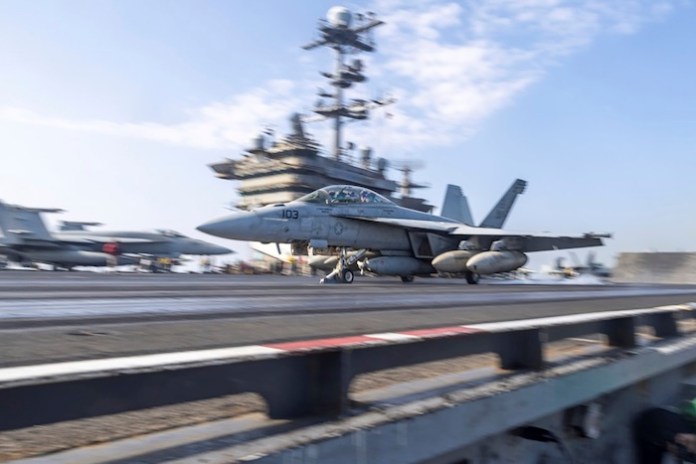
The United States struck targets along Iran’s coastline, aiming to degrade its ability to control the Strait of Hormuz on the second consecutive day of strikes, with President Donald Trump declaring the U.S.-Iran memorandum of understanding “over.” U.S. Central Command said that it struck approximately 90 Iranian military targets overnight, including air defense systems, coastal []
Narrative Intelligence Brief
This article was published by Washington Examiner, a source frequently categorized with a lean right bias based in United States of America. Our narrative intelligence engine continuously monitors coverage from this outlet to track framing, bias, and rhetorical patterns. Our initial algorithmic scan of this specific piece did not flag high-confidence rhetorical techniques, suggesting a generally straightforward reporting style or neutral framing. By understanding the editorial perspective of Washington Examiner, readers can better contextualize the information presented and compare it across our broader media matrix to find the real narrative.
More from Washington Examiner
July 12, 2026
At least two killed in shooting at Toronto music festival
July 11, 2026
Iran hits cargo ship in Strait of Hormuz as CENTCOM announces new strikes
July 11, 2026
Sanders and Ocasio-Cortez to stump for Abdul el Sayed in Michigan Senate primary
July 11, 2026
The rat race to replace Platner: How the candidates have campaigned so far
July 11, 2026
Los Angeles homelessness crisis becomes central fight in Bass-Raman mayoral race
Analysis Methodology
This narrative analysis was generated using the CoDataLab Global Intelligence Engine. Our proprietary AI scans thousands of cross-border sources to identify sentiment patterns, framing techniques, and potential media bias. While AI provides the data-driven foundation, our objective is to empower readers with additional context beyond the standard headline.The content displayed above is a structured summary designed for rapid information processing. For the full original report, please visit the source outlet.More Coverage
Discussion
"jude bellingham"
Tuchel angry at 'lucky' and 'sloppy' England – can 'mentality' be enough?

Tuchel angry at 'lucky' and 'sloppy' England – can 'mentality' be enough?

2026 World Cup Golden Boot Odds: Jude Bellingham Skyrockets After Brace
How other outlets are covering this story
Compare narratives across 6 related reports from 6 sources. Real Narrative News aggregates the coverage spectrum so you can see who emphasises what — bias tags reflect the outlet, not the story.
Coverage bias distribution
6 sources
Left 33%
Center 17%
Right 50%
Al Jazeera
· Jun 28, 2026
Why is Article 5 of MoU causing confrontations in the Strait of Hormuz?
Iran and the US trade attacks over navigation through the Strait of Hormuz, which has emerged as a major sticking point.
Libertarian Institute
· Jul 9, 2026
Formalizing Control Over the Strait of Hormuz Is Iran’s Top Priority
Formalizing its control over the Strait of Hormuz has become Iran’s top priority in negotiations with the US. Tehran says it will not discuss the nuclear issue with Washington until control over the Strait is established. Reuters reported on Thursday, speaking with an Iranian source who explained Tehran is unwilling to speak with American officials []
BRICS News
· Jun 27, 2026
JUST IN: 🇮🇷🇺🇸 Iran says it struck US military targets.
JUST IN: Iran says it struck US military targets.@BRICSNews
ArcaMax
· Jun 26, 2026
US strikes Iran in response to Strait of Hormuz ship attack
WASHINGTON — The United States attacked Iran one day after Tehran struck a commercial ship in the Strait of Hormuz, an exchange that threatened to break the fragile ceasefire between the two countries. U.S. Central Command said that American ...
NDTV
· Jul 10, 2026
War Or Peace? Trump Says Talks On After Iran Plea 'But Ceasefire Is Over'
After a series of attacks on vessels in the Strait of Hormuz, US forces struck targets in Iran over two days this week. Tehran responded with attacks on American bases in the region.
NBC News
· Jun 27, 2026
Trump’s deal to end war in question after Iran retaliates to US strikes
Iran said it struck U.S. linked targets in response to U.S. strikes on Iranian missile and drone storage locations. The newest exchange of fire raises questions about President Trump’s Memorandum of Understanding with Iran. Iran’s foreign minister has accused the U.S. of “treaty breaking.” NBC News’ Keir Simmons has the latest.
Topics:
Related coverage for "US strikes target Iran’s ability to control Strait of Hormuz after Trump declares MOU ‘over’": Al Jazeera — Why is Article 5 of MoU causing confrontations in the Strait of Hormuz?. Libertarian Institute — Formalizing Control Over the Strait of Hormuz Is Iran’s Top Priority. BRICS News — JUST IN: 🇮🇷🇺🇸 Iran says it struck US military targets.. ArcaMax — US strikes Iran in response to Strait of Hormuz ship attack. NDTV — War Or Peace? Trump Says Talks On After Iran Plea 'But Ceasefire Is Over'. NBC News — Trump’s deal to end war in question after Iran retaliates to US strikes