
Today in News History
On June 27, several notable moments in the history of News stand out. In 1905, During the Russo-Japanese War, sailors start a mutiny aboard the Russian battleship Potemkin. In 1941, World War II: German troops capture the city of Białystok during Operation Barbarossa. In 1950, The United States decides to send troops to fight in the Korean War. In 1954, The Obninsk Nuclear Power Plant, the Soviet Union's first nuclear power station, opens in Obninsk, near Moscow. In 1957, Hurricane Audrey makes landfall near the Texas-Louisiana border, killing over 400 people, mainly in and around Cameron, Louisiana. In 1974, U.S. president Richard Nixon visits the Soviet Union. In 1976, Air France Flight 139 (Tel Aviv-Athens-Paris) is hijacked en route to Paris by the PFLP and redirected to Entebbe, Uganda. In 1980, The 'Ustica massacre': Itavia Flight 870 crashes in the sea while en route from Bologna to Palermo, Italy, killing all 81 on board. In 1991, Two days after it had declared independence, Slovenia is invaded by Yugoslav troops, tanks, and aircraft, starting the Ten-Day War. In 2014, At least fourteen people are killed when a Gas Authority of India Limited pipeline explodes in the East Godavari district of Andhra Pradesh, India. Together, these milestones provide historical context for today's news news and ongoing narratives.
U.S. says it struck Iran in retaliation for prior Iranian attack in Hormuz Strait

Narrative Intelligence Brief
This article was published by Haaretz, a source frequently categorized with a left bias based in Israel. Our narrative intelligence engine continuously monitors coverage from this outlet to track framing, bias, and rhetorical patterns. Our initial algorithmic scan of this specific piece did not flag high-confidence rhetorical techniques, suggesting a generally straightforward reporting style or neutral framing. By understanding the editorial perspective of Haaretz, readers can better contextualize the information presented and compare it across our broader media matrix to find the real narrative.
More from Haaretz
June 27, 2026
U.S. says it struck Iran in retaliation for prior Iranian attack in Strait of Hormuz
June 26, 2026
U.S. attack 'will lead to retreat and regret', senior Iranian lawmaker says
June 26, 2026
U.S. strikes Iran in response to attack on ship in Strait of Hormuz
June 26, 2026
With IDF drones circling overhead, Lebanon's Shi'ites celebrate the Ashura holiday
June 26, 2026
'Do they expect us to wave the LGBT flag?': Arab world erupts over Egypt–Iran 'Pride Match' in Seattle
Analysis Methodology
This narrative analysis was generated using the CoDataLab Global Intelligence Engine. Our proprietary AI scans thousands of cross-border sources to identify sentiment patterns, framing techniques, and potential media bias. While AI provides the data-driven foundation, our objective is to empower readers with additional context beyond the standard headline.The content displayed above is a structured summary designed for rapid information processing. For the full original report, please visit the source outlet.More Coverage
Discussion
"venezuela"
Venezuela earthquakes: 589 confirmed dead so far as international rescue teams arrive – as it happened
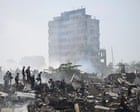
Forty seconds of chaos that wrecked Venezuela’s comeback

Desperate Search For Quake Survivors in Venezuela’s La Guaira
