Today in News History
On July 9, several notable moments in the history of News stand out. In 1925, Charles E. Wicks, American engineer, author, and academic (died 2010) was born. In 1926, Ben Roy Mottelson, American-Danish physicist and academic, Nobel Prize laureate (died 2022) was born. In 1929, Chi Haotian, Chinese general was born. In 1944, World War II: American forces take Saipan, bringing the Japanese archipelago within range of B-29 raids, and causing the downfall of the Tojo government. In 1955, The Russell-Einstein Manifesto calls for a reduction of the risk of nuclear warfare. In 1958, A 7.8 Mw strike-slip earthquake in Alaska causes a landslide that produces a megatsunami. The runup from the waves reached 525 m (1,722 ft) on the rim of Lituya Bay; five people were killed. In 1961, Whittaker Chambers, American spy and witness in Hiss case(born 1901) passed away. In 1966, Zheng Cao, Chinese-American soprano and actress (died 2013) was born. In 2004, The Senate Report on Iraqi WMD Intelligence is released by the United States Senate Select Committee on Intelligence, casting doubt on the rationale for the Iraq War. In 2011, South Sudan gains independence and secedes from Sudan. Together, these milestones provide historical context for today's news news and ongoing narratives.
US-China scientific decoupling: the hidden costs of geopolitical rivalry
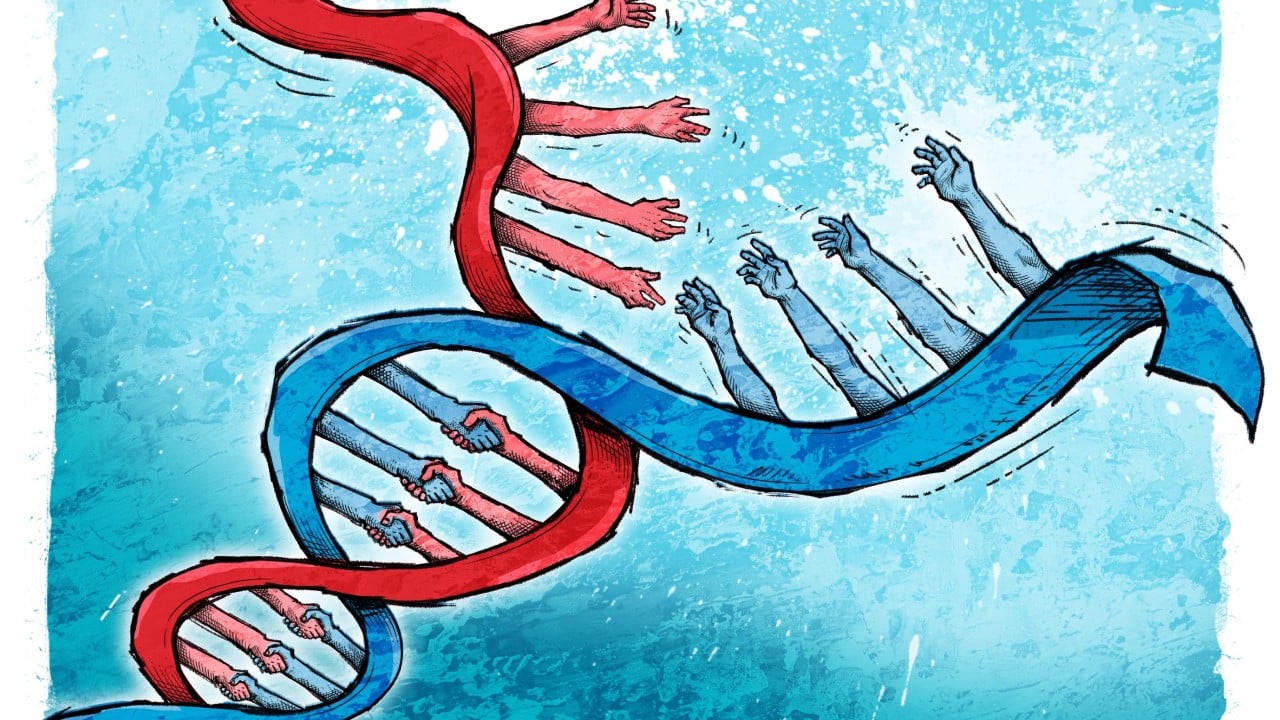
As the United States marks the 250th anniversary of its founding, it confronts a new world order dominated by its relationship with China. In this wide-ranging series, we examine the pressure points and possibilities in those ties, from hard tech to soft power. Here, Dannie Peng looks at what is at stake amid the countries’ historic low in scientific collaboration. In late May, Zhang Ning, founder of TopEdit, a Maryland-based company that provides editing services for academic publications,...
Narrative Intelligence Brief
This article was published by South China Morning Post, a source frequently categorized with a lean left bias based in Hong Kong. Our narrative intelligence engine continuously monitors coverage from this outlet to track framing, bias, and rhetorical patterns. Our initial algorithmic scan of this specific piece did not flag high-confidence rhetorical techniques, suggesting a generally straightforward reporting style or neutral framing. By understanding the editorial perspective of South China Morning Post, readers can better contextualize the information presented and compare it across our broader media matrix to find the real narrative.
More from South China Morning Post
July 9, 2026
Meet Biomni: the free powerful biomed AI agent turning data into hypotheses
July 9, 2026
Ebola outbreak is ‘fastest growing ever’ as 600 die in DR Congo
July 9, 2026
Turkish president’s ‘unusual’ gift to Nato leaders: 1 revolver, 6 bullets
July 9, 2026
Florida airport renamed ‘Trump’ in latest push to expand his brand
July 9, 2026
A World of Opportunity Begins at Canadian International School of Hong Kong
Analysis Methodology
This narrative analysis was generated using the CoDataLab Global Intelligence Engine. Our proprietary AI scans thousands of cross-border sources to identify sentiment patterns, framing techniques, and potential media bias. While AI provides the data-driven foundation, our objective is to empower readers with additional context beyond the standard headline.The content displayed above is a structured summary designed for rapid information processing. For the full original report, please visit the source outlet.More Coverage
Discussion
"donald trump"
Trump’s Son Wipes $600M From Family Fortune With Disastrous Bet

US declares ceasefire is ‘over’ following wave of strikes on Iran
Trump rightly calls off wedding after Iran’s abusive engagement