Today in News History
On June 25, several notable moments in the history of News stand out. In 1868, Carlo Matteucci, Italian physicist and neurophysiologist (born 1811) passed away. In 1935, Charles Sheffield, English-American mathematician, physicist, and author (died 2002) was born. In 1956, Anthony Bourdain, American chef and author (died 2018) was born. In 1960, Cold War: Two cryptographers working for the United States National Security Agency left for vacation to Mexico, and from there defected to the Soviet Union. In 1975, Michele Merkin, American model and television host was born. In 1976, Carlos Nieto, Argentinian-Italian rugby player was born. In 1998, Kyle Chalmers, Australian swimmer was born. In 2011, Annie Easley, American computer scientist and mathematician (born 1933) passed away. In 2016, Adam Small, South African writer of apartheid-period (born 1936) passed away. In 2024, Sika Anoa‘i, American Samoan professional wrestler (born 1945) passed away. Together, these milestones provide historical context for today's news news and ongoing narratives.
Unconventional AI releases its first model, built on an oscillator architecture its founder says could cut power use by a factor of a thousand
Narrative Analysis: Card Stacking
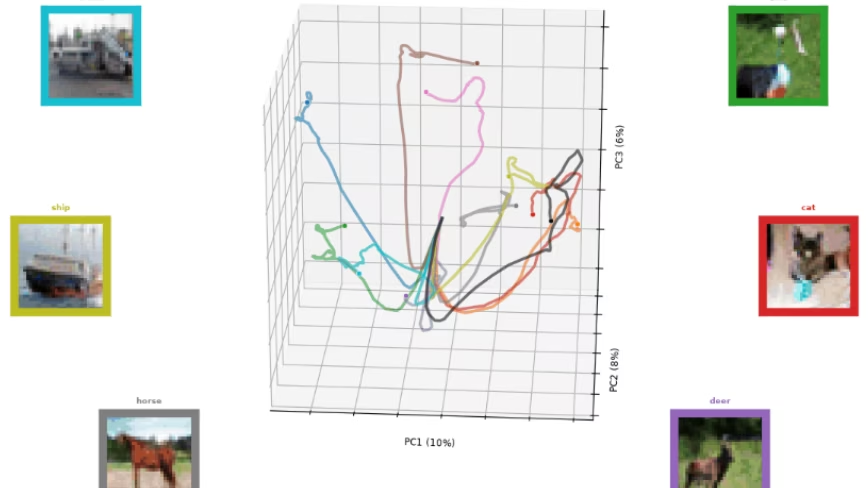
Unconventional AI, the startup founded by former Databricks AI chief Naveen Rao, has released its first AI model, an image generation system called Un-0 that runs on a completely new kind of computing architecture. The model produces results comparable to state-of-the-art diffusion models like Stable Diffusion, according to an accompanying research paper. The catch is [] This story continues at The Next Web
Narrative Intelligence Brief
This article was published by The Next Web, a source frequently categorized with a lean left bias based in Netherlands. Our narrative intelligence engine continuously monitors coverage from this outlet to track framing, bias, and rhetorical patterns. In this specific piece, our systems detected the potential use of the "Card Stacking" technique. This narrative approach is often used to shape reader perception by highlighting specific emotional or rhetorical angles. By understanding the editorial perspective of The Next Web, readers can better contextualize the information presented and compare it across our broader media matrix to find the real narrative.
More from The Next Web
June 25, 2026
Claude is winning over paying consumers in a market ChatGPT has owned, credit card data shows
June 25, 2026
Sarah Wynn-Williams sues Meta over efforts to keep her quiet
June 25, 2026
Microsoft raises Xbox console prices for the third time in 13 months, pushing the Series X to $800
June 25, 2026
Klue says the hackers who stole its customer data are deleting it, but now a second group is making threats
June 25, 2026
Google Finance exits beta with a dedicated Android app, portfolio tracking, and AI-powered scheduled briefings
Reliability Insights
P
Technique: Card Stacking
System analysis detected use of specific narrative techniques in this piece.Analysis Methodology
This narrative analysis was generated using the CoDataLab Global Intelligence Engine. Our proprietary AI scans thousands of cross-border sources to identify sentiment patterns, framing techniques, and potential media bias. While AI provides the data-driven foundation, our objective is to empower readers with additional context beyond the standard headline.The content displayed above is a structured summary designed for rapid information processing. For the full original report, please visit the source outlet.More Coverage
Discussion
"cup"
PODCAST: Is France prepared to face more hellish heatwaves and why are the French ruling the World Cup

Kevin Taylor blasts on Djed Spence after controversial Thomas Partey handshake snub incident

Energy crisis continues as households trapped in £4.79BILLION debt with bill hike only days away