Today in News History
On June 22, several notable moments in the history of News stand out. In 1897, British colonial officers Charles Walter Rand and Lt. Charles Egerton Ayerst are assassinated in Pune, Maharashtra, India by the Chapekar brothers and Mahadeo Vinayak Ranade, who are later caught and hanged. In 1911, George V and Mary of Teck are crowned King and Queen of the United Kingdom of Great Britain and Ireland. In 1940, World War II: France is forced to sign the Second Compiègne armistice with Germany, in the same railroad car in which the Germans signed the Armistice in 1918. In 1941, Terttu Savola, Finnish journalist and politician was born. In 1949, Brian Leveson, English lawyer and judge was born. In 1960, Erin Brockovich, American lawyer and environmentalist was born. In 1962, Air France Flight 117 crashes on approach to Pointe-à-Pitre International Airport in Guadeloupe, killing 112 people. In 1979, Former Liberal Party leader Jeremy Thorpe was acquitted of conspiracy to murder Norman Scott, who had accused Thorpe of having a relationship with him. In 2000, Wuhan Airlines Flight 343 is struck by lightning and crashes into Wuhan's Hanyang District, killing 49 people. In 2009, A Washington D.C Metro train traveling southbound near Fort Totten station collides into another train waiting to enter the station. Nine people are killed in the collision (eight passengers and the train operator) and at least 80 others are injured. Together, these milestones provide historical context for today's news news and ongoing narratives.
Two men plead guilty over £39m TfL cyber attack that caused months of disruption

Thalha Jubair, 20, and Owen Flowers, 18, pleaded guilty for their role in the hack on 31 August 2024.
Narrative Intelligence Brief
This article was published by BBC News, a source frequently categorized with a center bias based in United Kingdom. Our narrative intelligence engine continuously monitors coverage from this outlet to track framing, bias, and rhetorical patterns. Our initial algorithmic scan of this specific piece did not flag high-confidence rhetorical techniques, suggesting a generally straightforward reporting style or neutral framing. By understanding the editorial perspective of BBC News, readers can better contextualize the information presented and compare it across our broader media matrix to find the real narrative.
More from BBC News
June 22, 2026
Safe-sleep checks for nursery children to be part of Ofsted inspections
June 22, 2026
A decade on from Brexit, the new PM has big calls to make on Europe
June 22, 2026
How four weeks in court unravelled 'sinful and deceitful' Jeffrey Donaldson
June 22, 2026
Vance says Iran will allow nuclear inspectors back into the country
June 22, 2026
Starmer's premiership in six charts
Analysis Methodology
This narrative analysis was generated using the CoDataLab Global Intelligence Engine. Our proprietary AI scans thousands of cross-border sources to identify sentiment patterns, framing techniques, and potential media bias. While AI provides the data-driven foundation, our objective is to empower readers with additional context beyond the standard headline.The content displayed above is a structured summary designed for rapid information processing. For the full original report, please visit the source outlet.More Coverage
Discussion
"keir starmer"
Breaking! Keir Starmer Steps Down, Trump’s Cuba Threats, Oil Barrel Crisis | PBD #821

Kemi Badenoch breaks silence after Starmer’s resignation, reveals what she says is Labour’s real problem

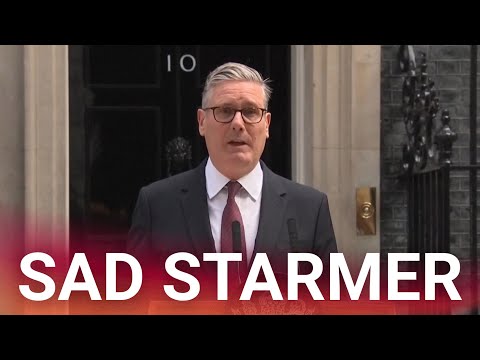
‘Too hard for Starmer’: PM holds back tears as he resigns from office