
Today in News History
On June 17, several notable moments in the history of News stand out. In 1929, Bud Collins, American journalist and sportscaster (died 2016) was born. In 1933, Union Station massacre: In Kansas City, Missouri, four FBI agents and captured fugitive Frank Nash are gunned down by gangsters attempting to free Nash. In 1943, Newt Gingrich, American historian and politician, 58th Speaker of the United States House of Representatives was born. In 1958, Jon Leibowitz, American lawyer and politician was born. In 1959, Nikos Stavropoulos, Greek basketball player and coach was born. In 1971, U.S. President Richard Nixon in a televised press conference called drug abuse "America's public enemy number one", starting the War on drugs. In 1972, Watergate scandal: Five White House operatives are arrested for burgling the offices of the Democratic National Committee during an attempt by members of the administration of President Richard M. Nixon to illegally wiretap the political opposition as part of a broader campaign to subvert the democratic process. In 1979, Tyson Apostol, American television personality was born. In 1994, Following a televised low-speed highway chase, O. J. Simpson is arrested for the murders of his ex-wife, Nicole Brown Simpson, and her friend Ronald Goldman. In 2001, Donald J. Cram, American chemist and academic, Nobel Prize laureate (born 1919) passed away. Together, these milestones provide historical context for today's news news and ongoing narratives.
Trump nominee hit at hearing: 'You can't want the big job but not to answer big questions'
Narrative Analysis: Plain Folks
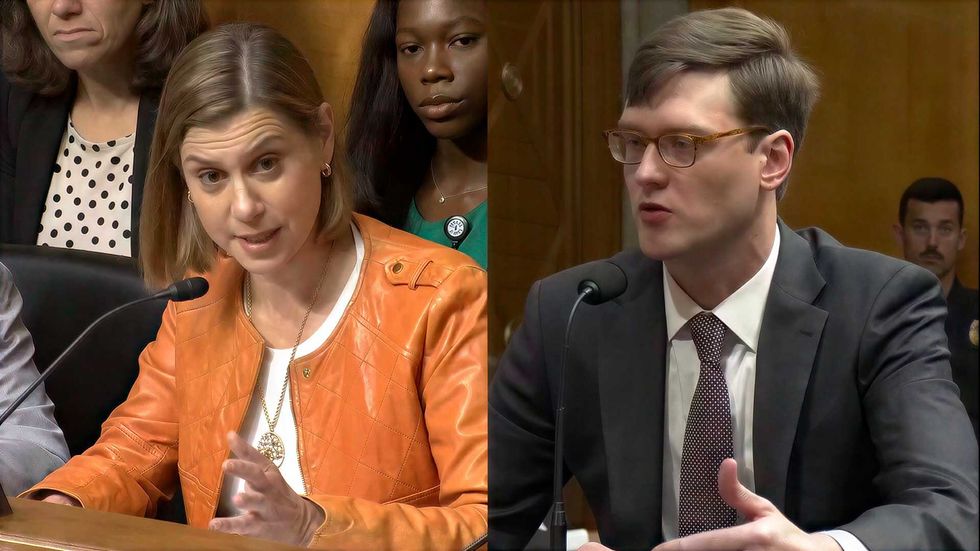
Sen. Elissa Slotkin (D-MI) grilled President Donald Trump's budget office nominee, warning that his confirmation would enable anti-American policies.Slotkin zeroed in on Hal Duncan, Trump's pick for deputy director of the Office of Management and Budget, during his confirmation hearing before the Senate Homeland Security and Governmental Affairs Committee on Wednesday. At issue: a sweeping OMB proposed rule that would allow the government to yank federal grants from organizations deemed to promote anti-American values or damage the reputation of the federal government.The Michigan Democrat pressed Duncan on a direct hypothetical — if a university received federal cancer research funding but allowed a peaceful protest of the Iran war on campus, would that cost it its grant?Is a peaceful First Amendment protest on a college campus enough to threaten the federal dollars they are getting for cancer research under the rules that you will be enforcing? Yes or no? Slotkin demanded.Duncan would not answer directly.In the hypothetical question that you're asking, related to grants for cancer research, this administration is committed to gold-standard science and wants to advance the best cancer research that we possibly can, he said.Slotkin pushed further — would a domestic violence shelter that publicly criticized the administration's funding cuts risk being labeled anti-American?Again, Duncan deflected, saying decisions on specific grants would fall to agency political appointees, not OMB.The ultimate deciders of these grants will be the political appointees at the agencies, Duncan said.The political appointees — like yourself? Slotkin shot back.You can't want the big job but then not answer the big questions, she continued. The idea that the administration would put that kind of language out there to intimidate and scare people out of freedom of speech is the most anti-American thing I've seen in a long time.
Narrative Intelligence Brief
This article was published by Raw Story, a source frequently categorized with a left bias based in United States of America. Our narrative intelligence engine continuously monitors coverage from this outlet to track framing, bias, and rhetorical patterns. In this specific piece, our systems detected the potential use of the "Plain Folks" technique. This narrative approach is often used to shape reader perception by highlighting specific emotional or rhetorical angles. By understanding the editorial perspective of Raw Story, readers can better contextualize the information presented and compare it across our broader media matrix to find the real narrative.
More from Raw Story
June 17, 2026
Outgoing GOP senator torches Trump's Iran deal: 'Worst foreign policy blunder in decades'
June 17, 2026
Trump sparks fresh health concerns after displaying new 'blotch' at G7 Summit: report
June 17, 2026
Tommy Tuberville's own words could get him disqualified from Alabama governor's race
June 17, 2026
Republican senator defies Trump's order to cancel Senate hearing
June 17, 2026
JD Vance's fraud task force picks new target — the unemployed: report
Reliability Insights
P
Technique: Plain Folks
System analysis detected use of specific narrative techniques in this piece.Analysis Methodology
This narrative analysis was generated using the CoDataLab Global Intelligence Engine. Our proprietary AI scans thousands of cross-border sources to identify sentiment patterns, framing techniques, and potential media bias. While AI provides the data-driven foundation, our objective is to empower readers with additional context beyond the standard headline.The content displayed above is a structured summary designed for rapid information processing. For the full original report, please visit the source outlet.More Coverage
Discussion
"cup"
Ange Postecoglou is putting the World Cup’s awful pundits to shame

Failure to beat Panama in World Cup group stage will be disappointing – Ghanaian fans to Black Stars
Women and children in abusive settings face ‘more sinister’ World Cup kick-off
