Today in News History
On June 20, several notable moments in the history of News stand out. In 451, Battle of Chalons: Flavius Aetius battles Attila the Hun. After the battle, which was inconclusive, Attila retreats, causing the Romans to interpret it as a victory. In 1895, The Kiel Canal, crossing the base of the Jutland peninsula and the busiest artificial waterway in the world, is officially opened. In 1900, Baron Eduard Toll, leader of the Russian Polar Expedition of 1900, departs Saint Petersburg in Russia on the explorer ship Zarya, never to return. In 1945, The United States Secretary of State approves the transfer of Wernher von Braun and his team of Nazi rocket scientists to the U.S. under Operation Paperclip. In 1948, The Deutsche Mark is introduced in Western Allied-occupied Germany. The Soviet Military Administration in Germany responded by imposing the Berlin Blockade four days later. In 1956, A Venezuelan Super-Constellation crashes in the Atlantic Ocean off Asbury Park, New Jersey, killing 74 people. In 1959, A rare June hurricane strikes Canada's Gulf of St. Lawrence killing 35. In 1963, Following the Cuban Missile Crisis, the Soviet Union and the United States sign an agreement to establish the so-called "red telephone" link between Washington, D.C., and Moscow. In 1982, The International Conference on the Holocaust and Genocide opens in Tel Aviv, despite attempts by the Turkish government to cancel it, as it included presentations on the Armenian genocide. In 2019, Iran's Air Defense Forces shoot down an American surveillance drone over the Strait of Hormuz amid rising tensions between the two countries. Together, these milestones provide historical context for today's news news and ongoing narratives.
Trump floats new plan to impose his own tolls on Strait of Hormuz
Narrative Analysis: Appeal to Fear
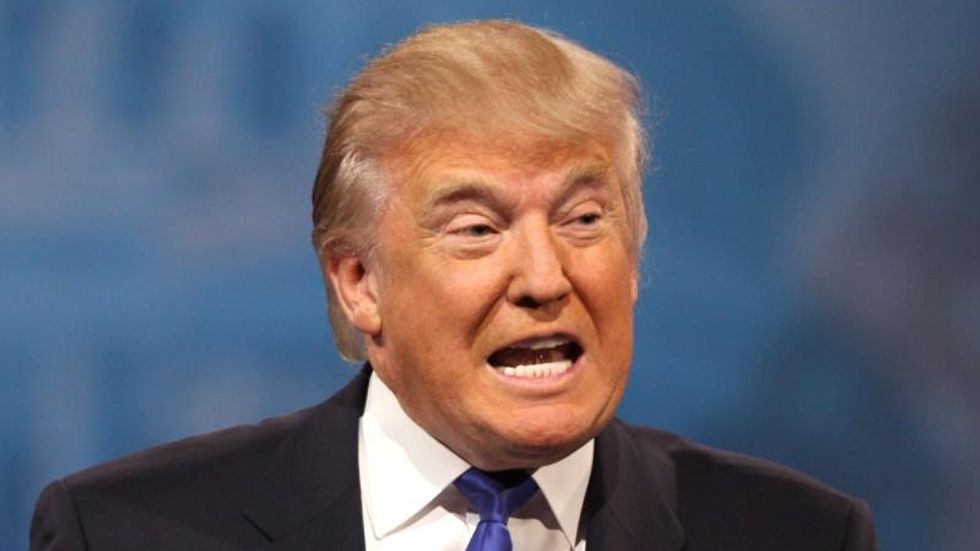
President Donald Trump took to Truth Social to muse about who gets to charge ships for passing through the Strait of Hormuz — and landed on an answer that put the United States, and himself, at the center of it.In a post Wednesday, Trump declared there would be NO TOLLS in the Hormuz Strait for 60 days during what he called the Cease Fire Period, and NO TOLLS after the 60 day period has expired — with one sweeping exception. The carve-out: tolls imposed by and for the United States of America, should the underlying deal collapse.The justification he offered was pretty clear. The fees, he wrote, would be compensation for services rendered as the Guardian Angel to the countries of the Middle East, covering past, present, and future reimbursement of costs. He signed off, as he often does, with Thank you for your attention to this matter!!!The post recasts a fragile ceasefire — one Trump secured only after threatening that Iran's whole civilization will die tonight — as a kind of protection arrangement, with Washington positioned to bill the region for the privilege of safe passage.His latest post openly contemplates American tolls rather than ruling them out.Iran, for its part, has confirmed it won't collect tolls for 60 days but, per semiofficial outlet Tasnim, plans to start charging for services once the window closes — leaving both Washington and Tehran eyeing fees on the same waterway.The stakes behind the bravado are real. Roughly a fifth of the world's oil — about 20 million barrels a day — moves through the Strait of Hormuz, alongside much of the globe's liquefied natural gas.
Narrative Intelligence Brief
This article was published by Raw Story, a source frequently categorized with a left bias based in United States of America. Our narrative intelligence engine continuously monitors coverage from this outlet to track framing, bias, and rhetorical patterns. In this specific piece, our systems detected the potential use of the "Appeal to Fear" technique. This narrative approach is often used to shape reader perception by highlighting specific emotional or rhetorical angles. By understanding the editorial perspective of Raw Story, readers can better contextualize the information presented and compare it across our broader media matrix to find the real narrative.
More from Raw Story
June 20, 2026
Trump's Reflecting Pool sabotage claim falls apart: 'Brain is filled with tapioca'
June 20, 2026
Congressman sounds alarm over Trump move that 'should be on front page of every newspaper'
June 20, 2026
'They sound exactly the same': Trump plot to rename ICE torn apart by critics
June 20, 2026
Legal analysts burn Justice Neil Gorsuch's 'absurd' rationale in gun rights case
June 20, 2026
Olympian arrested for touching remnants of decaying Reflecting Pool: report
Reliability Insights
P
Technique: Appeal to Fear
System analysis detected use of specific narrative techniques in this piece.Analysis Methodology
This narrative analysis was generated using the CoDataLab Global Intelligence Engine. Our proprietary AI scans thousands of cross-border sources to identify sentiment patterns, framing techniques, and potential media bias. While AI provides the data-driven foundation, our objective is to empower readers with additional context beyond the standard headline.The content displayed above is a structured summary designed for rapid information processing. For the full original report, please visit the source outlet.More Coverage
Discussion
"cup"
Cold War Steve on … the arrival of the World Cup superheroes

Cape Verde’s Roberto Lopes was working at a bank when he was recruited on LinkedIn to play soccer—he thought it was spam, now he’s at the World Cup

Türkiye eliminated from World Cup after 1-0 loss to Paraguay