Today in News History
On June 20, several notable moments in the history of News stand out. In 1761, Jacob Hübner, German entomologist and author (died 1826) was born. In 1809, Isaak August Dorner, German theologian and academic (died 1884) was born. In 1941, Stephen Frears, English actor, director, and producer was born. In 1963, Following the Cuban Missile Crisis, the Soviet Union and the United States sign an agreement to establish the so-called "red telephone" link between Washington, D.C., and Moscow. In 1969, Misha Verbitsky, Russian mathematician and academic was born. In 1972, Watergate scandal: An .mw-parser-output .frac{white-space:nowrap}.mw-parser-output .frac .num,.mw-parser-output .frac .den{font-size:80%;line-height:0;vertical-align:super}.mw-parser-output .frac .den{vertical-align:sub}.mw-parser-output .sr-only{border:0;clip:rect(0,0,0,0);clip-path:polygon(0px 0px,0px 0px,0px 0px);height:1px;margin:-1px;overflow:hidden;padding:0;position:absolute;width:1px}18+1⁄2-minute gap appears in the tape recording of the conversations between U.S. President Richard Nixon and his advisers regarding the recent arrests of his operatives while breaking into the Watergate complex. In 2005, Larry Collins, American journalist, historian, and author (born 1929) passed away. In 2011, RusAir Flight 9605 crashes in Besovets during approach to Petrozavodsk Airport, killing 47. In 2012, Andrew Sarris, American critic (born 1928) passed away. In 2024, Donald Sutherland, Canadian actor and producer (born 1935) passed away. Together, these milestones provide historical context for today's news news and ongoing narratives.
Trump DOJ's 'verboten' mistakes in Broadview Six case raise red flags for expert
Narrative Analysis: Name Calling
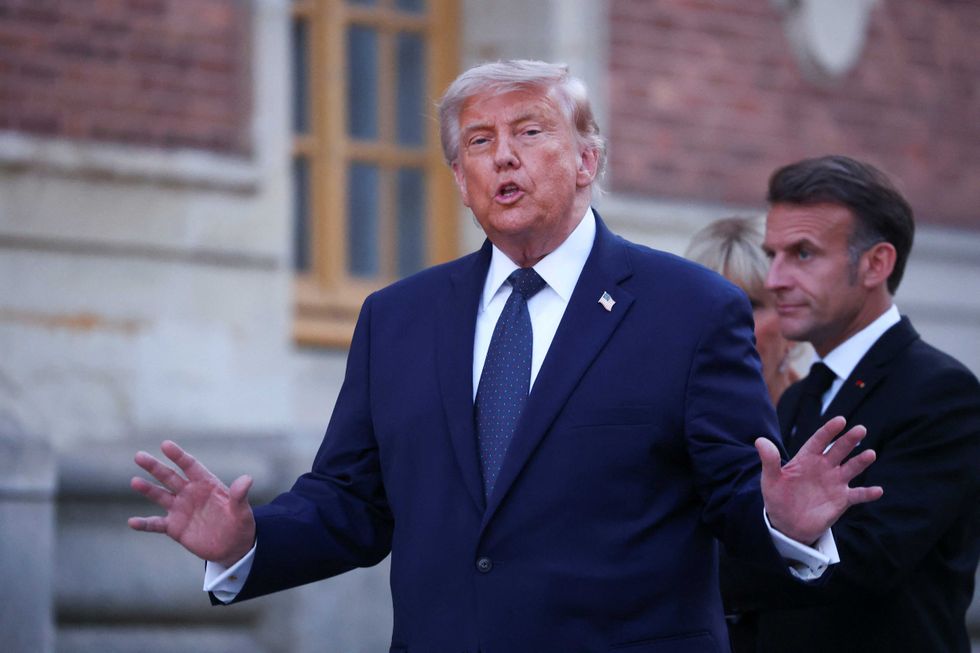
The recently released Broadview Six transcripts revealed a stunning pattern of behavior by President Donald Trump's Department of Justice, raising multiple red flags for a legal expert. Andrew Weissmann, a former federal prosecutor, said during a new interview on All Rise News with Adam Klasfeld on Friday that the federal prosecutors who brought the Broadview Six case broke some verboten rules in the legal profession. They include trying to sway a grand jury, trying to cover up prosecutorial misdeeds, and bringing weak evidence to support their case. One of the most flagrant abuses, according to Weissmann, was the prosecutors' own admission that they chose a specific grand jury because they trusted them.Choosing the grand jury because you trust them and they trust you and you like them and they like you ... this is like blatantly saying I engaged in grand jury shopping, Weissman said. But then the second thing is you cannot ever say whether the grand jury stage or the trial stage, 'Trust me, I'm telling you there's probable cause. I would never present something without probable cause.'It is verboten. Everybody knows that.Weissmann said the prosecutors' misconduct was so egregious that it made him question whether it was intentional. This is so fundamental that you have to know that it's wrong, he said.
Narrative Intelligence Brief
This article was published by Raw Story, a source frequently categorized with a left bias based in United States of America. Our narrative intelligence engine continuously monitors coverage from this outlet to track framing, bias, and rhetorical patterns. In this specific piece, our systems detected the potential use of the "Name Calling" technique. This narrative approach is often used to shape reader perception by highlighting specific emotional or rhetorical angles. By understanding the editorial perspective of Raw Story, readers can better contextualize the information presented and compare it across our broader media matrix to find the real narrative.
More from Raw Story
June 20, 2026
'Trying to hide': Kennedy Center refuses to take tarps off where Trump's name was removed
June 20, 2026
Trump hemorrhaging support from key business community as 'buyer's remorse' settles in
June 20, 2026
New Jersey Republican with mafia rap sheet arrested for loan sharking
June 20, 2026
'Huge gamble': Expert shares sobering prediction after Trump ruptures alliance with insult
June 20, 2026
Trump's $100 million stock trading rally fueled by favorable court ruling: analysis
Reliability Insights
P
Technique: Name Calling
System analysis detected use of specific narrative techniques in this piece.Analysis Methodology
This narrative analysis was generated using the CoDataLab Global Intelligence Engine. Our proprietary AI scans thousands of cross-border sources to identify sentiment patterns, framing techniques, and potential media bias. While AI provides the data-driven foundation, our objective is to empower readers with additional context beyond the standard headline.The content displayed above is a structured summary designed for rapid information processing. For the full original report, please visit the source outlet.More Coverage
Discussion
"iran talks"
US-Iran talks in Switzerland stall as Lebanon escalation tests diplomacy

With Lebanon ceasefire set, Trump envoy heads to Switzerland for U.S.-Iran talks

Vance's Switzerland Trip Called Off as Lebanon Fighting Stalls Iran Deal