
Today in News History
On June 19, several notable moments in the history of News stand out. In 1785, The Boston King's Chapel adopts James Freeman's revised prayer book, without the Nicene Creed, establishing it as the first Unitarian congregation in the United States. In 1865, Over two years after the Emancipation Proclamation, slaves in Galveston, Texas, United States, are officially informed of their freedom. The anniversary was officially celebrated in Texas and other states as Juneteenth. On June 17, 2021, Juneteenth officially became a federal holiday in the United States. In 1939, John F. MacArthur, American minister and theologian was born. In 1987, Basque separatist group ETA commits one of its most violent attacks, in which a bomb is set off in a supermarket, Hipercor, killing 21 and injuring 45. In 2009, Mass riots involving over 10,000 people and 10,000 police officers break out in Shishou, China, over the dubious circumstances surrounding the death of a local chef. In 2012, WikiLeaks founder Julian Assange requests asylum in London's Ecuadorian Embassy for fear of extradition to the US after publication of previously classified documents including footage of civilian killings by the US army. In 2013, Vince Flynn, American author (born 1966) passed away. In 2018, The 10,000,000th United States Patent is issued. In 2018, Antwon Rose II is fatally shot in East Pittsburgh by East Pittsburgh Police Officer Michael Rosfeld after being involved in a near-fatal drive-by shooting. In 2020, Animal rights advocate Regan Russell is run over and killed by a transport truck outside of a pig slaughterhouse in Burlington, Ontario. Together, these milestones provide historical context for today's news news and ongoing narratives.
Trump 2.0 puts religious liberty back on offense
Narrative Analysis: Name Calling
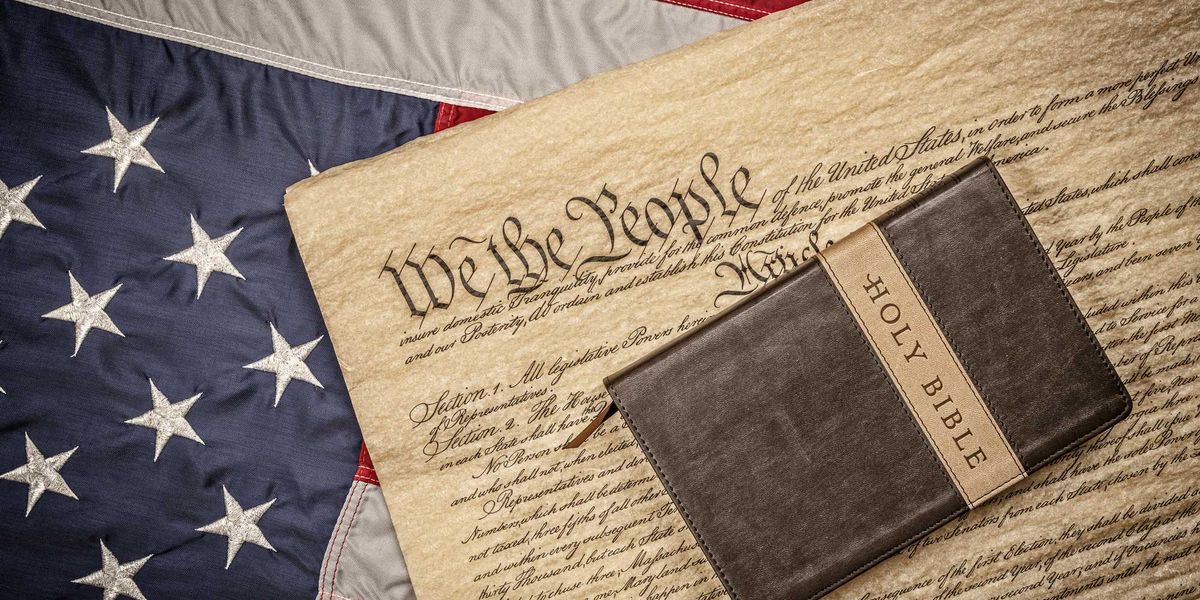
One underreported achievement of President Trump’s first administration was the support the Justice Department provided to religious-liberty litigants.During those years, the federal government filed statements of interest and friend-of-the-court briefs defending conscience rights at a pace unmatched by either of Trump’s immediate predecessors. Cases involving memorial crosses, conscience protections, ministerial autonomy, and the rights of religious schools all reflected a broader shift in posture from the Obama administration.Constitutional guarantees are only as durable as the institutions willing to enforce them.The federal government no longer treated religion merely as a tolerated private exercise. It treated religious liberty as a constitutional good worthy of affirmative protection.That shift has only strengthened under Trump 47.At the time, critics dismissed many of the administration’s actions as symbolic or temporary. What looked then like a change in tone now appears to have been the beginning of an institutional realignment.The Justice Department’s recently released report from the Task Force to Eradicate Anti-Christian Bias suggests that the second Trump administration intends not merely to defend religious liberty episodically, but to embed those protections throughout the administrative state.The point is not simply the report’s conclusions, significant as they are. The point is the scope of the undertaking.Drawing participation from 17 federal agencies, the report catalogs hundreds of pages of examples in which religious Americans — Christians in particular — faced adverse treatment from the federal government because of their views on life, sexuality, education, parental rights, and medical conscience. The report and its 1,200 footnotes present reams of evidence to support its central argument: During the Biden years, religious exercise was often treated less as a constitutional guarantee than as an obstacle to the ideological objectives of a political machine.A major development of Trump’s second administration has therefore been the construction of infrastructure around religious liberty itself. The White House Faith Office, the Religious Liberty Commission, agency faith liaisons, and now the Task Force to Eliminate Anti-Christian Bias all reflect an effort to institutionalize protections that previously depended too heavily on presidential discretion.This development is especially visible inside the Justice Department. During the first Trump administration, Attorney General Jeff Sessions issued welcome guidance for federal prosecutors handling religious-liberty matters and established the Place to Worship Initiative to address violence and discrimination directed at houses of worship.RELATED: Trump’s Justice Department is shining a light on woke universities — finally Angela Lewis/Bloomberg/Getty ImagesThe current report builds on that framework. Rather than focusing only on isolated incidents, it argues that anti-Christian bias — and therefore hostility to religious liberty — became embedded in regulatory enforcement itself, especially when religious convictions conflicted with prevailing doctrines on sexuality, gender identity, or pro-life Christian opposition to the progressive sacrament of abortion.The report points, for example, to enforcement disparities under the FACE Act. Pro-life activists received aggressive federal scrutiny, while attacks against churches and pregnancy resource centers received comparatively limited attention. Even when political pressure left the Biden administration little choice, its enforcement of the FACE Act against actual vandals went only as far as necessary to stem rising public complaint.The report goes further, identifying conflicts involving military chaplains, foster-care providers, health care workers, religious schools, and federal employees who sought accommodation for sincerely held religious beliefs.Whether one agrees with every characterization in the report is almost beside the point. The broader constitutional question remains unavoidable: Can government remain neutral toward religion while treating orthodox religious belief as presumptively discriminatory?Historically, the answer has been no.Religious liberty in the American tradition has never meant mere freedom of inward belief. The founders protected religious exercise because they understood that belief inevitably shapes action: education, charity, worship, speech, commerce, and public participation. The First Amendment restrains government not because religion is politically useful, but because conscience stands beyond the state’s authority.That understanding has often been obscured in recent decades by a truncated vision of religious freedom — one that permits worship inside sanctuary walls while treating religious conviction outside those walls as suspect. Many of the conflicts cataloged in the Justice Department report arise from that narrowing impulse. The fight is no longer over whether Americans may privately believe traditional religious teachings, even explicitly Christian ones. The fight is whether they may live according to them publicly.Judging by this report and other promising signs, the latest version of the Trump administration recognizes this reality more clearly than any administration in modern memory.Critics argue that these initiatives privilege Christianity or collapse the distinction between church and state. But that has always been their schtick. Trump’s direct confrontation and dismissive rhetoric have exposed many modern assumptions about the “separation of church and state” as political slogans rather than constitutional arguments.RELATED: 5 countries where Christians face brutal persecution — and how you can help EMMY IBU/AFP/Getty ImagesThe more important legal question is whether religious Americans — Christians and all people of faith — may participate fully in public life without surrendering core convictions as the price of admission. This report focuses on bias against a majoritarian religion. But imagine the damage if the state focused its ire on minority faiths. Religious liberty belongs to all Americans.The administration’s trajectory is unmistakable. The president’s Religious Liberty Commission has been assigned with developing long-term recommendations for protecting religious exercise across education, health care, public funding, parental rights, and federal policy. The Justice Department report, which will continue to expand into 2027, serves as both justification and road map for that effort.Critics will insist these measures are unnecessary because religious believers already possess constitutional protections. Only a cynic could look at the mountain of evidence in the Justice Department report and claim nothing happened. Those constitutional protections existed during the last administration, too, but we now know that officials chose political ideology over the foundational principles of the First Amendment.Constitutional guarantees are only as durable as the institutions willing to enforce them.The most important question, then, is not whether Trump personally embodies religious devotion. He plainly does not fit conventional expectations of religious statesmanship. The more consequential question is whether his administration understands the structural importance of religious liberty within the constitutional order.Increasingly, the answer appears to be yes.For religious Americans, Christians in particular, who spent much of the last decade defending themselves against the coercive power of administrative agencies, that distinction matters a great deal.
Narrative Intelligence Brief
This article was published by Conservative Review, a source frequently categorized with a right bias based in United States of America. Our narrative intelligence engine continuously monitors coverage from this outlet to track framing, bias, and rhetorical patterns. In this specific piece, our systems detected the potential use of the "Name Calling" technique. This narrative approach is often used to shape reader perception by highlighting specific emotional or rhetorical angles. By understanding the editorial perspective of Conservative Review, readers can better contextualize the information presented and compare it across our broader media matrix to find the real narrative.
More from Conservative Review
June 19, 2026
NIGHTMARE as 3-year-old winds up in crocodile pit — suspect is already back on the street
June 19, 2026
Microsoft says business must pay to use its AI — and eyes cheap Chinese model for lowly consumers
June 19, 2026
Juneteenth only makes sense if natural law is real
June 19, 2026
Full 'Disclosure': Steven Spielberg's latest has no signs of intelligent life
June 19, 2026
Exclusive: JD Vance minces no words with BlazeTV host Allie Beth Stuckey about Israeli influence, Iran deal
Reliability Insights
P
Technique: Name Calling
System analysis detected use of specific narrative techniques in this piece.Analysis Methodology
This narrative analysis was generated using the CoDataLab Global Intelligence Engine. Our proprietary AI scans thousands of cross-border sources to identify sentiment patterns, framing techniques, and potential media bias. While AI provides the data-driven foundation, our objective is to empower readers with additional context beyond the standard headline.The content displayed above is a structured summary designed for rapid information processing. For the full original report, please visit the source outlet.More Coverage
Discussion


