
Today in News History
On June 22, several notable moments in the history of News stand out. In 910, The Hungarians defeat the East Frankish army near the Rednitz River, killing its leader Gebhard, Duke of Lotharingia (Lorraine). In 1939, Don Matthews, American-Canadian football player and coach (died 2017) was born. In 1940, Monty Noble, Australian cricketer and sportscaster (born 1873) passed away. In 1972, Damien Oliver, Australian jockey was born. In 1978, Dan Wheldon, English racing driver (died 2011) was born. In 1981, Sione Lauaki, New Zealand rugby player (died 2017) was born. In 1982, Andoni Iraola, Spanish footballer was born. In 1986, The famous Hand of God goal, scored by Diego Maradona in the quarter-finals of the 1986 FIFA World Cup match between Argentina and England, ignites controversy. This was later followed by the Goal of the Century. Argentina wins 2-1 and later goes on to win the World Cup. In 1994, Carlos Vinícius Santos de Jesus, Brazilian footballer was born. In 2011, Coşkun Özarı, Turkish footballer and coach (born 1931) passed away. Together, these milestones provide historical context for today's news news and ongoing narratives.
This World Cup Is Beating A Dead Dark Horse
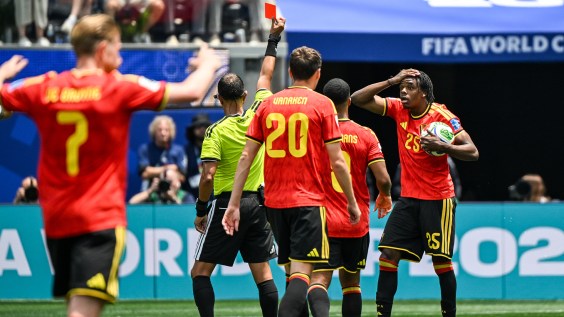
Every international tournament, the widely used and abused dark horse designation is bandied about as pundits, fans, and cretins (gamblers) try to be the first to predict a deep run for an unexpected team. The term dark horse itself is vague enough to apply to about half the field, depending on one's own criteria. It fits a team that could be a sneaky knockout-stage qualifier from a tough group, it fits a small nation that could even win a knockout match, and it fits a surprise quarterfinalist. However, the concept is most consistently applied to a team outside of the World Cup elite (made up of the eight countries that have won it, plus the Netherlands) that has a realistic shot at getting to the semifinals. In that way, the dark horses are supposed to be the best of the rest, the best hopes we have of getting something more interesting and novel than just some combination of Argentina, France, Brazil, Spain, the Netherlands, Germany, and England in the final four. The problem is that the World Cup doesn't really work like that. Looking at a list of semifinalists since the first World Cup of the millennium (2002 in South Korea and Japan), you could make the argument that only two true dark horses have made the semis: 2006 Portugal and 2018 Belgium. Those two teams came into the tournament loaded with talent and expectations, and, had things gone slightly differently—if Portugal doesn't give up a penalty to France, or if prime Eden Hazard-Romelu Lukaku-Kevin De Bruyne don't forget how to score against a French defense that shipped three against an underwhelming Argentina—they could have gone on to lift the trophy. (Maybe the trick to be a dark horse World Cup winner is just to avoid France.)
Narrative Intelligence Brief
This article was published by Defector, a source frequently categorized with a center bias based in United States of America. Our narrative intelligence engine continuously monitors coverage from this outlet to track framing, bias, and rhetorical patterns. Our initial algorithmic scan of this specific piece did not flag high-confidence rhetorical techniques, suggesting a generally straightforward reporting style or neutral framing. By understanding the editorial perspective of Defector, readers can better contextualize the information presented and compare it across our broader media matrix to find the real narrative.
More from Defector
June 22, 2026
Alan Greenspan, Influential Economic Policymaker Whom I Once Terrified At A Party, Is Dead
June 22, 2026
You Can Now Be Arrested For Sticking Your Hand In Donald Trump’s Disgusting Reflecting Pool
June 22, 2026
Justin Verlander Is Looking For His Wheels
June 22, 2026
The Crossword, June 22: Position Changes
June 22, 2026
The U.S. Is Still Killing People In Illegal Boat Strikes
Analysis Methodology
This narrative analysis was generated using the CoDataLab Global Intelligence Engine. Our proprietary AI scans thousands of cross-border sources to identify sentiment patterns, framing techniques, and potential media bias. While AI provides the data-driven foundation, our objective is to empower readers with additional context beyond the standard headline.The content displayed above is a structured summary designed for rapid information processing. For the full original report, please visit the source outlet.More Coverage
Discussion


