
The world behind Barita’s next chapter
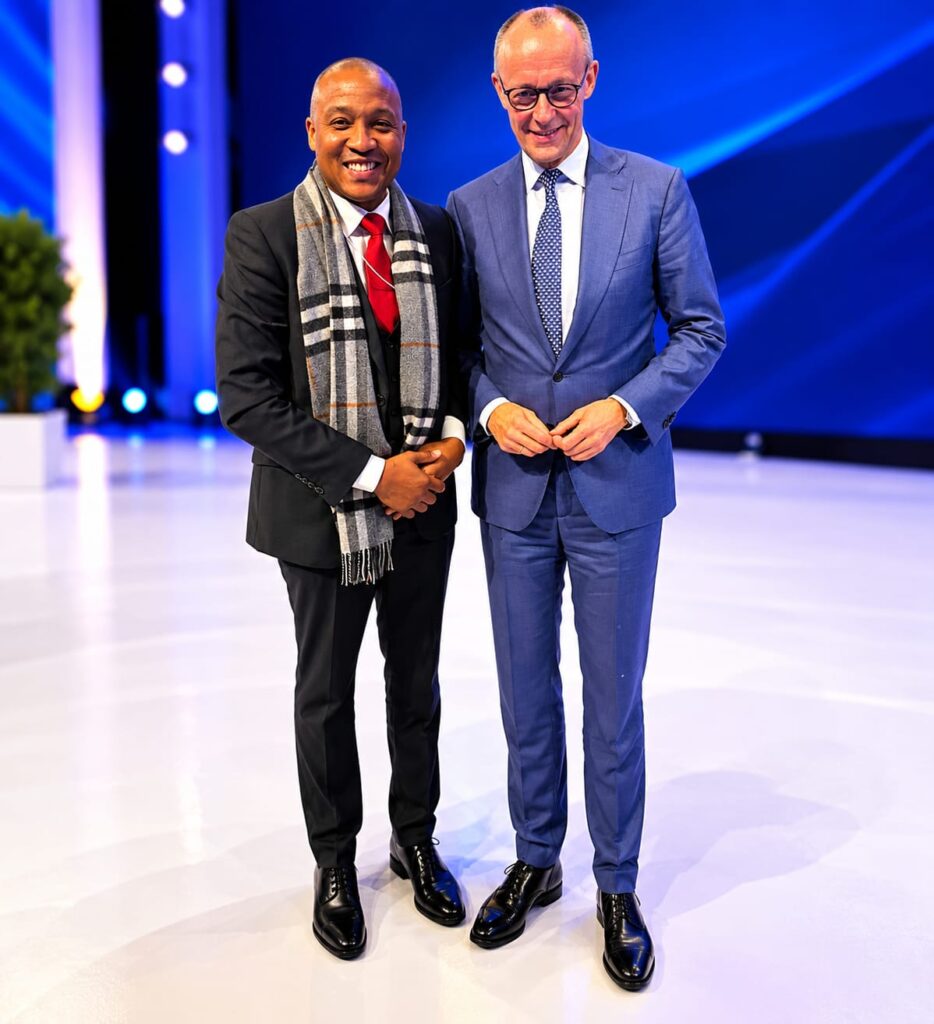
KINGSTON, Jamaica — For years, Paul Simpson’s international engagements could easily have been read as high-level networking: a Jamaican financial-sector executive photographed with global political and business figures at major international forums.But as Cornerstone moves Barita into a new phase involving digital banking, asset management, real estate, regional expansion and technology-led financial services, those meetings are being presented by the group as part of a broader process: studying how larger and faster-moving economies have built the systems Jamaica now needs to compete.The photographs tell part of that story.They place Simpson, founder, president and chief executive officer of Cornerstone, alongside figures associated with technology, payments, infrastructure, industrial development, financial policy and economic transformation. For Cornerstone, the relevance is not simply access, but exposure — to ideas, institutions and execution models that may help shape the group’s next phase.That phase now extends well beyond Barita’s historic identity as an investment house.Cornerstone’s wider ambition is to position Barita as a platform sitting at the intersection of banking, technology, capital, real estate and regional development. The central bet is that a Jamaican financial group can build locally, learn globally and eventually compete across a wider regional market.The first part of that thinking is technology.One of Simpson’s engagements was with Elon Musk, founder of SpaceX, Tesla and xAI and co-founder of PayPal. For Simpson, the meeting carried two points of relevance. The first was national: he used the opportunity to thank Musk for the role Starlink played in helping restore connectivity in Jamaica after Hurricane Melissa, when reliable communications became essential to relief, recovery and coordination.The second was strategic.Before Musk became globally associated with electric vehicles, space exploration and artificial intelligence, he was one of the entrepreneurs behind PayPal, a company that helped reshape digital payments and showed how technology could change the movement of money.That history matters to Cornerstone because the group’s own digital banking ambitions are built around a similar question: how can technology reduce friction in financial services and make transactions faster, cheaper and more accessible?Through its Miami-based technology operations, Cornerstone has sought to place itself closer to the talent, partners and innovation networks shaping payments, banking, artificial intelligence, customer experience and digital transformation.“Our view has always been that Jamaica and the Caribbean should not be spectators in the next wave of financial technology,” Simpson said. “We have to build relationships with the people and ecosystems shaping the future, understand the technologies that are transforming payments and banking globally, and then apply those lessons in ways that solve real problems for our people.”That technology lens also explains Simpson’s engagement in Latin America.In another photograph, Simpson is seen with Edgar Amador Zamora, Mexico’s secretary of finance and public credit. The connection is relevant because Mexico has become one of Latin America’s more important fintech markets, with growing activity in digital payments, digital banking, financial inclusion and technology-enabled financial services.For Cornerstone, Latin America is not being viewed only as a neighbouring region, but as a market laboratory.Many of the problems Barita’s digital banking platform is intended to address in Jamaica are also present across parts of Latin America and the Caribbean: underserved customers, high transaction costs, dependence on remittances, limited banking access, and small businesses seeking faster ways to move money.“Many of the challenges we are seeking to solve are not unique to Jamaica,” Simpson said. “Across Latin America and the Caribbean there are millions of people who remain underserved by traditional financial institutions, millions more who depend on remittances, and countless businesses seeking faster, more efficient ways to transact.”He said Cornerstone is thinking beyond a Jamaica-only model.“As we build our platform, we are not only thinking about Jamaica. We are thinking about how technology can create a more connected financial ecosystem across the wider region,” Simpson said.If the Mexico connection speaks to financial inclusion and regional scale, Simpson’s engagement with Germany points to another part of the group’s thinking: competitiveness.In a photograph with Friedrich Merz, chancellor of Germany, Simpson is placing emphasis on a country long associated with industrial development, engineering, renewable energy and technological innovation.For Jamaica, those themes matter because the country continues to face long-running constraints around energy costs, infrastructure gaps, productivity, logistics and competitiveness. Cornerstone’s interest in those issues goes beyond financial services, particularly as the group expands its real estate and development interests.Simpson said the value of these engagements is in understanding how more advanced economies have approached long-term economic transformation.“One of the most important responsibilities of leadership is to ensure that Jamaica remains connected to the best ideas, technologies, and opportunities available globally,” Simpson said. “Whether the discussion is about finance, energy, infrastructure, innovation, or economic development, there is tremendous value in learning from countries that have successfully navigated similar challenges.”The infrastructure piece is even more explicit in Simpson’s engagement with Türkiye.A photograph of Simpson with Recep Tayyip Erdoğan, president of Türkiye, points to a country that has spent the past two decades undertaking major infrastructure development across transportation, housing, logistics, energy, ports, airports and urban development.For Cornerstone, Türkiye offers a different kind of lesson: how emerging economies execute large projects at scale.That matters as the group’s ambitions increasingly extend into real estate and development. Cornerstone has been building a portfolio of strategic land holdings with potential applications across residential, commercial, industrial, tourism and infrastructure-related projects. Those activities are expected to be led by Bernhard Stocker, the group’s recently appointed CEO for real estate development.The group has also spent years developing relationships with Turkish construction, engineering and infrastructure firms, with the aim of understanding how global project execution and construction management practices could be adapted to Jamaica and the wider Caribbean.“As we look at Jamaica’s future, we believe there is tremendous value in studying countries that have successfully transformed their economies through infrastructure investment and disciplined execution,” Simpson said. “Türkiye’s experience demonstrates what can be achieved when long-term vision is matched with the ability to deliver.”Taken together, the photographs show the outline of Cornerstone’s wider playbook.Musk represents technology, payments, artificial intelligence and connectivity. Mexico points to financial inclusion and regional digital banking scale. Germany speaks to industrial competitiveness, energy and innovation. Türkiye points to infrastructure delivery and large-scale development.The common thread is Simpson’s argument that Jamaica and the Caribbean cannot build their next phase of growth in isolation.For Cornerstone, that thinking now sits behind Barita’s transformation. The group is trying to move from a conventional financial-services model into a broader platform that combines banking, investments, technology, real estate and regional ambition.But the challenge is execution.Relationships with global leaders and institutions may provide access to ideas, capital and expertise, but they do not guarantee customer adoption, profitable projects or successful regional expansion. The real test will be whether Cornerstone can turn global exposure into local products, investable projects and measurable value for customers and shareholders.That makes the next phase of Barita’s development less about any single approval, acquisition or photograph.It is about whether a Jamaican financial group can use global relationships to help build a Caribbean platform — and whether the ambition behind the images can be converted into results.
Narrative Intelligence Brief
This article was published by Jamaica Observer, a source frequently categorized with a Unknown bias based in Jamaica. Our narrative intelligence engine continuously monitors coverage from this outlet to track framing, bias, and rhetorical patterns. Our initial algorithmic scan of this specific piece did not flag high-confidence rhetorical techniques, suggesting a generally straightforward reporting style or neutral framing. By understanding the editorial perspective of Jamaica Observer, readers can better contextualize the information presented and compare it across our broader media matrix to find the real narrative.
Explore related topics: Stay informed with Real Narrative News as we track unfolding stories. Dive deeper into our coverage of pivotal topics including strikes iran, costa rica, nba finals, white house, patrick bruel, social media, coupe monde, donald trump, iran war, and cup warmup. Our intelligence streams continuously monitor these keywords to bring you unbiased analysis and real-time updates on topics like "The world behind Barita’s next chapter".
More from Jamaica Observer
June 10, 2026
3.5 magnitude earthquake felt in parts of Jamaica
June 10, 2026
Brown urges faster cybersecurity legislation after reported NHF cyber incident
June 10, 2026
Jordan Scott rebounds to win triple jump at Oslo DL
June 10, 2026
The world behind Barita’s next chapter
June 10, 2026
Assault case against Spanish Town mayor resolved through mediation
Analysis Methodology
This narrative analysis was generated using the CoDataLab Global Intelligence Engine. Our proprietary AI scans thousands of cross-border sources to identify sentiment patterns, framing techniques, and potential media bias. While AI provides the data-driven foundation, our objective is to empower readers with additional context beyond the standard headline.The content displayed above is a structured summary designed for rapid information processing. For the full original report, please visit the source outlet.More Coverage
Discussion