
Today in News History
On June 22, several notable moments in the history of News stand out. In 1633, The Holy Office in Rome forces Galileo Galilei to recant his view that the Sun, not the Earth, is the center of the Universe in the form he presented it in, after heated controversy. In 1828, Lars Ingier, Norwegian road manager, land owner, and mill owner (born 1760) passed away. In 1907, The London Underground's Charing Cross, Euston and Hampstead Railway opens. In 1926, George Englund, American film editor, director, producer and actor (died 2017) was born. In 1944, World War II: Opening day of the Soviet Union's Operation Bagration against the Army Group Centre. In 1960, Erin Brockovich, American lawyer and environmentalist was born. In 2000, Wuhan Airlines Flight 343 is struck by lightning and crashes into Wuhan's Hanyang District, killing 49 people. In 2004, Bob Bemer, American computer scientist and engineer (born 1920) passed away. In 2007, The small town of Elie, Manitoba is hit by Canada’s most intense tornado on record. In 2009, A Washington D.C Metro train traveling southbound near Fort Totten station collides into another train waiting to enter the station. Nine people are killed in the collision (eight passengers and the train operator) and at least 80 others are injured. Together, these milestones provide historical context for today's news news and ongoing narratives.
Some Electricians Think Building Data Centers Is for Sellouts

Big Tech is throwing big money into data center buildouts. As national opposition to the facilities grows, some workers are beginning to question whether it’s worth it.
Narrative Intelligence Brief
This article was published by Wired, a source frequently categorized with a lean left bias based in United States of America. Our narrative intelligence engine continuously monitors coverage from this outlet to track framing, bias, and rhetorical patterns. Our initial algorithmic scan of this specific piece did not flag high-confidence rhetorical techniques, suggesting a generally straightforward reporting style or neutral framing. By understanding the editorial perspective of Wired, readers can better contextualize the information presented and compare it across our broader media matrix to find the real narrative.
More from Wired
June 22, 2026
These Are the 12 Ikea Products the Company's Design Chief Personally Owns
June 22, 2026
The UK Just Lost Its Sixth Prime Minister of the Decade
June 22, 2026
The UK Just Lost Its Sixth Prime Minster of the Decade
June 22, 2026
World Cup Scams Are Getting Harder to Spot
June 22, 2026
Dyson Promo Codes: 25% Off in June 2026
Analysis Methodology
This narrative analysis was generated using the CoDataLab Global Intelligence Engine. Our proprietary AI scans thousands of cross-border sources to identify sentiment patterns, framing techniques, and potential media bias. While AI provides the data-driven foundation, our objective is to empower readers with additional context beyond the standard headline.The content displayed above is a structured summary designed for rapid information processing. For the full original report, please visit the source outlet.More Coverage
Discussion
"keir starmer"
Breaking! Keir Starmer Steps Down, Trump’s Cuba Threats, Oil Barrel Crisis | PBD #821

Full text: Prime Minister Keir Starmer’s resignation speech
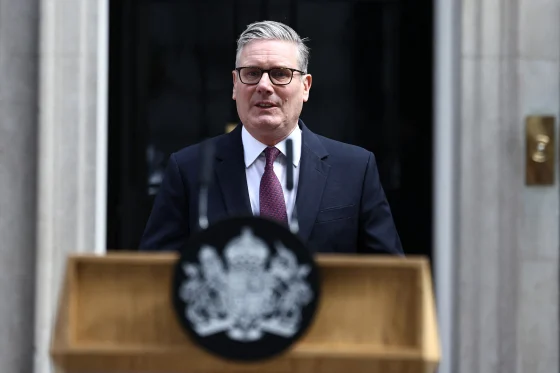
U.K. Prime Minister Keir Starmer Quits After Party Rebellion
