
Today in News History
On July 12, several notable moments in the history of News stand out. In 981, Xue Juzheng, Chinese scholar-official and historian passed away. In 1493, Hartmann Schedel's Nuremberg Chronicle, one of the best-documented early printed books, is published. In 1580, The Ostrog Bible, one of the early printed Bibles in a Slavic language, is published. In 1850, Otto Schoetensack, German anthropologist and academic (died 1912) was born. In 1879, Margherita Piazzola Beloch, Italian mathematician (died 1976) was born. In 1902, Günther Anders, German philosopher and journalist (died 1992) was born. In 1914, Mohammad Moin, Iranian linguist and lexicographer (died 1971) was born. In 1926, Gertrude Bell, English archaeologist and spy (born 1868) passed away. In 1966, D. T. Suzuki, Japanese philosopher and author (born 1870) passed away. In 1975, São Tomé and Príncipe declare independence from Portugal. Together, these milestones provide historical context for today's news news and ongoing narratives.
Scientists Have Deciphered the Surviving Fragments of a 2,000-Year-Old Philosophical Treatise Frozen in Time by Mount Vesuvius' Eruption
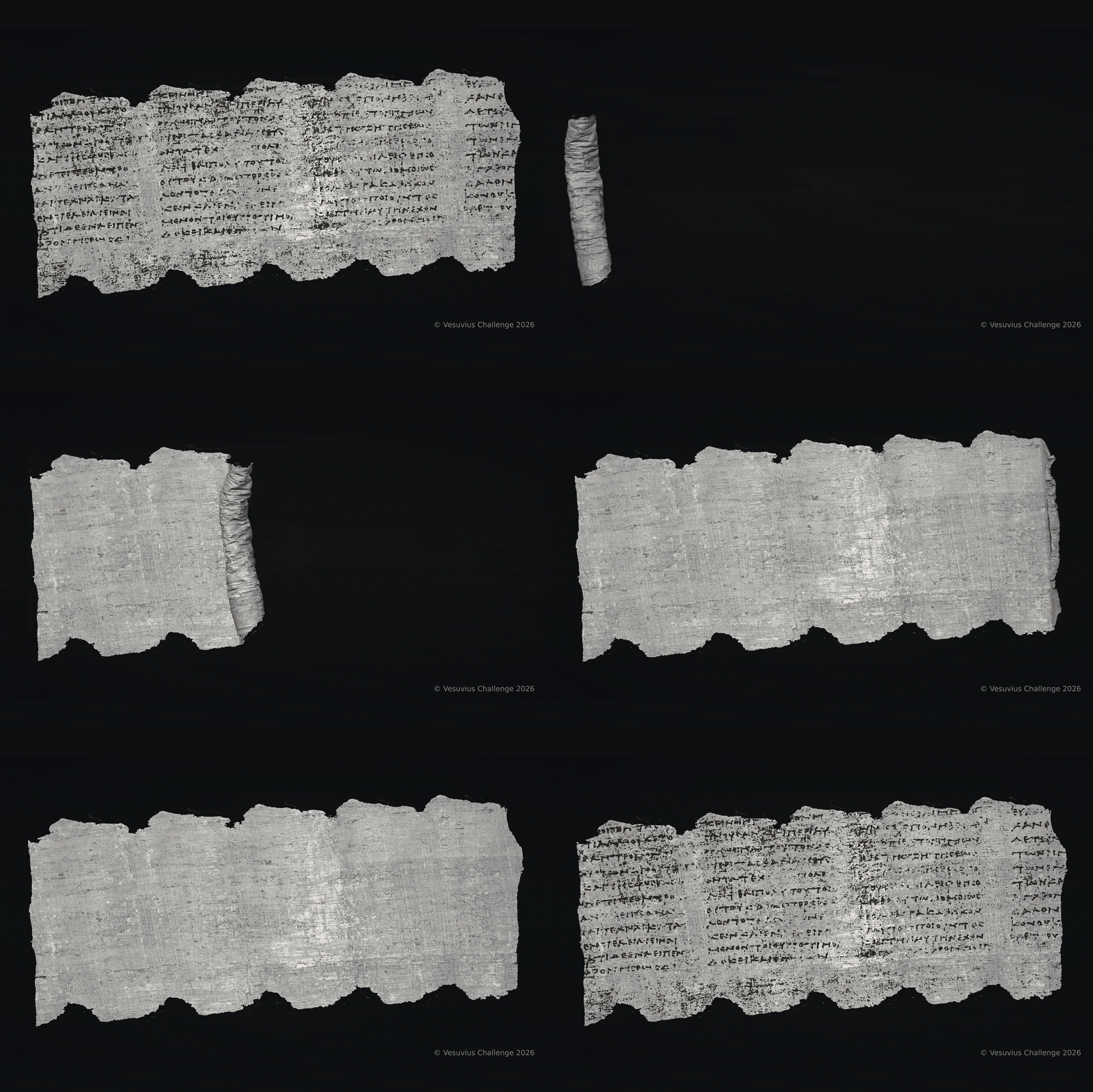
The papyrus manuscript was part of a vast library preserved by volcanic ash. Now, the remaining passages—which examine ethics, knowledge and human nature—are accessible for the first time since 79 C.E.
Narrative Intelligence Brief
This article was published by Smithsonian Magazine, a source frequently categorized with a center bias based in United States of America. Our narrative intelligence engine continuously monitors coverage from this outlet to track framing, bias, and rhetorical patterns. Our initial algorithmic scan of this specific piece did not flag high-confidence rhetorical techniques, suggesting a generally straightforward reporting style or neutral framing. By understanding the editorial perspective of Smithsonian Magazine, readers can better contextualize the information presented and compare it across our broader media matrix to find the real narrative.
More from Smithsonian Magazine
July 10, 2026
See Artifacts That Archaeologists Discovered in This 1,600-Year-Old Byzantine Christian Town Buried in an Oasis in Egypt
July 10, 2026
Cases of a Parasitic Infection That Can Cause Diarrhea for Weeks Are Rapidly Rising in the U.S. Here's What to Know
July 10, 2026
In the Latest Brazen Heist, Jewelry and Artworks Worth $5 Million Were Stolen From a Famed French Designer's Museum
July 10, 2026
An Ancient Sea Once Split North America Down the Middle. The Beautiful Multicolored Ammonite Shells From Its Waters Are So Perfectly Preserved That They Still Shimmer Today
July 10, 2026
DNA Reveals the Identity of a Teenager Who Died in the Revolutionary War, Cracking a Nearly 250-Year-Old Cold Case
Analysis Methodology
This narrative analysis was generated using the CoDataLab Global Intelligence Engine. Our proprietary AI scans thousands of cross-border sources to identify sentiment patterns, framing techniques, and potential media bias. While AI provides the data-driven foundation, our objective is to empower readers with additional context beyond the standard headline.The content displayed above is a structured summary designed for rapid information processing. For the full original report, please visit the source outlet.More Coverage
Discussion
"alexander zverev"



How other outlets are covering this story
Compare narratives across 6 related reports from 6 sources. Real Narrative News aggregates the coverage spectrum so you can see who emphasises what — bias tags reflect the outlet, not the story.
Coverage bias distribution
6 sources
Left 0%
Center 33%
Right 17%
https://cdn.mos.cms.futurecdn.net/mpNwB8YVJPXWns7gXUQJGG.jpg
· Jun 29, 2026
2,000-year-old scrolls buried by Mount Vesuvius eruption finally deciphered with help from AI
2,000-year-old scrolls buried by Mount Vesuvius eruption finally deciphered with help from AI
AzerNews
· Jun 25, 2026
AI reveals hidden text in 2,000-year-old Vesuvius scroll
A fragment of an ancient scroll that was charred during the eruption of Mount Vesuvius nearly 2,000 years ago has been digitally unwrapped and read using artificial intelligence (AI).
NASA
· Jul 1, 2026
Curiosity Blog, Sols 4934-4940: In the Land of the Polygons
Written by William Farrand, Senior Research Scientist, Space Science Institute Earth planning date: Friday, June 26, 2026 There were two planning cycles over this span of sols. The Monday planning took place with Curiosity situated within a unit that from orbital imagery appeared light-toned, and from earlier rover positions appeared smooth. Reaching this unit, the []
NaturalNews.com
· Jul 10, 2026
Scientists Identify 73 Previously Unknown Underwater Volcanoes
(NaturalNews) Discovery of Submarine CalderasResearchers have identified 73 previously unknown volcanic calderas on the ocean floor using an algorithm originally ...
https://cdn.mos.cms.futurecdn.net/FMSikpAkYAreBN56NmDycS.jpg
· Jul 1, 2026
Ancient-DNA analysis solves 500-year-old mystery of what killed 2 Medici brothers
Ancient-DNA analysis solves 500-year-old mystery of what killed 2 Medici brothers
Ancient Pages
· Jul 2, 2026
2,000-Year-Old Vesuvius Papyrus Scroll PHerc. 1667 Deciphered With Help Of AI
Jan Bartek - AncientPages.com - An ancient scroll that survived the eruption of Mount Vesuvius in 79 AD has finally given up its secrets. The scroll was found in the 1750s, but it was too delicate to open. Thanks to AI technology, scholars have now read the entire text, which turns out to be a []
Topics:
Related coverage for "Scientists Have Deciphered the Surviving Fragments of a 2,000-Year-Old Philosophical Treatise Frozen in Time by Mount Vesuvius' Eruption": https://cdn.mos.cms.futurecdn.net/mpNwB8YVJPXWns7gXUQJGG.jpg — 2,000-year-old scrolls buried by Mount Vesuvius eruption finally deciphered with help from AI . AzerNews — AI reveals hidden text in 2,000-year-old Vesuvius scroll. NASA — Curiosity Blog, Sols 4934-4940: In the Land of the Polygons. NaturalNews.com — Scientists Identify 73 Previously Unknown Underwater Volcanoes. https://cdn.mos.cms.futurecdn.net/FMSikpAkYAreBN56NmDycS.jpg — Ancient-DNA analysis solves 500-year-old mystery of what killed 2 Medici brothers . Ancient Pages — 2,000-Year-Old Vesuvius Papyrus Scroll PHerc. 1667 Deciphered With Help Of AI