
Today in News History
On July 12, several notable moments in the history of News stand out. In 1807, Thomas Hawksley, English engineer and academic (died 1893) was born. In 1850, Otto Schoetensack, German anthropologist and academic (died 1912) was born. In 1863, Albert Calmette, French physician, bacteriologist, and immunologist (died 1933) was born. In 1884, Louis B. Mayer, Russian-born American film producer, co-founded Metro-Goldwyn-Mayer (died 1957) was born. In 1888, Zygmunt Janiszewski, Polish mathematician and academic (died 1920) was born. In 1895, Buckminster Fuller, American architect and engineer, designed the Montreal Biosphère (died 1983) was born. In 1909, Herbert Zim, American naturalist, author, and educator (died 1994) was born. In 1928, Elias James Corey, American chemist and academic, Nobel Prize laureate was born. In 1935, Satoshi Ōmura, Japanese biochemist and academic, Nobel Prize laureate was born. In 2015, Cheng Siwei, Chinese engineer, economist, and politician (born 1935) passed away. Together, these milestones provide historical context for today's news news and ongoing narratives.
Scientists built a cell from scratch that eats, divides and evolves. They just won’t call it alive
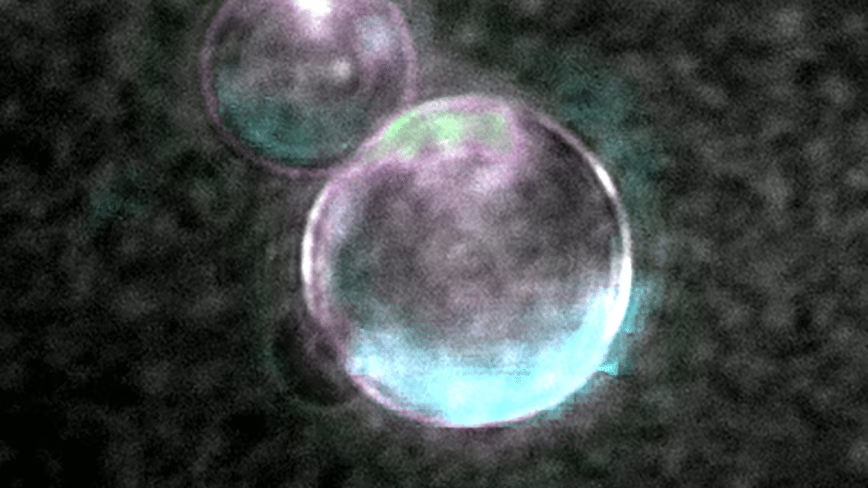
Scientists in Minnesota have built a cell from scratch. It can feed, grow, and divide, and it competes with its own offspring. Its makers do not claim it is alive. But the line between chemistry and biology just got a lot thinner. The team at the University of Minnesota calls its creation SpudCell, and says [] This story continues at The Next Web
Narrative Intelligence Brief
This article was published by The Next Web, a source frequently categorized with a lean left bias based in Netherlands. Our narrative intelligence engine continuously monitors coverage from this outlet to track framing, bias, and rhetorical patterns. Our initial algorithmic scan of this specific piece did not flag high-confidence rhetorical techniques, suggesting a generally straightforward reporting style or neutral framing. By understanding the editorial perspective of The Next Web, readers can better contextualize the information presented and compare it across our broader media matrix to find the real narrative.
More from The Next Web
July 12, 2026
Ubisoft is in crisis, and a 13-year-old pirate game is part of the escape plan
July 12, 2026
Netflix is reportedly considering always-on channels and bundles, which is to say, cable
July 12, 2026
AI has triggered the biggest gas-plant building boom in history, and a quiet fight to stop it
July 12, 2026
Zhipu’s founder says frontier AI should stay open to everyone. His own government may disagree.
July 12, 2026
Meta spent a year being punished for its AI spending. Then it told investors how it would get the money back.
Analysis Methodology
This narrative analysis was generated using the CoDataLab Global Intelligence Engine. Our proprietary AI scans thousands of cross-border sources to identify sentiment patterns, framing techniques, and potential media bias. While AI provides the data-driven foundation, our objective is to empower readers with additional context beyond the standard headline.The content displayed above is a structured summary designed for rapid information processing. For the full original report, please visit the source outlet.More Coverage
Discussion
"lindsey graham"
Outrage as Trump and Netanyahu accused of using Lindsey Graham’s death to promote agendas

'Meet the Press’ Host Addresses Lindsey Graham's Death After Interview Plan

"No Conspiracy": Former Israeli Consul Dismisses Conspiracy Theories about Lindsey Graham's Death
How other outlets are covering this story
Compare narratives across 6 related reports from 6 sources. Real Narrative News aggregates the coverage spectrum so you can see who emphasises what — bias tags reflect the outlet, not the story.
Coverage bias distribution
6 sources
Left 33%
Center 17%
Right 17%
Daily Mail
· Jul 2, 2026
Scientists BUILD a cell from scratch: Synthetic organism can feed, grow, copy its DNA and divide in world-first breakthrough
Scientists BUILD a cell from scratch: Synthetic organism can feed, grow, copy its DNA and divide in world-first breakthrough
BoingBoing
· Jul 3, 2026
A synthetic cell grew, copied its DNA, and split in two
A synthetic cell built from scratch — no living components, just liposomes, DNA, and 36 commercial enzymes standing in for protein synthesis — grew, copied its own DNA, and split into two, according to Quanta's report on this synthetic-cell milestone: the first time researchers have watched an artificial cell complete a full division cycle. — Read the rest The post A synthetic cell grew, copied its DNA, and split in two appeared first on Boing Boing.
https://cdn.mos.cms.futurecdn.net/StCsomdk7AdY2q5dEqLFAV.jpg
· Jul 6, 2026
Scientists just created the most lifelike cell ever made in a lab — here's what it could accomplish
Scientists just created the most lifelike cell ever made in a lab — here's what it could accomplish
https://cdn.mos.cms.futurecdn.net/468oRmsak796WaimXBHwL9.png
· Jul 2, 2026
New synthetic cells tiptoe toward creating life
New synthetic cells tiptoe toward creating life
The Eastern Herald
· Jul 1, 2026
Scientists Build the First Synthetic Cell That Can Grow, Divide and Compete
University of Minnesota scientists say a synthetic cell called SpudCell, built entirely from non-living chemical components, has completed a full biological life cycle for the first time, growing, replicating its DNA and dividing into daughter cells without starting from any living organism.
Crooks and Liars
· Jul 7, 2026
Scientists Create First Synthetic Cell
This is kind of wild. CBS News, Scientists at the University of Minnesota say they've made the first synthetic cell that can complete a life cycle, a major breakthrough that could lead to innovation in the medicine and engineering fields. Called SpudCell — a play on the first space satellite Sputnik — it is made entirely from chemical components but can grow, divide and replicate. Quanta Magazine explains: For the very first time, biologists packed nonliving components into a cell-like membrane, piece by piece, and witnessed the bag of molecules start to behave like life. The lab-made synthetic cell grew, replicated its DNA, and divided, demonstrating the basic functions of a cell cycle. It’s “an impressive step,” said Jack Szostak (opens a new tab), who studies the origins of life at the University of Chicago and was not involved in the research. “I don’t know of any other effort to put together an artificial cell from biological components that has progressed so far.” read more
Topics:
Related coverage for "Scientists built a cell from scratch that eats, divides and evolves. They just won’t call it alive": Daily Mail — Scientists BUILD a cell from scratch: Synthetic organism can feed, grow, copy its DNA and divide in world-first breakthrough. BoingBoing — A synthetic cell grew, copied its DNA, and split in two. https://cdn.mos.cms.futurecdn.net/StCsomdk7AdY2q5dEqLFAV.jpg — Scientists just created the most lifelike cell ever made in a lab — here's what it could accomplish . https://cdn.mos.cms.futurecdn.net/468oRmsak796WaimXBHwL9.png — New synthetic cells tiptoe toward creating life . The Eastern Herald — Scientists Build the First Synthetic Cell That Can Grow, Divide and Compete. Crooks and Liars — Scientists Create First Synthetic Cell