Today in News History
On June 17, several notable moments in the history of News stand out. In 1861, American Civil War: Battle of Vienna, Virginia. In 1863, American Civil War: Battle of Aldie in the Gettysburg Campaign. In 1932, Bonus Army: Around a thousand World War I veterans amass at the United States Capitol as the U.S. Senate considers a bill that would give them certain benefits. In 1940, The three Baltic states of Estonia, Latvia and Lithuania fall under the occupation of the Soviet Union. In 1953, Cold War: East Germany Workers Uprising: In East Germany, the Soviet Union orders a division of troops into East Berlin to quell a rebellion. In 1963, A day after South Vietnamese President Ngô Đình Diệm announced the Joint Communiqué to end the Buddhist crisis, a riot involving around 2,000 people breaks out. One person is killed. In 1966, Mohammed Ghazy Al-Akhras, Iraqi journalist and author was born. In 1967, Nuclear weapons testing: China announces a successful test of its first thermonuclear weapon. In 1992, A "joint understanding" agreement on arms reduction is signed by U.S. President George Bush and Russian President Boris Yeltsin (this would be later codified in START II). In 2013, Atiqul Haque Chowdhury, Bangladeshi playwright and producer (born 1930) passed away. Together, these milestones provide historical context for today's news news and ongoing narratives.
READ IN FULL: The 14-point peace agreement with Iran
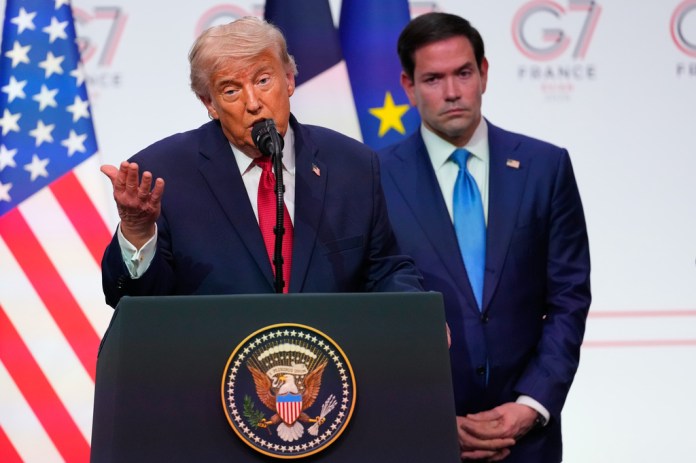
A senior Trump administration official read the 14-point Iran agreement to reporters on Wednesday afternoon, ending days of speculation about the contents of a memorandum of understanding meant to wind down the three-month conflict. President Donald Trump and Vice President JD Vance apparently signed the MOU on Sunday electronically, but a draft copy was leaked []
Narrative Intelligence Brief
This article was published by Washington Examiner, a source frequently categorized with a lean right bias based in United States of America. Our narrative intelligence engine continuously monitors coverage from this outlet to track framing, bias, and rhetorical patterns. Our initial algorithmic scan of this specific piece did not flag high-confidence rhetorical techniques, suggesting a generally straightforward reporting style or neutral framing. By understanding the editorial perspective of Washington Examiner, readers can better contextualize the information presented and compare it across our broader media matrix to find the real narrative.
More from Washington Examiner
June 17, 2026
Rhode Island judge faces misconduct complaint over attacks on DOJ lawyers
June 17, 2026
Top five hot mic moments from world leaders at G7 Summit
June 17, 2026
Trump jokes that Vance will take blame if Iran peace deal falls apart: ‘I like that idea’
June 17, 2026
Warsh-led Fed holds rates steady, as inflation rules out easing sought by Trump
June 17, 2026
The real scandal in California elections is what is legal
Analysis Methodology
This narrative analysis was generated using the CoDataLab Global Intelligence Engine. Our proprietary AI scans thousands of cross-border sources to identify sentiment patterns, framing techniques, and potential media bias. While AI provides the data-driven foundation, our objective is to empower readers with additional context beyond the standard headline.The content displayed above is a structured summary designed for rapid information processing. For the full original report, please visit the source outlet.More Coverage
Discussion