
Today in News History
On July 12, several notable moments in the history of News stand out. In 1909, Herbert Zim, American naturalist, author, and educator (died 1994) was born. In 1918, The Imperial Japanese Navy battleship Kawachi blows up at Shunan, western Honshu, Japan, killing at least 621. In 1935, Satoshi Ōmura, Japanese biochemist and academic, Nobel Prize laureate was born. In 1948, Elias Khoury, Lebanese intellectual, playwright and novelist (died 2024) was born. In 1959, David Brown, Australian meteorologist was born. In 1967, Riots begin in Newark, New Jersey. In 1979, Maya Kobayashi, Japanese journalist was born. In 1995, Chinese seismologists successfully predict the 1995 Myanmar-China earthquake, reducing the number of casualties to 11. In 2006, The 2006 Lebanon War begins. In 2014, Kenneth J. Gray, American soldier and politician (born 1924) passed away. Together, these milestones provide historical context for today's news news and ongoing narratives.
Pacific gray whales facing ‘catastrophic’ die-off as climate crisis hits food supply
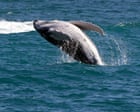
Trump administration urged to relist a species in ‘very, very serious trouble’ under Endangered Species ActClimate change is driving a gray whale “catastrophic mortality event” in the Pacific Ocean as melting sea ice depletes food sources and the animals starve, environmental groups warn.Meanwhile, a range of other issues, like ship strikes, oil spills, microplastic pollution, algal blooms and Russian harvesting are also probably contributing to the die-off that has nearly halved the whales’ estimated population. It fell from 20,000 in 2019 to fewer than 13,000 this year, and the deaths appear to be accelerating. Continue reading...
Narrative Intelligence Brief
This article was published by Wildlife | The Guardian, a source frequently categorized with a lean left bias based in United Kingdom. Our narrative intelligence engine continuously monitors coverage from this outlet to track framing, bias, and rhetorical patterns. Our initial algorithmic scan of this specific piece did not flag high-confidence rhetorical techniques, suggesting a generally straightforward reporting style or neutral framing. By understanding the editorial perspective of Wildlife | The Guardian, readers can better contextualize the information presented and compare it across our broader media matrix to find the real narrative.
More from Wildlife | The Guardian
July 12, 2026
Starmer is expected to use last week in power to push through Hillsborough law
July 12, 2026
World Cup 2026 power rankings: who leads the pack as semi-finals loom?
July 12, 2026
Big game Bellingham steps up again with show-stopping World Cup run for England | Andrew Beasley
July 12, 2026
Gianni Infantino hints at expansion to 64-team World Cup before 2030 event
July 12, 2026
Football Daily | Was Tuchel and Bellingham really a Keane v McCarthy moment?
Analysis Methodology
This narrative analysis was generated using the CoDataLab Global Intelligence Engine. Our proprietary AI scans thousands of cross-border sources to identify sentiment patterns, framing techniques, and potential media bias. While AI provides the data-driven foundation, our objective is to empower readers with additional context beyond the standard headline.The content displayed above is a structured summary designed for rapid information processing. For the full original report, please visit the source outlet.More Coverage
Discussion
"cup semifinal"
France vs. Spain odds, prediction, time: 2026 World Cup semifinal picks from expert on 19-7 run

[Photo] JUST IN: 🇦🇷 Argentina officially advances to the FIFA World Cup semifinal after defeat [...]

2026 World Cup Semifinal Odds: France, England Favored In Final Four Tilts

How other outlets are covering this story
Compare narratives across 6 related reports from 6 sources. Real Narrative News aggregates the coverage spectrum so you can see who emphasises what — bias tags reflect the outlet, not the story.
Coverage bias distribution
6 sources
Left 50%
Center 17%
Right 33%
RTÉ News
· Jun 28, 2026
Humpback whales visiting coast earlier each year – study
Humpback whales are visiting the Irish coastline, earlier each year, correlating with rising global ocean temperatures, according to new academic research.
Korea Times News
· Jul 2, 2026
Warmer seas bring endangered whale shark to Jeju coast
Warmer seas bring endangered whale shark to Jeju coast
Boston.com
· Jun 27, 2026
Is the Trump administration on the verge of further endangering North Atlantic right whales?
Experts say maritime slow zones protect the whales, but a major rollback of these rules could be on the horizon. The post Is the Trump administration on the verge of further endangering North Atlantic right whales? appeared first on Boston.com.
9 News Australia
· Jun 22, 2026
How AI is listening to whales beneath the surface | 9 News Australia
#EXCLUSIVE: #9News was given an up-close look at the new, underwater technology listening to whales as they migrate up and down our east coast. | Subscribe and 🔔: http://9Soci.al/KM6e50GjSK9 | Get more breaking news at 9News.com.au: http://9Soci.al/iyCO50GjSK6 FOLLOW 9News Australia ► Facebook: https://www.facebook.com/9News/ ► Twitter: https://twitter.com/9NewsAUS ► Instagram: https://www.instagram.com/9news/ Join 9News for the latest in news and events that affect you in your local city, as well as news from across Australia and the world. #BREAKINGNEWS #9NEWS #AUSTRALIA
The West Australian
· Jun 27, 2026
Pacific ocean a 'forever chemical' hotspot for whales
Widespread, long-living and top of the food chain, dolphins and other toothed whales are thought to be ideal indicators of forever chemical exposure in oceans.
Smithsonian Magazine
· Jun 26, 2026
Speed Limits for Ships Protect Endangered Right Whales From Vessel Strikes. Could the Animals Survive Without Them?
Since 2008, rules requiring ships to slow down to avoid collisions with North Atlantic right whales have reduced fatalities of the critically endangered animals. Now, NOAA is calling the regulations into question, raising concerns for the mammals’ future
Topics:
Related coverage for "Pacific gray whales facing ‘catastrophic’ die-off as climate crisis hits food supply": RTÉ News — Humpback whales visiting coast earlier each year – study. Korea Times News — Warmer seas bring endangered whale shark to Jeju coast. Boston.com — Is the Trump administration on the verge of further endangering North Atlantic right whales?. 9 News Australia — How AI is listening to whales beneath the surface | 9 News Australia. The West Australian — Pacific ocean a 'forever chemical' hotspot for whales. Smithsonian Magazine — Speed Limits for Ships Protect Endangered Right Whales From Vessel Strikes. Could the Animals Survive Without Them?