
Today in News History
On June 27, several notable moments in the history of News stand out. In 1889, Bangui is founded by Albert Dolisie and Alfred Uzac in what was then the upper reaches of the French Congo. In 1921, Robert Everett, American computer scientist (died 2018) was born. In 1929, Milton Glaser, American illustrator and graphic designer (died 2020) was born. In 1932, Don Valentine, American venture capitalist (died 2019) was born. In 1968, Guðni Th. Jóhannesson, Icelandic lecturer and politician, 6th President of Iceland was born. In 1990, Anni Blomqvist, Finnish author (born 1909) passed away. In 1998, Hacı Sabancı, Turkish businessman and philanthropist (born 1935) passed away. In 2000, The Human Genome Project announces the completion of a "rough draft" sequence. In 2005, Richard Whiteley, English journalist and game show host (born 1943) passed away. In 2020, Milton Glaser, American graphic designer (born 1929) passed away. Together, these milestones provide historical context for today's news news and ongoing narratives.
OpenAI releases its most powerful AI model to just 20 partners, each one approved by the US government
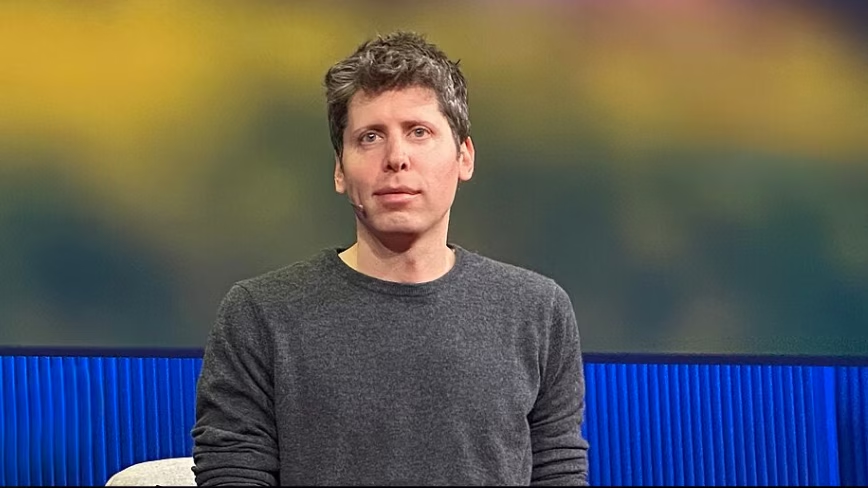
OpenAI has released GPT-5.6 Sol, its most powerful model, to roughly 20 partners whose names were individually approved by the US government. The release is the first time an American AI company has launched a frontier model under a government-managed access list, a step beyond the voluntary pre-release review framework Trump’s AI executive order established [] This story continues at The Next Web
Narrative Intelligence Brief
This article was published by The Next Web, a source frequently categorized with a lean left bias based in Netherlands. Our narrative intelligence engine continuously monitors coverage from this outlet to track framing, bias, and rhetorical patterns. Our initial algorithmic scan of this specific piece did not flag high-confidence rhetorical techniques, suggesting a generally straightforward reporting style or neutral framing. By understanding the editorial perspective of The Next Web, readers can better contextualize the information presented and compare it across our broader media matrix to find the real narrative.
More from The Next Web
June 26, 2026
Ford had to rehire 350 engineers after its AI got vehicle quality wrong
June 26, 2026
Russian hackers were behind the Jaguar Land Rover attack that cost the British economy two and a half billion dollars
June 26, 2026
TikTok is building a super app, and most of its users have not noticed yet
June 26, 2026
A single config file in a cloned repository could steal your AWS credentials through Amazon Q Developer
June 26, 2026
Xprize founder says global surveillance is a good thing because humans behave better when they are being watched
Analysis Methodology
This narrative analysis was generated using the CoDataLab Global Intelligence Engine. Our proprietary AI scans thousands of cross-border sources to identify sentiment patterns, framing techniques, and potential media bias. While AI provides the data-driven foundation, our objective is to empower readers with additional context beyond the standard headline.The content displayed above is a structured summary designed for rapid information processing. For the full original report, please visit the source outlet.More Coverage
Discussion
"venezuela"
Venezuela earthquakes: 589 confirmed dead so far as international rescue teams arrive – as it happened

Forty seconds of chaos that wrecked Venezuela’s comeback

Desperate Search For Quake Survivors in Venezuela’s La Guaira
