Today in News History
On June 17, several notable moments in the history of News stand out. In 632, Yazdegerd III ascends the throne as king (shah) of the Persian Empire. He becomes the last ruler of the Sasanian dynasty (modern Iran). In 1882, Mohammad Mosaddegh, Iranian educator and politician, 60th Prime Minister of Iran (died 1967) was born. In 1888, Alexander Friedmann, Russian physicist and mathematician (died 1925) was born. In 1955, Artemy Troitsky, Russian journalist and critic was born. In 1969, Shami Chakrabarti, English lawyer and academic was born. In 1981, US President Ronald Reagan awards the Congressional Gold Medal to Ken Taylor, Canada's former ambassador to Iran, for helping six Americans escape from Iran during the hostage crisis of 1979-81; he is the first foreign citizen bestowed the honor. In 1994, Rezar, Albanian wrestler was born. In 2000, The Secretary-General of the UN reports that Israel has complied with United Nations Security Council Resolution 425, 22 years after its issuance, and completely withdrew from Lebanon. The Resolution does not encompass the Shebaa farms, which is claimed by Israel, Syria and Lebanon. In 2012, Jorge Lankenau, Mexican banker and businessman (born 1944) passed away. In 2015, American businessman Donald Trump announces his campaign to run for President of the United States in the upcoming election. Together, these milestones provide historical context for today's news news and ongoing narratives.
New details of Trump admin's deal with Iran astound analysts: 'Insane concession'
Narrative Analysis: Name Calling
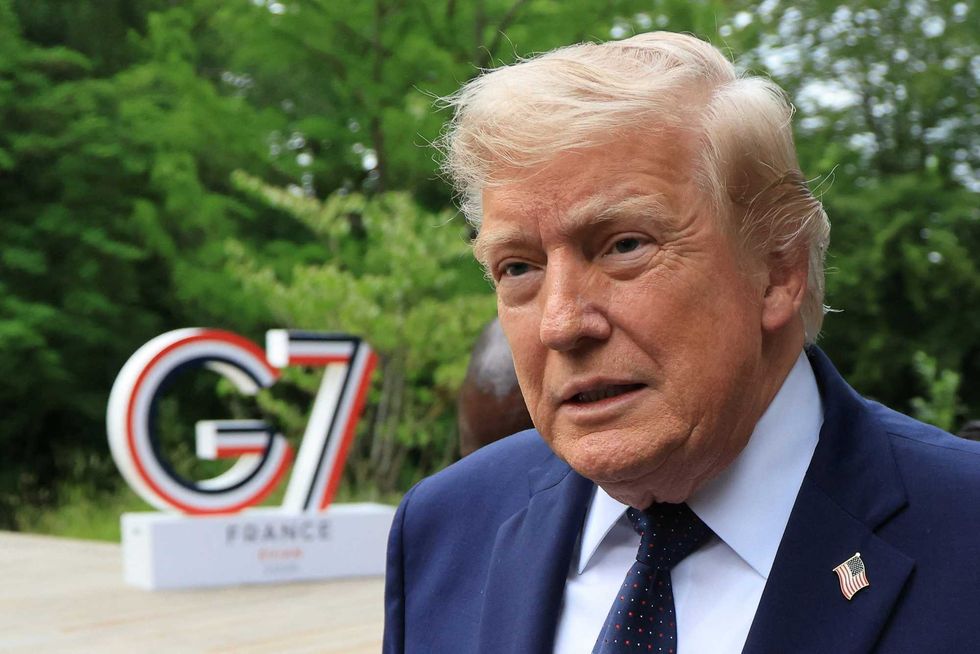
New details of the deal that President Donald Trump's administration struck with the Iranian regime over the weekend astounded political analysts and observers on Tuesday. The Wall Street Journal reported, citing people familiar with the agreement, that one stipulation of the deal is that Iran will be allowed to begin selling oil immediately. That provision takes effect once the agreement is officially signed, and the signing ceremony is tentatively scheduled for Friday. A senior U.S. official said Tuesday that even though Iran would get upfront sanctions relief for oil sales, sustained relief would be tied to Iran’s performance on U.S. demands regarding issues like opening the strategic Strait of Hormuz and its nuclear program. Tehran would still not get immediate access to billions of dollars in frozen funds, the report reads in part. Over the weekend, the Trump administration announced that it had an agreement in place with Iran that could lead to the end of the more than 16-week conflict between the two countries. Experts have questioned the description of the deal as an agreement because it is a framework designed to move the two sides toward a longer-lasting deal. Political analysts and observers were astounded by the WSJ's reporting. Insane concession to Tehran - for simply opening Hormuz, which they were supposed to have done for the ceasefire, and WH says was already open. Under MOU they can get BILLIONS from oil sales, WHICH before the war they couldn’t access even if selling oil. INSANE!! Josh Block, an adjunct fellow at the Hudson Institute, posted on X. Money for nothing and ballistics for free, Philip Klein, editor of National Review Online, posted on X. A lot of think tank Senior Fellows about to have Senior Freakouts, journalist Aaron Maté posted on X. Money upfront, in other words. The thing they said wouldn’t happen, author Michael Weiss posted on X.
Narrative Intelligence Brief
This article was published by Raw Story, a source frequently categorized with a left bias based in United States of America. Our narrative intelligence engine continuously monitors coverage from this outlet to track framing, bias, and rhetorical patterns. In this specific piece, our systems detected the potential use of the "Name Calling" technique. This narrative approach is often used to shape reader perception by highlighting specific emotional or rhetorical angles. By understanding the editorial perspective of Raw Story, readers can better contextualize the information presented and compare it across our broader media matrix to find the real narrative.
More from Raw Story
June 17, 2026
Pete Hegseth faces bipartisan retaliation that would freeze his travel budget: report
June 17, 2026
Trump's biographer exposes Trump as 'totally alone figure' with no intimate life: report
June 17, 2026
MAGA senator gives wildly blunt assessment of Trump chaos: 'Aggressively unpredictable'
June 17, 2026
Trump 'falls flat on his face' as desperation for greatness backfires: columnist
June 17, 2026
Internet reacts to Trump leaning on Prime Minister Narendra Modi for support
Reliability Insights
P
Technique: Name Calling
System analysis detected use of specific narrative techniques in this piece.Analysis Methodology
This narrative analysis was generated using the CoDataLab Global Intelligence Engine. Our proprietary AI scans thousands of cross-border sources to identify sentiment patterns, framing techniques, and potential media bias. While AI provides the data-driven foundation, our objective is to empower readers with additional context beyond the standard headline.The content displayed above is a structured summary designed for rapid information processing. For the full original report, please visit the source outlet.More Coverage
Discussion
"die"
Hiring managers: Don’t make this fatal mistake when writing job descriptions

Lagos police demand retraction of misleading publication on Khan Salihu’s death

‘View’ Hosts Gets Visibly Angry as Their Trap for JD Vance Backfires