
Today in News History
On July 9, several notable moments in the history of News stand out. In 1789, In Versailles, the National Assembly reconstitutes itself as the National Constituent Assembly and begins preparations for a French constitution. In 1790, The Swedish Navy captures one third of the Russian Baltic fleet. In 1807, The second Treaty of Tilsit is signed between France and Prussia, ending the War of the Fourth Coalition. In 1918, Nicolaas Govert de Bruijn, Dutch mathematician and academic (died 2012) was born. In 1943, World War II: The Allied invasion of Sicily begins, leading to the downfall of Mussolini and forcing Hitler to break off the Battle of Kursk. In 1944, World War II: Continuation War: Finland wins the Battle of Tali-Ihantala, the largest battle ever fought in northern Europe. The Red Army withdraws its troops from Ihantala and digs into a defensive position, thus ending the Vyborg-Petrozavodsk Offensive. In 1955, The Russell-Einstein Manifesto calls for a reduction of the risk of nuclear warfare. In 1974, Kārlis Skrastiņš, Latvian ice hockey player (died 2011) was born. In 1985, Paweł Korzeniowski, Polish swimmer was born. In 2004, Paul Klebnikov, American journalist and historian (born 1963) passed away. Together, these milestones provide historical context for today's news news and ongoing narratives.
Nato summit delivers unity and billions in defence deals, Rutte says
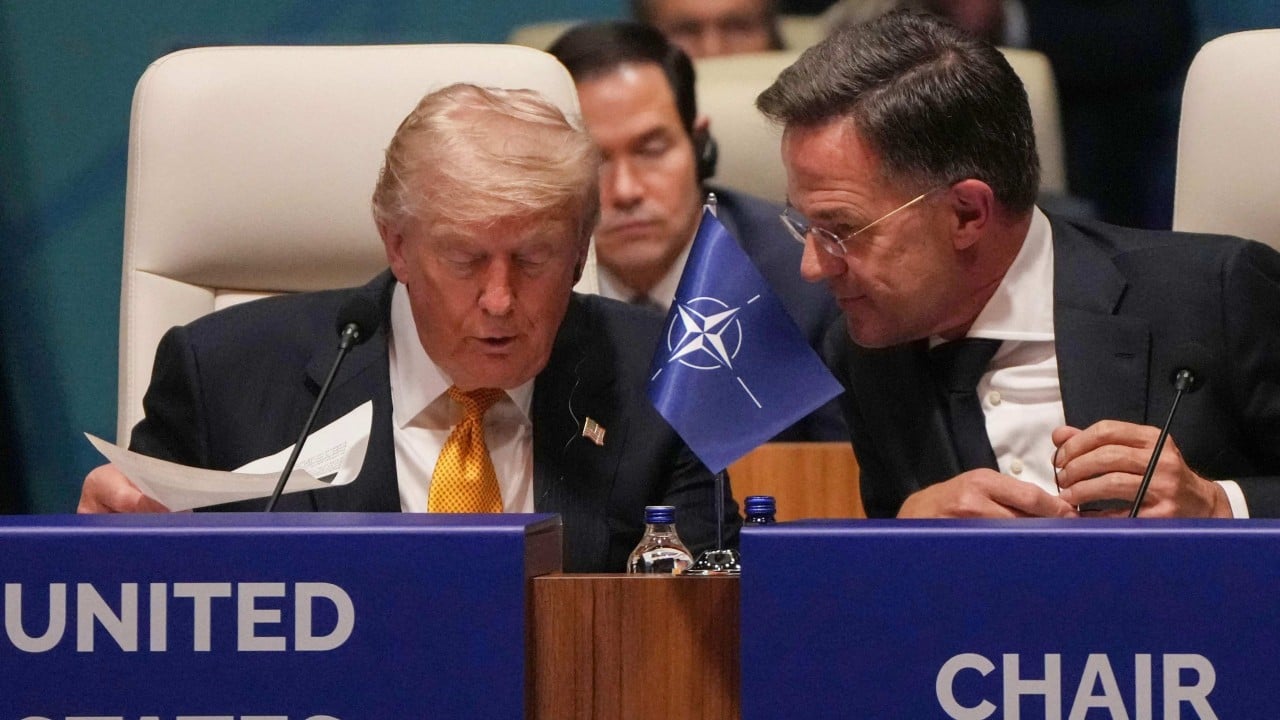
Nato Secretary General Mark Rutte defended US President Donald Trump’s criticism of the transatlantic security alliance, while saying this year’s summit showed “a huge sense of unity” and produced procurement plans worth tens of billions of dollars. During a press conference after the North Atlantic Council meeting of leaders at the Nato summit hosted by Turkey in Ankara on Wednesday, Rutte said this year’s gathering had resulted in more than US50 billion in procurement deals as part of efforts...
Narrative Intelligence Brief
This article was published by South China Morning Post, a source frequently categorized with a lean left bias based in Hong Kong. Our narrative intelligence engine continuously monitors coverage from this outlet to track framing, bias, and rhetorical patterns. Our initial algorithmic scan of this specific piece did not flag high-confidence rhetorical techniques, suggesting a generally straightforward reporting style or neutral framing. By understanding the editorial perspective of South China Morning Post, readers can better contextualize the information presented and compare it across our broader media matrix to find the real narrative.
More from South China Morning Post
July 9, 2026
Myanmar has ‘a mountain to climb’ to woo 2 million tourists a year
July 8, 2026
When will Hong Kong’s retail leasing market see a turnaround?
July 8, 2026
Trump says he will ask US Supreme Court to rehear birthright citizenship case
July 8, 2026
US says China gave only hours’ warning before Pacific submarine missile launch
July 8, 2026
Trump’s tariff war pushes Brazil’s trade towards China as US share hits record low
Analysis Methodology
This narrative analysis was generated using the CoDataLab Global Intelligence Engine. Our proprietary AI scans thousands of cross-border sources to identify sentiment patterns, framing techniques, and potential media bias. While AI provides the data-driven foundation, our objective is to empower readers with additional context beyond the standard headline.The content displayed above is a structured summary designed for rapid information processing. For the full original report, please visit the source outlet.More Coverage
Discussion
"trump"
Trump has CATASTROPHIC AM and KILLS 8 IRANIANS…WAR EXPLODES!!!

Trump’s surprise Ukraine shift steadies nervous Nato allies

Trump excoriates NATO, calls Iranians ‘lying scum,’ and declares MOU over in angry tirade
