
Today in News History
On July 12, several notable moments in the history of News stand out. In 1394, Ashikaga Yoshinori, Japanese shōgun (died 1441) was born. In 1441, Ashikaga Yoshinori, Japanese shōgun (born 1394) passed away. In 1909, Joe DeRita, American actor (died 1993) was born. In 1909, Motoichi Kumagai, Japanese photographer and illustrator (died 2010) was born. In 1918, The Imperial Japanese Navy battleship Kawachi blows up at Shunan, western Honshu, Japan, killing at least 621. In 1961, Indian city Pune floods due to failure of the Khadakwasla and Panshet dams, killing at least two thousand people. In 1966, D. T. Suzuki, Japanese philosopher and author (born 1870) passed away. In 1992, Luke Berry, English footballer was born. In 1995, Chinese seismologists successfully predict the 1995 Myanmar-China earthquake, reducing the number of casualties to 11. In 2012, A tank truck explosion kills more than 100 people in Okobie, Nigeria. Together, these milestones provide historical context for today's news news and ongoing narratives.
Nasa knows how to deflect an asteroid. Can Japan’s Hayabusa2 pull it off?
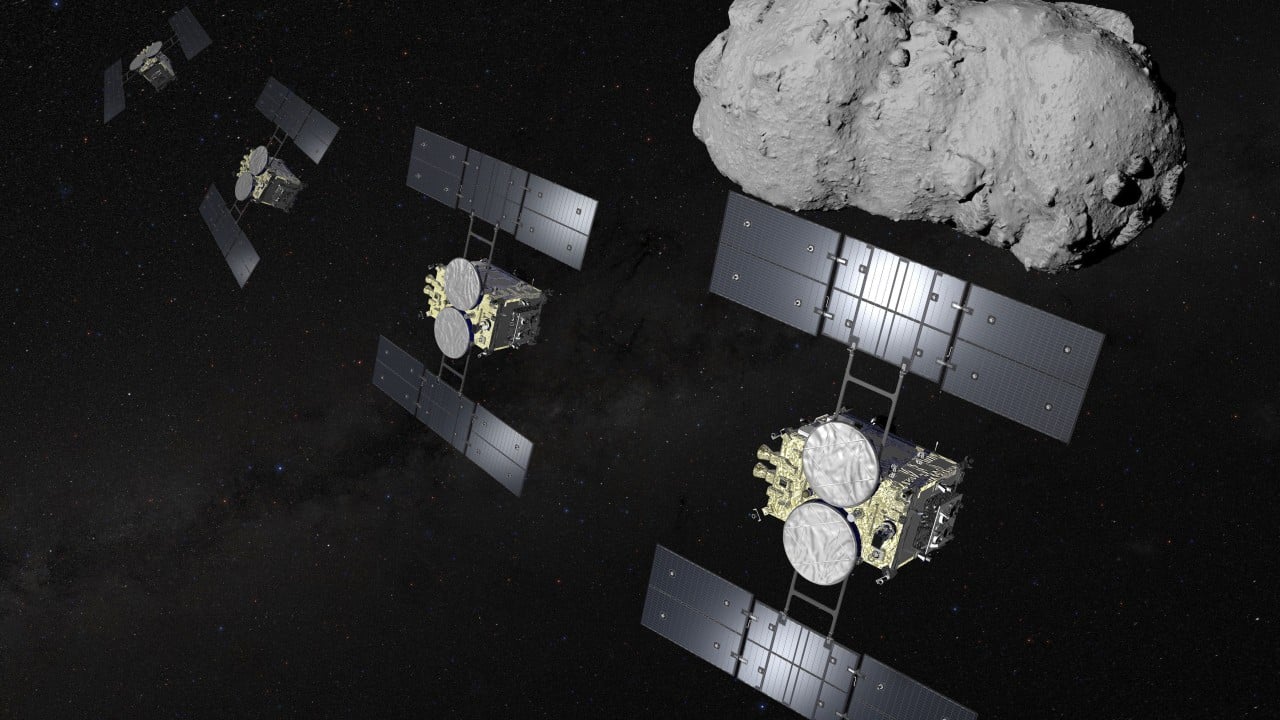
Japan’s Hayabusa2 fly-by of Torifune marks a leap in asteroid defence, showcasing the country’s growing space prowess and “goodwill science” role vital for protecting Earth from cosmic threats. The space probe, named after the Peregrine falcon in Japanese, successfully flew within 800 metres (0.5 miles) of the asteroid, the Japan Aerospace Exploration Agency (JAXA) said on July 5. JAXA said Hayabusa2 performed as expected and responded to all instructions from land-based mission control, about...
Narrative Intelligence Brief
This article was published by South China Morning Post, a source frequently categorized with a lean left bias based in Hong Kong. Our narrative intelligence engine continuously monitors coverage from this outlet to track framing, bias, and rhetorical patterns. Our initial algorithmic scan of this specific piece did not flag high-confidence rhetorical techniques, suggesting a generally straightforward reporting style or neutral framing. By understanding the editorial perspective of South China Morning Post, readers can better contextualize the information presented and compare it across our broader media matrix to find the real narrative.
More from South China Morning Post
July 12, 2026
Gulf capital flowing into Asia as Hong Kong-Middle East trade up 35%: Paul Chan
July 12, 2026
Sheikh Hamad bin Khalifa Al Thani, who raised Qatar’s global profile, dies at 74
July 12, 2026
Wombs for hire: the painful price of Asia’s baby trade
July 12, 2026
In China’s electronics hub, a memory chip crisis is hitting consumers hard
July 12, 2026
Ageing in Hong Kong – should you fear it?
Analysis Methodology
This narrative analysis was generated using the CoDataLab Global Intelligence Engine. Our proprietary AI scans thousands of cross-border sources to identify sentiment patterns, framing techniques, and potential media bias. While AI provides the data-driven foundation, our objective is to empower readers with additional context beyond the standard headline.The content displayed above is a structured summary designed for rapid information processing. For the full original report, please visit the source outlet.More Coverage
Discussion
"england"
Tuchel angry at 'lucky' England - but Bellingham defends players

Tuchel angry at 'lucky' England - but Bellingham defends players

‘A dangerous movie’: Glenn Beck warns ‘Citizen Vigilante’ signals a dark moral shift after Germany bans it

How other outlets are covering this story
Compare narratives across 5 related reports from 5 sources. Real Narrative News aggregates the coverage spectrum so you can see who emphasises what — bias tags reflect the outlet, not the story.
Coverage bias distribution
5 sources
Left 40%
Center 20%
Right 40%
Smithsonian Magazine
· Jul 8, 2026
New Images Reveal That This Asteroid Is Actually Two Conjoined Space Rocks That Form a Peanut-Shaped Object Called a 'Contact Binary'
A flyby conducted by the Japanese spacecraft Hayabusa2 uncovered the asteroid's strange shape. Data gathered by the probe will also help defend the planet against potentially threatening space rocks
South China Morning Post
· Jul 5, 2026
Japan space probe, size of a fridge, flies near asteroid in planet defence test
A Japanese space probe performed a fly-by of a near-Earth asteroid on Sunday, in a test mission for technology that could help protect the planet from space rocks. The fridge-sized Hayabusa2 was due to fly within 800 metres (0.5 miles) of asteroid Torifune, Japan Aerospace Exploration Agency (JAXA) scientists said earlier, a trial run to see whether such a probe could deflect a potentially dangerous space rock away from Earth. The mission comes after Nasa deliberately smashed a spacecraft into...
Mashable
· Jul 8, 2026
Japan and China just flew past asteroids. Heres what they saw.
Japan and China reveal new asteroid photos as their spacecraft, Hayabusa2 and Tianwen-2, capture Torifune and Kamo'oalewa up close.
Vision Times
· Jun 29, 2026
Japan Accelerates Deep-Sea Rare Earth Development Near Minamitori Island to Cut Dependence on China
Japan is advancing a strategic project to extract rare earth elements (REEs) from deep-sea mud deposits in its exclusive economic zone (EEZ) near Minamitorishima (also called Minamitori Island or Marcus Island), a remote coral about 1,180 miles southeast of Tokyo, according to Nikkei. Japan plans to begin industrial-scale verification testing as early as 2027, with []
Borneo Bulletin
· Jul 6, 2026
Japan releases snowman-like asteroid image after flyby
Japan releases snowman-like asteroid image after flyby
Topics:
Related coverage for "Nasa knows how to deflect an asteroid. Can Japan’s Hayabusa2 pull it off?": Smithsonian Magazine — New Images Reveal That This Asteroid Is Actually Two Conjoined Space Rocks That Form a Peanut-Shaped Object Called a 'Contact Binary'. South China Morning Post — Japan space probe, size of a fridge, flies near asteroid in planet defence test. Mashable — Japan and China just flew past asteroids. Heres what they saw.. Vision Times — Japan Accelerates Deep-Sea Rare Earth Development Near Minamitori Island to Cut Dependence on China. Borneo Bulletin — Japan releases snowman-like asteroid image after flyby