Today in News History
On June 23, several notable moments in the history of News stand out. In 1314, First War of Scottish Independence: The Battle of Bannockburn (south of Stirling) begins. In 1812, War of 1812: Great Britain revokes the restrictions on American commerce, thus eliminating one of the chief reasons for going to war. In 1884, Cyclone Taylor, Canadian ice hockey player and politician (died 1979) was born. In 1946, The 1946 Vancouver Island earthquake strikes Vancouver Island, British Columbia, Canada. In 1958, John Hayes, English politician, Minister of State at the Department of Energy and Climate Change was born. In 1973, A fire at a house in Hull, England, which kills a six-year-old boy is passed off as an accident; it later emerges as the first of 26 deaths by fire caused over the next seven years by serial arsonist Peter Dinsdale. In 1975, KT Tunstall, Scottish singer-songwriter and musician was born. In 1985, A terrorist bomb explodes at Narita International Airport near Tokyo, killing two and injuring four. An hour later, the same group detonates a second bomb aboard Air India Flight 182, bringing the Boeing 747 down off the coast of Ireland killing all 329 aboard. In 2013, Militants storm a high-altitude mountaineering base camp near Nanga Parbat in Gilgit-Baltistan, Pakistan, killing ten climbers and a local guide. In 2017, A series of terrorist attacks take place in Pakistan, resulting in 96 deaths and wounding 200 others. Together, these milestones provide historical context for today's news news and ongoing narratives.
Lightning and thunder batter Britain overnight ahead of 'extreme' heat weather warning
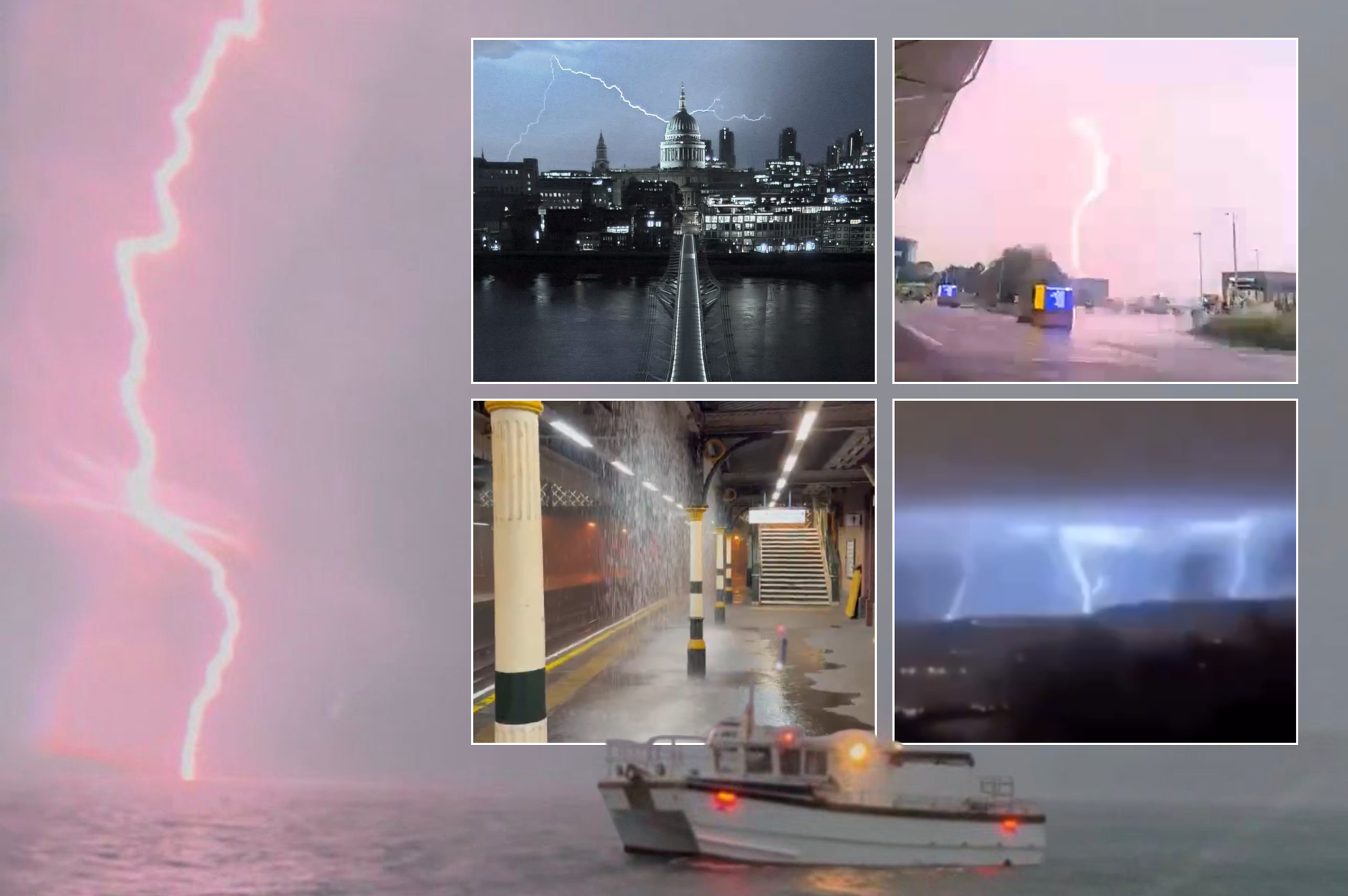
Lightning and thunder battered Britain last night, with GB News obtaining an incredible image of the phenomenon over the English Channel.Nearly 30,000 strikes were recorded in the UK in the last 24 hours to 9am on Tuesday, according to Met Office data.All 29,074 streaks of lightning were over England, with over three in five occurring in Somerset.The south-west region recorded 18,540 strikes, according to the National Weather Service. TRENDING Stories Videos Your Say The south-east of England experienced hundreds more strikes on Tuesday morning.Temperatures reached 20.4C in Gosport, Hampshire, the highest in the UK, while eight other places recorded a tropical night, with temperatures not falling below 20C.A house just east of Bristol caught fire last night, shortly before 6pm.Everyone inside escaped unharmed.A rare red weather warning for extreme heat has also been issued for central and southern England and Wales, the first red warning since July 2022.The alert comes into force on Wednesday morning at 9am and lasts 36 hours until 9pm Thursday.Temperatures are expected to rise to near-record-breaking heights, with highs in parts between 38C to 40C.Top temperatures are expected on Wednesday and Thursday, potentially testing the UK's all-time record of 40.3C.LATEST WEATHER UPDATESBritons brace for 'worst heatwave in 50 years' as Atlantic storm sends temperatures soaring to 38CSchools across Britain to shut down and commuters urged to avoid railways amid severe heat warningLightning strike destroys family home in Bristol as neighbours watch flames rip through roofAreas just west of London, including Oxfordshire, Buckinghamshire, and Berkshire, are forecast to be the hottest.It is widely expected that this week could break the record for the hottest June temperature of 35.6C, set in 1976 in Southampton.The extreme heat could also disrupt rail, road and air travel, with the possibility of some tarmac melting, according to the Met Office.Alongside the two-day red alert, the Met Office has issued a four-day amber heat warning for parts of England and Wales from Monday to Thursday.Wednesday and Thursday’s amber alert expands to include parts of Greater Manchester, Yorkshire and Cheshire.People in the alert area are advised to drink plenty of fluids and keep out of the sun and avoid exercising between 11am and 3pm, the weather service said.The heat comes after at least 15 people died after getting into trouble in open water during a hot spell in May.Mr Partridge said: “We’re also asking everybody to be very wary around bodies of water, because in the last heatwave, unfortunately, quite a few people lost their lives by going into cold water and getting cold water shock.“That’s still very much an issue, so just be careful how you cool yourself down. If there’s the option between a hose pipe and jumping in the lake, probably go for the hose pipe and just keep yourself safer.”Our Standards: The GB News Editorial Charter
Narrative Intelligence Brief
This article was published by GB News, a source frequently categorized with a lean right bias based in United States of America. Our narrative intelligence engine continuously monitors coverage from this outlet to track framing, bias, and rhetorical patterns. Our initial algorithmic scan of this specific piece did not flag high-confidence rhetorical techniques, suggesting a generally straightforward reporting style or neutral framing. By understanding the editorial perspective of GB News, readers can better contextualize the information presented and compare it across our broader media matrix to find the real narrative.
More from GB News
June 23, 2026
Simple protein swap linked to significant weight loss in menopausal women
June 23, 2026
Royals from across the globe support their nations at the World Cup
June 23, 2026
Murder investigation launched after missing teenage girl, 14, found dead in Wales
June 23, 2026
Sir Paul Marshall calls for a world where the ‘majority and not just the minority can flourish’
June 23, 2026
Nissan to 'axe production of new electric car' at Sunderland factory in latest blow to UK auto industry
Analysis Methodology
This narrative analysis was generated using the CoDataLab Global Intelligence Engine. Our proprietary AI scans thousands of cross-border sources to identify sentiment patterns, framing techniques, and potential media bias. While AI provides the data-driven foundation, our objective is to empower readers with additional context beyond the standard headline.The content displayed above is a structured summary designed for rapid information processing. For the full original report, please visit the source outlet.More Coverage
Discussion
"prime"
‘The Big Short’ investor issues a dire warning about Nvidia. Here’s why he believes an ‘aggressive fall’ is coming, and how businesses can avoid the same fate

Romania’s Crisis Deepens as Parliament Rejects PM-Designate’s Government

Keir Starmer has gone but Britain’s crisis is about to get even worse