Today in News History
On June 18, several notable moments in the history of News stand out. In 1769, Robert Stewart, Viscount Castlereagh, Irish-English politician, Secretary of State for Foreign and Commonwealth Affairs (died 1822) was born. In 1822, Konstantinos Kanaris blows up the Ottoman navy's flagship at Chios, killing the Kapudan Pasha Nasuhzade Ali Pasha. In 1839, William H. Seward Jr., American general and banker (died 1920) was born. In 1887, Tancrède Labbé, Canadian businessman and politician (died 1956) was born. In 1953, A United States Air Force C-124 crashes and burns near Tachikawa, Japan, killing 129. In 1972, Staines air disaster: One hundred eighteen people are killed when a BEA H.S. Trident crashes minutes after takeoff from London's Heathrow Airport. In 2007, The Charleston Sofa Super Store fire happened in Charleston, South Carolina, killing nine firefighters. In 2011, Frederick Chiluba, Zambian politician, 2nd President of Zambia (born 1943) passed away. In 2013, Garde Gardom, Canadian lawyer and politician, 26th Lieutenant Governor of British Columbia (born 1924) passed away. In 2022, Uffe Ellemann-Jensen, Danish politician, minister of foreign affairs (born 1941) passed away. Together, these milestones provide historical context for today's news news and ongoing narratives.
Key cabinet member now in a dangerous spot after Trump's international humiliation: MS NOW
Narrative Analysis: Name Calling
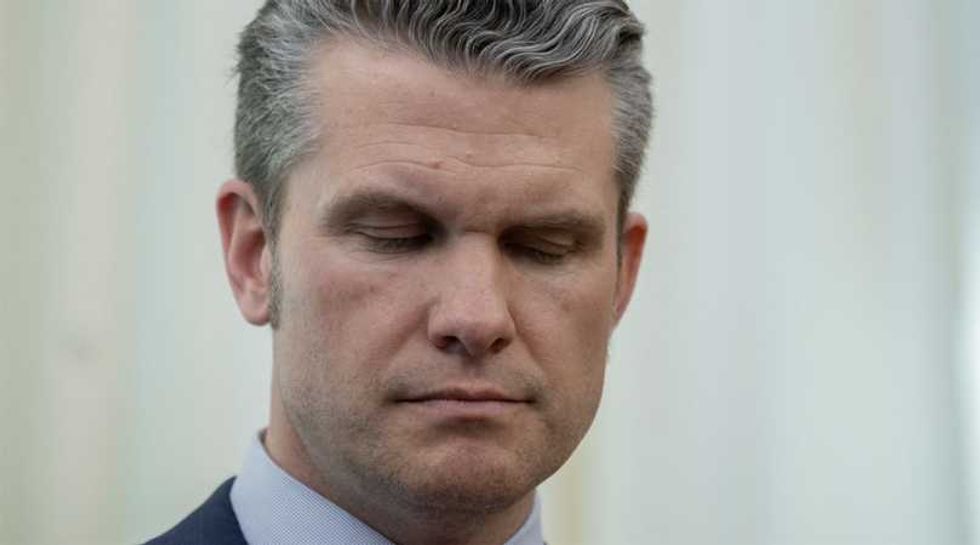
While Donald Trump is being excoriated by Republicans over his Iran deal, which one GOP lawmaker called “ a tremendous foreign policy blunder,” MS NOW’s Bill Rohde stated on Thursday morning that Defense Secretary Pete Hegseth can expect that his role in advising the president to launch the war has put his job at risk.Discussing the blowback Trump is facing over the war that, for the moment, has ended in a stalemate, Rohde claimed that Hegseth is already a prime target instead since he is already on the outs with a substantial number of Republican lawmakers.“At some point. President Trump is the person most responsible for this strategic defeat and failure,” Rohde told the Morning Joe” co-hosts. “But I would argue the person second most responsible, who is in the most dangerous position politically, is Defense Secretary Pete Hegseth. He repeatedly lied to the American public in his press conferences about the progress of the war, and he also refused to give basic information to members of Congress. There's a lot of ill will among senators and House members towards Pete Hegseth.”Quoting Hegseth asserting “The aftermath of this is going to be in our interest,” Rohde asked, “Did he warn the president about the Strait of Hormuz before this war? Was he honest with the American public? And to the 50,000 Americans who risked their lives in the 13 soldiers who died? You know, his performance is just something that has to be looked at.”Co-host Willie Geist added, “We haven't seen the defense secretary in public much since those podium-banging news briefings that he would give every week, where he would lecture the media about how to cover the war, what was actually happening, and from all the reporting that he would show the president of the United States an iPad with things blowing up to show that they were doing well. It turns out this is a much, much more complicated problem than can be solved by blowing things up.” - YouTube youtu.be
Narrative Intelligence Brief
This article was published by Raw Story, a source frequently categorized with a left bias based in United States of America. Our narrative intelligence engine continuously monitors coverage from this outlet to track framing, bias, and rhetorical patterns. In this specific piece, our systems detected the potential use of the "Name Calling" technique. This narrative approach is often used to shape reader perception by highlighting specific emotional or rhetorical angles. By understanding the editorial perspective of Raw Story, readers can better contextualize the information presented and compare it across our broader media matrix to find the real narrative.
More from Raw Story
June 18, 2026
Trump's unusual appearance at the G7 catches analyst's eye
June 18, 2026
A maniacal fury blinds Trump every time he thinks of this man
June 18, 2026
GOP strategist rips MAGA pastor as 'narcissistic sleaze' after scandal sinks his campaign
June 18, 2026
Republicans pin 'surrender' anger on Vance as Iran deal finger-pointing flies: report
June 18, 2026
'Revolt': Trump's self-destructive habit threatens to blow up Senate GOP support
Reliability Insights
P
Technique: Name Calling
System analysis detected use of specific narrative techniques in this piece.Analysis Methodology
This narrative analysis was generated using the CoDataLab Global Intelligence Engine. Our proprietary AI scans thousands of cross-border sources to identify sentiment patterns, framing techniques, and potential media bias. While AI provides the data-driven foundation, our objective is to empower readers with additional context beyond the standard headline.The content displayed above is a structured summary designed for rapid information processing. For the full original report, please visit the source outlet.More Coverage
Discussion
"trump"
🚨 MAGA Mike GOES MISSING as HELL BREAKS LOOSE in HOUSE!!!

Trump takes back pastor’s endorsement in Oklahoma race after scandal

Man who burned cross in Chicago park, calling it a protest against Trump, charged with hate crime