
Today in News History
On June 19, several notable moments in the history of News stand out. In 1731, Joaquim Machado de Castro, Portuguese sculptor (died 1822) was born. In 1764, José Gervasio Artigas, Uruguayan general and politician (died 1850) was born. In 1964, Brent Goulet, American soccer player and manager was born. In 1966, Mike Hasenfratz, Canadian ice hockey referee was born. In 1972, Brian McBride, American soccer player and coach was born. In 1979, José Kléberson, Brazilian footballer was born. In 1980, Nuno Santos, Portuguese footballer was born. In 1985, José Ernesto Sosa, Argentinian footballer was born. In 1985, Members of the Revolutionary Party of Central American Workers, dressed as Salvadoran soldiers, attack the Zona Rosa area of San Salvador. In 1986, Lázaro Borges, Cuban pole vaulter was born. Together, these milestones provide historical context for today's news news and ongoing narratives.
Just when people want to celebrate their identity during the World Cup, sneering elites have taken unforgivable action
Narrative Analysis: Glittering Generalities
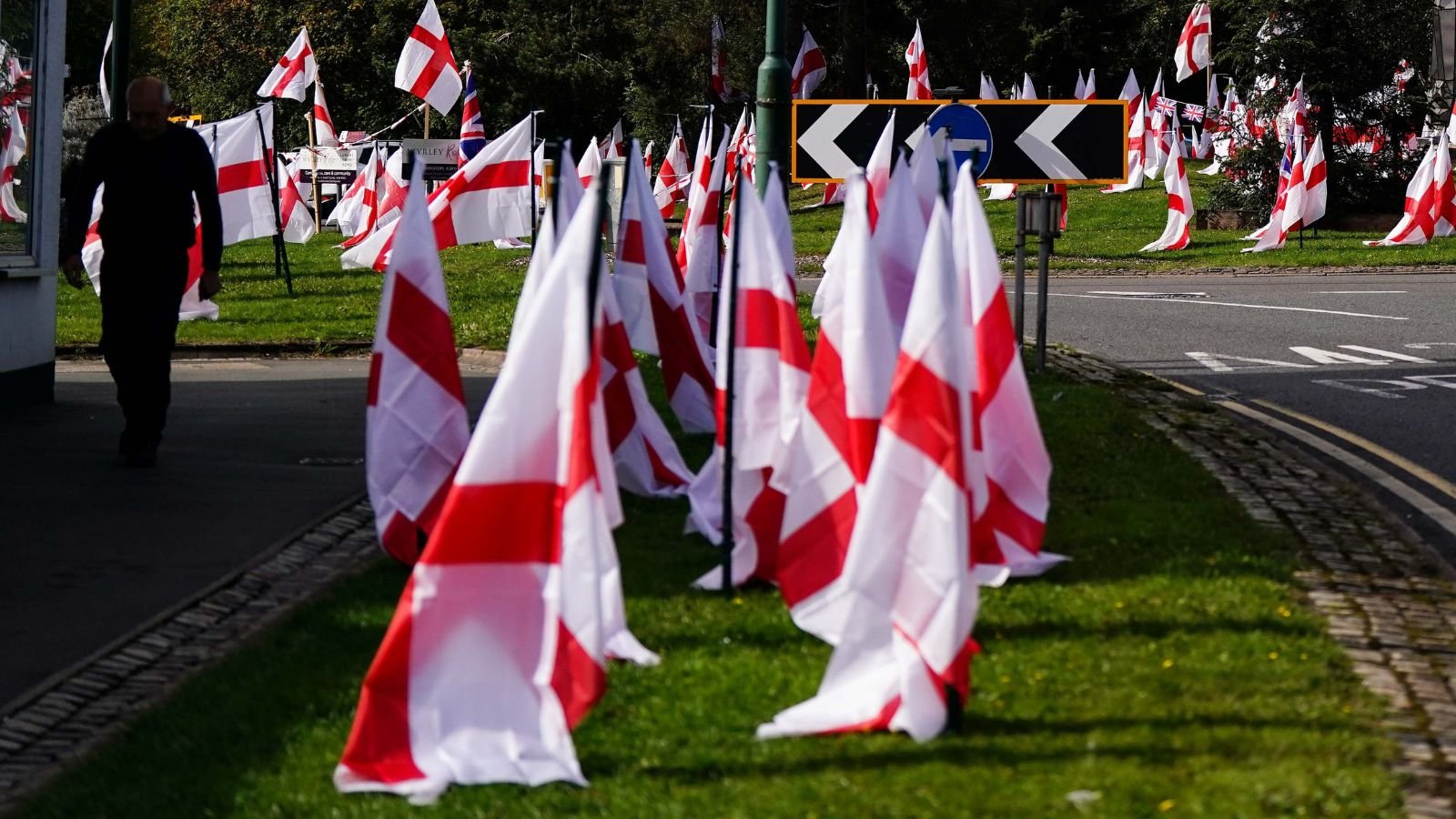
There are few things more depressing than watching people in authority treat patriotism as a problem.Just as England fans prepare to get behind their country during the World Cup, with St George’s flags appearing across streets, pubs and all over communities, Oxfordshire County Council has chosen this moment to escalate a legal battle over flags. You just couldn’t make it up.To many ordinary people, this looks like yet another example of a modern political class that is completely detached from the country it is supposed to serve. A political class that is perfectly comfortable with fashionable causes and political campaigns like pro Palestine flags, LGBTQ flags and all their marches, but suddenly develops concerns when people want to display pride in Britain or England.That is why so many people are angry. TRENDING Stories Videos Your Say In my view, Britain has developed a strange and unhealthy relationship with its own national identity. We seem to be one of the few countries in the world where displaying the national flag can attract suspicion, criticism or accusations of extremism.Go to America and you’ll see the Stars and Stripes everywhere.Visit countless countries across Europe and you’ll see people proudly displaying their national colours.Yet here in Britain, there is often an attitude among sections of the Establishment and snobby class, that patriotism is somehow embarrassing. I find that extraordinary.For years we have been told that the Union Jack and the St George’s Cross have somehow been “weaponised” by the Right. But perhaps the real issue is far simpler. Perhaps some on the Left simply feel uncomfortable with expressions of national pride.Because whenever ordinary working people show pride in their country, there is often a sneer that follows.The people flying these flags are not extremists. They are not radicals. They are not dangerous.They are mums and dads, tradesmen, pensioners, pub landlords, football fans and taxpayers who happen to love their country. That should not be controversial.What many critics of Oxfordshire County Council find particularly frustrating is what they see as a double standard. They look around Britain and see numerous political and social causes celebrated in public spaces. Yet when it comes to the Union Jack or the St George’s Cross, there always seems to be a problem.Whether that perception is fair or not, it is undoubtedly widespread. And timing matters.If there was ever a moment when people are going to want to fly flags, it is during a World Cup. Communities come together. Pubs fill up. Streets are decorated and families gather around televisions. People celebrate a shared identity and support their country.That should be encouraged, not dragged through the courts.What worries me most is how disconnected decisions like this appear from the priorities of ordinary people. Families are struggling with bills. Crime remains a concern. Public services are under pressure, and yet councils seem increasingly drawn into symbolic battles that leave many residents scratching their heads.It definitely feels like a form of snobbery.A belief that the views, values and traditions of ordinary people are somehow less worthy than those of fashionable campaign groups.That is why stories like this resonate far beyond Oxfordshire.They tap into a growing feeling that too many people in positions of power look down on those who dare to be patriotic, who want secure borders, who care about their communities and who refuse to apologise for loving their country.The Union Jack and the St George’s Cross belong to all of us. They are not symbols of hate. They are not symbols of division. They are symbols of our nation, our history and our people.And the fact that displaying them has become controversial in modern Britain says far more about the political class than it does about the people proudly flying them.And if you are one of these the council cites as being intimidated by our flag you should not be in this country. Our Standards: The GB News Editorial Charter
Narrative Intelligence Brief
This article was published by GB News, a source frequently categorized with a lean right bias based in United States of America. Our narrative intelligence engine continuously monitors coverage from this outlet to track framing, bias, and rhetorical patterns. In this specific piece, our systems detected the potential use of the "Glittering Generalities" technique. This narrative approach is often used to shape reader perception by highlighting specific emotional or rhetorical angles. By understanding the editorial perspective of GB News, readers can better contextualize the information presented and compare it across our broader media matrix to find the real narrative.
More from GB News
June 19, 2026
Vaccine that 'rejuvenates' tired immune cells raises hopes for cancer and dementia patients
June 19, 2026
Katie Price's husband demands Susanna Reid be SACKED after ITV GMB star rolls eyes at Dubai arrest claims
June 19, 2026
Keir Starmer will find it 'difficult to survive' a leadership contest against Andy Burnham, top pollster tells GB News
June 19, 2026
Cristiano Ronaldo at centre of explosive Portugal row as talk of 'civil war' rocks World Cup bid
June 19, 2026
Two men jailed after plotting series of arson attacks targeting Keir Starmer
Reliability Insights
P
Technique: Glittering Generalities
System analysis detected use of specific narrative techniques in this piece.Analysis Methodology
This narrative analysis was generated using the CoDataLab Global Intelligence Engine. Our proprietary AI scans thousands of cross-border sources to identify sentiment patterns, framing techniques, and potential media bias. While AI provides the data-driven foundation, our objective is to empower readers with additional context beyond the standard headline.The content displayed above is a structured summary designed for rapid information processing. For the full original report, please visit the source outlet.More Coverage
Discussion
"cup"
Canada Soccer Star Ismaël Koné Suffers Brutal Leg Injury at World Cup

‘Living in a Movie’: World Cup Fans Are Losing Their Minds Over This U.S. Staple—and It’s Causing Chaos at Airports
Six arrested during England’s World Cup win – including for criminal trespass
