Today in News History
On July 4, several notable moments in the history of News stand out. In -362 BC, Battle of Mantinea: The Thebans, led by Epaminondas, defeated the Spartans. In 945, Zhuo Yanming, Chinese Buddhist monk and emperor passed away. In 1883, Rube Goldberg, American sculptor, cartoonist, and engineer (died 1970) was born. In 1897, Alluri Sitarama Raju, Indian activist (died 1924) was born. In 1910, Kabua the Great, Marshallese iroijlaplap (born c. 1820) passed away. In 1947, The "Indian Independence Bill" is presented before the British House of Commons, proposing the independence of the Provinces of British India into two sovereign countries: India and Pakistan. In 1983, Amol Rajan, Indian-English journalist was born. In 2012, Hiren Bhattacharyya, Indian poet and author (born 1932) passed away. In 2012, The discovery of particles consistent with the Higgs boson at the Large Hadron Collider is announced at CERN. In 2016, Abbas Kiarostami, Iranian film director, screenwriter, poet, and photographer (born 1940) passed away. Together, these milestones provide historical context for today's news news and ongoing narratives.
In some Indian temples, robotic elephants draw crowds and controversy
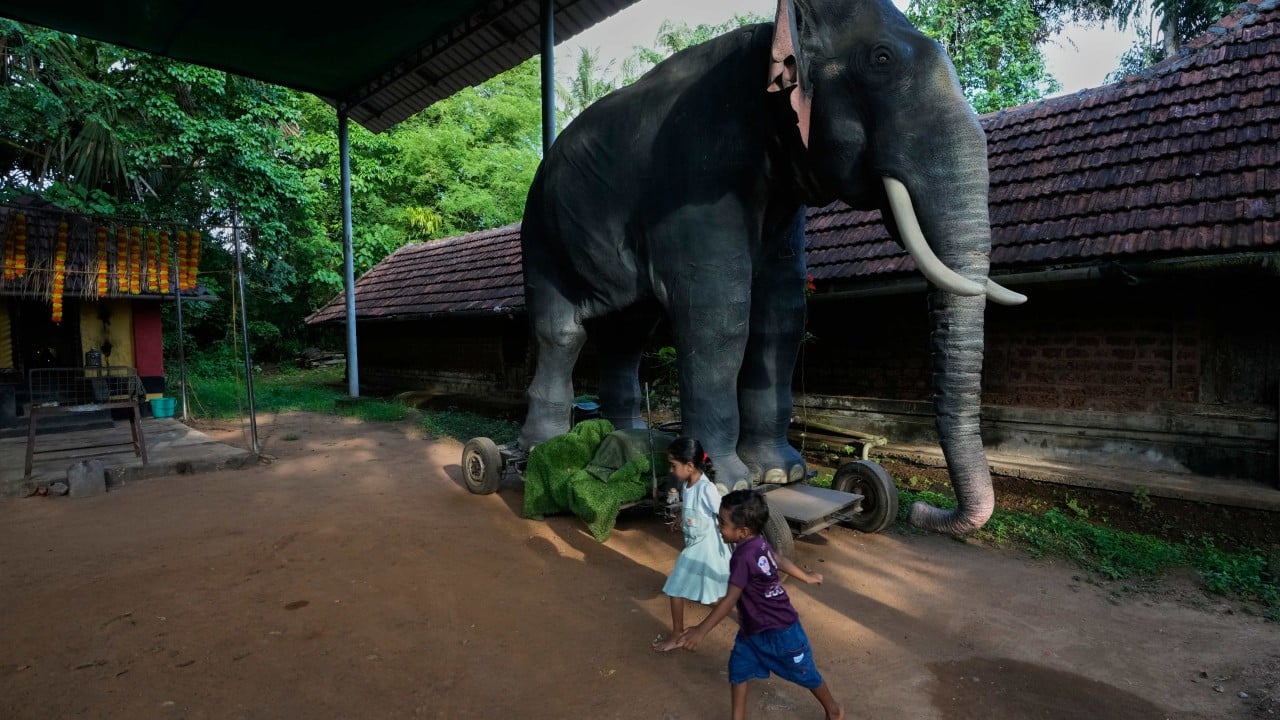
The life-size robotic elephants in Prasanth Prakashan’s backyard workshop have ears that flap, tails that swish and trunks that squirt water. But that’s about all they have in common with their real-life counterparts revered across India as manifestations of the divine. The animatrons, crafted from fibreglass, iron and rubber, are intended to take the place of live elephants in Hindu temples. The change pleases animal welfare activists but upsets those who passionately believe real elephants are...
Narrative Intelligence Brief
This article was published by South China Morning Post, a source frequently categorized with a lean left bias based in Hong Kong. Our narrative intelligence engine continuously monitors coverage from this outlet to track framing, bias, and rhetorical patterns. Our initial algorithmic scan of this specific piece did not flag high-confidence rhetorical techniques, suggesting a generally straightforward reporting style or neutral framing. By understanding the editorial perspective of South China Morning Post, readers can better contextualize the information presented and compare it across our broader media matrix to find the real narrative.
More from South China Morning Post
July 4, 2026
‘No one lifts a finger’: Gaza’s fate eclipsed by Middle East war
July 4, 2026
‘We won’t tolerate this’: thousands in Germany protest against far-right AfD
July 4, 2026
Top Chinese influencer sells pricey courses after government live-streaming ban
July 4, 2026
2 wet lab buildings at Hong Kong Hetao innovation hub fully leased in first phase
July 4, 2026
Australia’s Great Barrier Reef avoids ‘in danger’ listing by Unesco
Analysis Methodology
This narrative analysis was generated using the CoDataLab Global Intelligence Engine. Our proprietary AI scans thousands of cross-border sources to identify sentiment patterns, framing techniques, and potential media bias. While AI provides the data-driven foundation, our objective is to empower readers with additional context beyond the standard headline.The content displayed above is a structured summary designed for rapid information processing. For the full original report, please visit the source outlet.More Coverage
Discussion
"cup"
Trump FURIOUS as USMNT Defies his ADMINISTRATION’S WISHES!!!

Mohamed Salah explains penalty after Egypt make history at World Cup 2026: ‘I had to decide at the last minute’
Luka Modrić Blasts VAR For Penalty Decision After Croatia's Round Of 32 Loss