Today in News History
On June 17, several notable moments in the history of News stand out. In 1904, Nikolay Bobrikov, Russian soldier and politician, Governor-General of Finland (born 1839) passed away. In 1929, Tigran Petrosian, Armenian chess player (died 1984) was born. In 1940, The three Baltic states of Estonia, Latvia and Lithuania fall under the occupation of the Soviet Union. In 1942, Doğu Perinçek, Turkish lawyer and politician was born. In 1955, Mati Laur, Estonian historian, author, and academic was born. In 1963, Aleksander Kesküla, Estonian politician (born 1882) passed away. In 1986, Apoula Edel, Armenian footballer was born. In 1992, A "joint understanding" agreement on arms reduction is signed by U.S. President George Bush and Russian President Boris Yeltsin (this would be later codified in START II). In 2012, Nathan Divinsky, Canadian mathematician and chess player (born 1925) passed away. In 2015, Süleyman Demirel, Turkish engineer and politician, 9th President of Turkey (born 1924) passed away. Together, these milestones provide historical context for today's news news and ongoing narratives.
If Trump believes in Azerbaijan-Armenia peace, why does Baku want weapons?
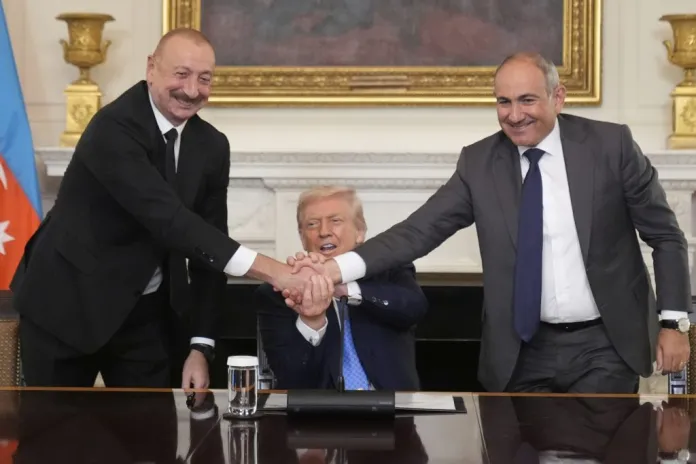
On June 1, Azerbaijani President Ilham Aliyev posted a framed order President Donald Trump gave him waiving Section 907 of the Freedom Support Act. Essentially, Trump’s waiver allows Azerbaijan to purchase American weaponry. In 1992, Congress passed the Freedom Support Act to help the newly independent states that emerged from the Soviet Union’s collapse build []
Narrative Intelligence Brief
This article was published by Washington Examiner, a source frequently categorized with a lean right bias based in United States of America. Our narrative intelligence engine continuously monitors coverage from this outlet to track framing, bias, and rhetorical patterns. Our initial algorithmic scan of this specific piece did not flag high-confidence rhetorical techniques, suggesting a generally straightforward reporting style or neutral framing. By understanding the editorial perspective of Washington Examiner, readers can better contextualize the information presented and compare it across our broader media matrix to find the real narrative.
More from Washington Examiner
June 17, 2026
Robert White bests Brooke Pinto in race to replace Holmes Norton in Congress as DC delegate
June 17, 2026
Nuclear promises, unfrozen funds, and lifted sanctions part of US-Iran deal: Report
June 17, 2026
Trump-backed Barry Moore wins Alabama GOP Senate runoff
June 17, 2026
Rick Jackson topples Trump-backed Lt. Gov. Burt Jones in Georgia GOP gubernatorial runoff
June 17, 2026
B-52 descended at nearly a mile a minute before crash that killed eight
Analysis Methodology
This narrative analysis was generated using the CoDataLab Global Intelligence Engine. Our proprietary AI scans thousands of cross-border sources to identify sentiment patterns, framing techniques, and potential media bias. While AI provides the data-driven foundation, our objective is to empower readers with additional context beyond the standard headline.The content displayed above is a structured summary designed for rapid information processing. For the full original report, please visit the source outlet.More Coverage
Discussion
"cup"
Football Daily | ‘Pico’ Lopes and Cape Verde give Spain’s boys one hell of a neutralising

Son Heung-min Boycotts South Korea Media Over ‘Leaked Derogatory Remarks’

The backlash against AI reveals it’s a terrible scapegoat